Sorry, but this is verging on the US litigiousness. “Nobody told me sticking a fork in a power was dangerous…”
However, if she was INSTRUCTED to perform with the sparklers close to the ceiling, that is a different story.
Sorry, but this is verging on the US litigiousness. “Nobody told me sticking a fork in a power was dangerous…”
However, if she was INSTRUCTED to perform with the sparklers close to the ceiling, that is a different story.
She has a tag, had to hand in her passport and has to report to the police station every 48 hours.
She is considered a flight risk but was allowed to stay free in order to look after their two children.
Read this opinion piece from Roberto Saviano some days ago and was waiting for the reaction from Switzerland. It’s an interesting take:
The venue serves to justify cash flows as revenue, to transform opaque capital into revenue, to make ordinary what, in other contexts, would seem atypical. Bars, restaurants, and nightclubs are not just places of consumption, but also economic devices with high cash circulation, capable of absorbing liquidity without generating demand. When investment is not oriented towards industrial profitability, but rather towards financial function, the success of the venue is measured not only in customers or profits, but in its ability to move money. In this sense, the business is not the end, but the instrument: a mechanism that allows capital to move, camouflage, and stabilize within the legal economy. And all of this is typical of mafia practice.
The Corsican mafia is the only European organized crime group, outside of Italy, to have developed a fully mafia-like model, even if not legally codified like Article 416-bis. It has historically invested in bars, restaurants, discos, nightclubs, and casinos. La Brise de Mer, founded in Bastia in the 1970s, took its name from a bar. Le Petit Bar, in Ajaccio, was its rival clan and successor. The names of the establishments became the names of the organizations. When newspapers today evoke the Corsican mafia in connection with bars, nightclubs, family-run businesses, and shady money, they aren’t making direct accusations. They’re evoking a historical European structural precedent. This is how the gray zone works: it doesn’t openly protect, it normalizes the exception.
Asking whether “the mafia” is behind Le Constellation is perhaps the least useful question. The right question is another: how many businesses in Europe are growing today without anyone really asking where the money comes from and what power they wield? The judiciary will determine criminal liability. But political, economic, and cultural responsibility remains outside the courtroom. Crans-Montana is not just the site of a tragedy. It’s the symbol of a Europe where money moves faster than demands, where power is exercised before crime, where controls come only after deaths. The victims aren’t demanding revenge. They’re demanding something more difficult: that the gray area be illuminated before the next fire.
TBH, I expected either silence or an arrogant reply from media in Switzerland. I did not expect an adult answer. 20min asked Swiss Fedpol their opinion:
According to Fedpol, various mafia groupings are active in Switzerland. Although violence has been openly carried out so far has been spared, drug deliveries in the tonne range and the professional planning of homicides are also organized from Switzerland.
In addition to the Italian groups, Corsican organized crime is also active. The Corsican Mafia was involved in a bank robbery in Le Locle in 2016. Under the guise of legal economic activity, it is also intended to operate restaurants, bars and clubs that are needed for money laundering. Fedpol does not comment on the Moretti case
Last paragraph in the short article:
Conclusion: Whether the Morettis maintained contacts with the Mafia or broke laws in the construction of their assets, the judiciary will have to judge. The fact that mafia structures exist in Switzerland is a fact. And the fact that authorities look away from where they should actually look, the expert also judges for Switzerland at least as a realistic scenario.
This is good. It’s impossible to catch the bad guys if people close their eyes to not see the bad guys.
Apparently she was told she needed to wear the crash helmet and I suspect being carried on someone else’s shoulders was part of the ‘the performance’ too.
It’s difficult to see above you, or to the side with a full face helmet on.
The was a reason why the bar owners quickly removed all social media presence straight after the fire and the few images from previous events which survived and are still floating around the web suggest that the sparkler routine was their marketing ploy.
TIS. A senior citizen crashes while riding and e-bike and the police immediately calls for witnesses. The local newspaper is full of this kind of announces.
Since the cantonal prosecutor has not started a call for for witnesses this time, one lawyer (Mr. Jordan) representing some victims is calling for witnesses, whistleblowers, people working on the rescue, neighbors, etc to come up with info. Controversy served.
When contacted about the specifics of his approach, Mr. Jordan replied: “The fact that one party is gathering information is in no way contrary to the Code of Criminal Procedure.” The lawyer added that he had asked the Public Prosecutor’s Office ten days ago to set up a platform to collect crucial videos to establish what happened: “But nothing has been done. And no appeal for witnesses has been launched.” He concluded: “Many people have contacted us and provided us with various pieces of information, which is why we wanted to organize things with this website.”
The Valais Public Prosecutor’s Office did not respond to our message regarding its assessment of the situation. Mr. Jordan also stated that he has not yet received any reaction from the prosecutors involved.
Cantonal authorities don’t like this website:
More updates. The media ran too early the mafia story.
Le Temps had a chance to look at some docs from investigation and there’s at least a mortgage from the cantonal bank and a loan from a cantonal government institution (CCF).
Whether speaking anonymously or not, several sources have claimed that Jacques and Jessica Moretti paid everything in cash. This is false.
A document in the (investigation) file shows that they took out a mortgage with the Valais Cantonal Bank in 2019. The amount was increased to 1.1 million francs in August 2022, when Le Constellation was purchased. At the same time, a second loan granted by the Centre de Cautionnement et de Financement de Sion (CFCF) in 2017 was increased to 250,000 francs. Le Temps can also reveal that, between their private assets and their four companies, the couple’s assets are worth approximately 5 million francs. Primarily invested in real estate in Valais, this portfolio is financed by approximately 80% mortgages. In other words, the Morettis have more than 4 million francs in debt.
Good news, the suspicion of money laundering is gone. But…ohhh, the cantonal government used taxpayer money to support this business. Considering Valais is a receiver canton of the federal fiscal equalization scheme, every net tax payer in Switzerland paid for this. Literally, my 2 cents.
New information comes up slowly. A young guy that escaped the fire share a video with the police. The bar workers (including owner) were not aware that they set up the place on fire for 30-35 seconds.
The footage shows the servers arriving in a line carrying bottles, each with a lit candle. Among them is Cyane Panine, the French waitress, perched on the shoulders of a colleague, as well as Jessica Moretti, the establishment’s manager.
The footage also reveals that the fire had started, but the servers hadn’t noticed. They continued to walk around the bar, despite the flames beginning to spread across the ceiling.
This detail had already been noted during the questioning of another waitress. She stated that the staff took “30 to 35 seconds” to realize the fire had started.
“With the music playing, people weren’t yelling ‘fire.’ We had our backs turned and couldn’t see the fire. We just carried on,” she told the police. She also indicated that she had shouted, “Everyone out, it’s going to explode!” and then left.
The young Italian man who filmed the videos told the police that he quickly fled. “I realized it was serious and I grabbed my friend to get out. We were the first to leave the establishment, walking quickly […] the fire spread very, very fast to the ceiling.”
“Outside, I called 144 at 01:29/h saying there was a fire and the location. One to two minutes later, the fire was already upstairs,” he explained.
And, a big update. Allegedly, there are 100+ witnesses of another fire from year 2024. Not much is public now, but did the witnesses call the police at the time? Did the police show up? Were the firefighters called? Any paper trail from that fire?
Some public camera data has been erased in the name of Data Protection. NZZ article. The evidence has been lost is soooooo _______ (insert preferred country from around the world):
NZZ research shows that the footage of the more than 250 public video cameras in Crans-Montana has also been deleted around New Year’s Eve. This is what the municipality’s police commander, Yves Sauvain, writes in a letter to the prosecutor’s office, which is part of the investigative files.
The commander makes an important restriction in his letter: The cantonal police of Valais have the pictures of the 1. January from midnight until 6 a.m. secured in the morning – the fire began at 1 a.m. 26.
However, the public prosecutor’s office obviously also wanted further recordings, namely already from 31. December and possibly from 1. January after 6 a.m.: Because the commander Sauvain emphasizes in his letter that the municipal police no longer have access to recordings of exactly these times. That seems problematic for several reasons.
First, according to the investigative files, the prosecution already has on 1. January, when she opened her criminal investigation, gave the cantonal police a clear mandate: This was to secure and evaluate the images of the public video cameras near the bar «Le Constellation». An exact period of time has not yet been mentioned.
Second, the deletion of the video footage seems problematic because it obviously contradicts the police regulations of the municipality. “The data will not be copied and kept for a maximum of one week unless it must be used for investigative purposes.”
Thirdly, the Data Protection Officer of the Canton of Valais explicitly provides for a longer retention period for special cases. He writes in a model regulations on the basis of the Valais municipalities: “Unless the stored data is kept in the context of a procedure, they must be destroyed after seven days or, in the case of a crime, after a maximum of 100 days.” The Federal Court also allows a period of 100 days.
Fourth, however, it is unclear whether the municipal police must be actively asked by the public prosecutor’s office to store surveillance footage for longer. Perhaps the municipal police assumed that with the securing of the six-hour material from New Year’s Eve by the cantonal police, all necessary recordings are available.
One more fail of the cantonal prosecutor:
If the date of the police commander Sauvain is correct, the public prosecutor’s office would have acted remarkably late once again in its investigation into the fire disaster. The original letter from the public prosecutor’s office is not available to the NZZ. The parents of a burn victim had the prosecution already on 6. January prompted to secure video footage.
And…Switzerland is fully covered with cameras for safety reasons. However, data will be dutifully erased when something happens. Really funny when the police chief praises the usefulness of video data and a few months later says: which data?
Sixthly, the deletion of the video recordings seems astonishing, because the municipality of Crans-Montana liked to emphasize its usefulness before the fire disaster. She is considered a pioneer in this type of surveillance in Valais, with which she began in 2006.
In April 2025, the police commander Sauvain explained the functionality in the municipal magazine «Info»: «Video surveillance forms a kind of bell» over the mountain community with its few access roads. So the police can identify who comes into the community and who leaves it, as Sauvain continued.
Thanks to camera clusters, Crans-Montana has “one of the best awareness rates for crimes in Switzerland.” Sauvain’s deputy stated in the same article: “Videos are evidence used for investigative purposes and at the request of the municipal or judicial authority.”
Investigating the municipal security officer is like investigating a single mechanic after an airplane crash.
Yes, it is important, but airlines and governments are systems. There’s a lot more people involved. Security is a systemic issue.
Apologies if this has been covered (I haven’t read the whole thread) but I find it baffling that, in a modern building, especially a public building, a ceiling would be made of flammable components.
It wasn’t a public building, rather a commercial building. It is also a stretch to call it modern by today’s standards. Thing is, it was practically a “DIY” renovation, and they apparently took the advice of Hornbach in choosing the tiles.
I’m more shocked that it didn’t require an automated fire alarm (that sends a signal straight to the fire brigade).
Not helpful here but if the IBC (2024) were applied to this club then it would need both an automatic sprinkler system and, because the customer area was not on the entrance floor (i.e. in this case it was in the basement), then an automated fire alarm would also be required.
One would like to think that as the release of the new Swiss building codes has been postponed (because of the Crans-Montana fire), they should really think about ripping them up and using the more stringent IBC codes instead.
But they won’t.
In other news today:
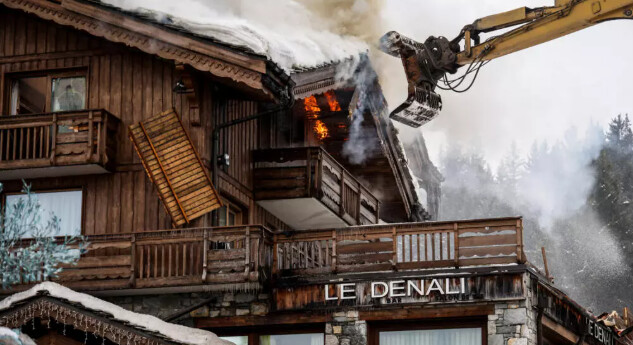
Scores of people were evacuated after a fire swept through a five-star hotel in the upmarket ski resort of Courchevel in the French Alps late on Tuesday, officials said.
No one was injured in the blaze which started in the attic of the Hotel des Grandes Alpes at around 7 p.m. (1800 GMT) on Tuesday. It was still burning and belching thick clouds of smoke late on Wednesday morning, the Prefecture of Savoie region, where Courchevel is located, said on its website.
It’s a bar, not a club. The requirements are lower.
I don’t remember where I read this (maybe here?). In the club a smoke alarm should stop the music and activate the sprinklers, but in the bar neither is required.
There was a video from the new year party of the Russian bloggers in Courchevel, and I noticed that there were LED lights attached to the bottles of champagne instead of sparkles. Probably the norms in France are stricter or it was a decision of the venue owner. I know that many bars and clubs in Switzerland are voluntary replacing sparkles with LED lights.
Not in the IBC regulations to which I was quite clearly refering.
Clubs, bars, restaurants, nightclubs etc are all in the same category.
The specific safety requirements depend on the number of occupants and the access routes to safety (more stringent requirements where the entertainment/customer level is not on the same level as the entrance.
Switzerland doesn’t have these standards. I was suggesting that they ought to have these or adopt the European standards.
France has it’s own regulations which are getting updated in May this year to align with the European standards.
They are prescriptive which actually makes sense as there’s no second-guessing or assumption making. Something has either been done correctly, or it hasn’t.
What is IBC?
International Building Code
OK, I should have guessed that. But I’m not seeing the relevance to this thread topic. Why should Switzerland simply adopt a standard that was adopted off-shore?
Because it makes sense. If I am a producer of ceiling tiles then it is a huge help if different countries have the same standards. It also makes it much easier for small countries if they let bigger countries pay for the development of requirements and then do checks to see that all is well at home. The problems in the Wallis seem to be ones of compliance more than missing regulations.
That’s my view as well. Switzerland is a world power in regulation but 4th world in ensuring compliance. If it can’t be caught by a camera, then forget about it.