The looks of that timing is awful.
11 weeks later, the cantonal police finished reviewing all the video evidence available and published the first chronological report of the events. Report and the original videos are now part of the investigation files, lawyers of the victims will have access later to these files, report can be ammended, etc. Meanwhile, a summary of the report by newspaper le temps (in French).
First, numbers relevant to fire protection.
Of the 164 people, including 132 in the basement, first counted by police just before the fire broke out, the vast majority did not escape unharmed. The death toll reached 41, with 115 injured.
Previous reporting shows that the authorized occupation was limited to 100 people in the underground level because 2 emergency exists. Thus, 132 >>> 100. This one is full liability of the bar operators.
The 2015 regulations of the Association of Cantonal Fire Insurance Establishments (AEAI) specify that premises accommodating up to 100 people must have two escape routes. For the basement, the inspection reports for the Constellation building limit the capacity of this floor to 100 people in total, including the smoking room, according to the safety officer at the time, since it has two escape routes.
Next, 164 total people - 115 injured - 41 dead = 8 left the building unharmed. From a fire protection perspective, this is a huge fail. Sometimes a fire happens in a tall building with limited escape optins, on when everyone sleeps, or in a place with people with reduced mobility. Nothing similar on this case. Tragedies happen and will still happen, but the fraction of people with good mobility that escapes unharmed from a building at ground and -1 level should be the majority, not 7%.
1m30s from start of the fire until the smoke blocked security cameras. This is a proxy of the time to escape.
A door on ground level that people on the street tried to open to rescue people inside, was apparently locked/latched 1 min before the start of the fire.
The DJ (RIP) passed in front of the cameras in the underground level, first to reach for a fire extinguisher in the toilets, and then going towards the fire. One security guy of the bar (RIP) makes big gestures to the customers to leave immediately. They did what they could, but the organisation, the system, let them down.
2 Likes
WTF?
Presumably that was coincidental, otherwise that’s pretty damning.
Well, it’s the first description of the timeline of the events. It only says WHAT happened. The search for WHY is ongoing.
Also, if I remember well this was a service door for the bar (bottles in, trash out), not an emergency exit. If it had been open some lives may have been spared, but from the liability point of view it’s another thing.
1 Like
The French original has more information.
It could have been both.
It wasn’t necessary that people died for cantonal authorities to look at hazards.
Anyway, someone remembered flooding, landslides and avalanches happen. 13 campings in Valais ordered to close due to natural hazards. Not related to fire, but it’s an improvement if hazards are not only something considered in documents and maps, also for the real world.
Dangers naturels: 13 campings vont devoir fermer en Valais (in French)
Treize campings valaisans pourraient ne pas ouvrir cet été Also, in French.
2 of the camping sites already flooded or the mud and debris flow (lave torrentielle) got too close in recent years.
The NZZ comes back today with 2 questions:
1 - How many people were in the bar at the time of the fire?
The police finished the sad job of counting people in videos, the estimate of how many people were in each room was published last week: 132 in the underground level.
2 - What was the allowed occupancy of the bar?
I’d say this question is much easier to answer. No need to watch videos of people dying, go to municipal archives and find the number in the license to operate the business, right?
Not so easy:
- The license to operate does not mention the allowed capacity.
- The fire safety reports from 2018 and 2019 tell 100 people above ground, 100 people below ground and 50 in the fumoir. But, no clarification if the 50 in the fumoir count towards the max 100 underground because the fumoir was also underground.
- During interrogation, one ex-municipal worker said max allowed capacity = 200 people.
- The prosecution has 250 people in mind, and sometimes mentions 300.
So, 200, 250 or 300? Authorities are unable to answer this simple question 12 weeks after the fire.
Assuming the allowed capacity number is determined one day, the next question is to compare this number to allowed capacity based on fire regulations. Based on the size of emergency exits, an anonymous fire expert says: not even 50 people in the underground level. This may explain why the document stating the allowed capacity is lost. If found, it will sink someone or more than one.
Authorities are not up to the challenge. This issue was approached by le Temps, interesting speculation about the lack of checks and balances in power. In villages power is held by a few and things work. As population centers grow, this approach doesn’t work, it’s impossible for 1 person to manage everything properly and catastrophes happen. I guess the lesson here is to keep the eyes open for those villages growing too quickly, the political system is unable to evolve fast enough to meet new challenges.
In Crans-Montana, in this city that wanted to remain a village (in French).
1 Like
If a fire exit is not compliant (open direction, locking mechanism, blocking, etc) it is deemed not to exist for the purposes of max pax calcuations. So if the staircase up was the only compliant exit from the basement, then that entire floor is 50 pax max. Can’t say for the ground floor.
100+ days after the fire, it’s time for the president of the municipal council of Crans-Montana to answer some questions.
Specifically, why the bar was not verified during 6 years while the law says “yearly inspections”. Hopefully, some administrative procedure will follow.
A surprisingly incisive article by Tages Anzeiger:
The president (of the Municipal Council) knew everything
Nicolas Féraud told the prosecutor’s office that the municipality had done everything right. It is not known why bars and restaurants were not controlled. Reports show: That’s not true
The message of Crans-Montana is clear: “On 2. In January 2026, the local council noted with dismay that the periodic checks of certain public holdings had not been carried out in recent years. This is what the Crans Montana municipality writes in its latest Press release shortly after the municipal president Nicolas Féraud (FDP) on Monday had testified before the prosecution".
This is the press release from Crans Montana. I’d say the keyword here is “pris connaissance”. They are telling they knew nothing about fire inspections not being performed as mandated by the law.
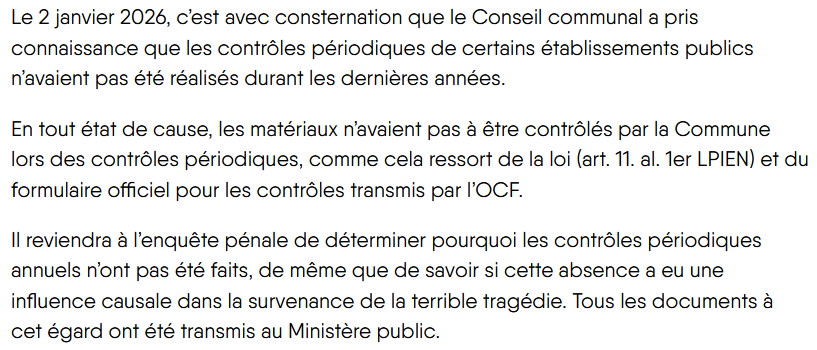
But…the guy in charge of public safety in Crans Montana wrote a report in August 2018 addressed to the Municipal Council telling:
"Currently, I am doing my utmost to carry out my work in accordance with the applicable requirements. Unfortunately, it is not possible for me to do everything. In my view, there are two solutions: the local council assumes responsibility and accepts that the current legislation in the field of fire protection is not fully implemented.” Or, secondly, “the local council decides to provide an additional percentage of resources to be determined to strengthen the security team.”
In a subsequent report from 2021, the guy in charge of security can’t tell it clearer. By law, 435 inspections, only 85 to 109 were done, ~300 inspections not done per year. So, only ~20% of work done.
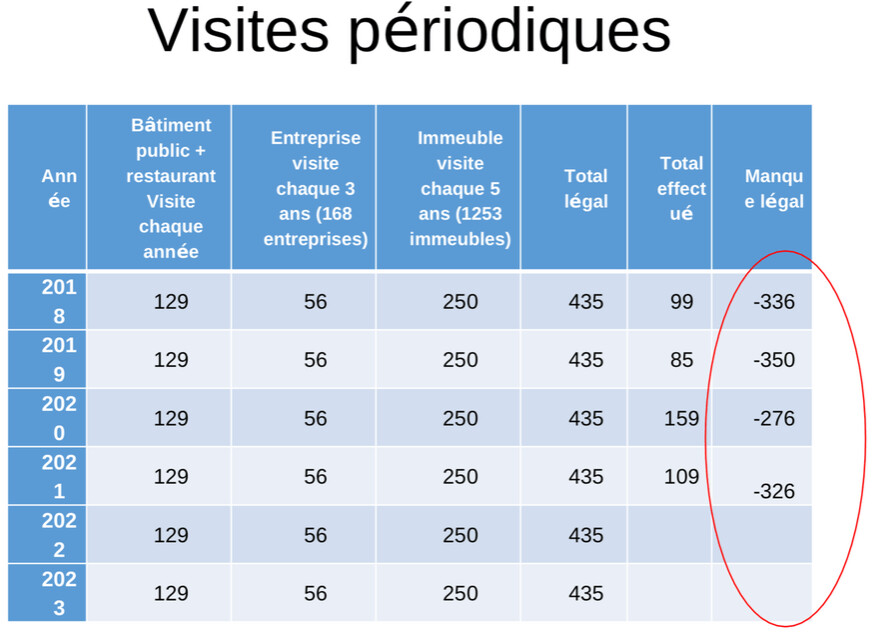
The following puts the prosecution in really hot water. The prosecution is not using their power to investigate, they’re only inviting people to cooperate instead of taking control. Can they survive “those who are being investigated decide for themselves which documents they submit to court”?. We’ll see next week.
As the municipality can say today that it has known nothing and has always complied with all requests for staff increase, remains their secret. The first part of the claim seems simply false, the second part is at least very glossed over.
Something else that the community indicates is apparently not true. It concerns the delivery of the necessary documents to the public prosecutor’s office. On Monday, it came to a glare because it turned out that part of the protocols were not delivered. Someone also did a lot of blackening in the minutes of the community lawyer. This led to submissions from victim advocates such as Sebastien Fanti or Pierre-François Vulliemin. Vulliemin says: “It is shocking that those who are being investigated decide for themselves which documents they submit to court."
2 Likes
In the news this week:
Switzerland angers Italy by claiming costs of treating Crans-Montana fire victims
Switzerland is asking for more than 100,000 Swiss francs ($127,000) in refunds for four Italian nationals treated for just one day at the Sion hospital after the blaze*
You may think this is fair but:
Italian ambassador to Switzerland Gian Lorenzo Cornado was quoted as saying that Swiss patients wounded in the Cans-Montana fire have been treated for months at the Niguarda hospital in Milan, northern Italy, and that Italy sent a civil protection helicopter to assist with rescue operations without asking for any money.
Italy have said they will refuse to pay.
1 Like
Quite a hysterical outcry over nothing.
The families have been informed months ago that these copies of bills are not expected to be paid.
Tagi writes in the Crans-Montana ticker:
“The services provided at the Valais Hospital are not billed to the families,” the Department of Health told the SDA news agency on Tuesday in response to an inquiry. This confirmed earlier reports from the Italian news agency ANSA.
The families had already been informed in writing between late February and early March about the procedure to follow should they receive such bills, which they are not required to pay, the statement added.
Reports are emerging (with information from previously unpublished videos) that Ms Moretti left the location as soon as the first flames showed, barging her way to the exit and pushing aside people who were in her way.
No sign she warned anybody on the way out.
The article to which I linked stated that - and that it would be the Italian Health ministry who would be billed.
The out cry, which didn’t sound hysterical to me, and I’ll repeat it here, is that Switzerland is asking for more than 100,000 Swiss francs ($127,000) in refunds for four Italian nationals treated for just one day at the Sion hospital after the blaze* but Italy is not charging Switzerland for the Swiss patients wounded in the Cans-Montana fire who have been treated for months at the Niguarda hospital in Milan, northern Italy, and that Italy sent a civil protection helicopter to assist with rescue operations without asking for any money.
If four patients for one day is 100,000 Swiss francs, how much should Italy charge Switzerland for months?
1 Like
The expense claim adds further strain to the relationship between the two countries, with Prime Minister Giorgia Meloni on Friday describing the move as “disgraceful” following news that the families of the fire victims had been billed.
This is the core aspect driving the hysteria.
And it couldn’t be more false given the fact that there’s no bill issued to the families.
Lawyers for some of the victims are putting forward a criminal case now against the emergency services in Crans Montana on the night of the fire. They’re citing insufficient numbers of stretchers and thermal blankets as being problematic and say the lack of oxygen cylinders made their treatment less effective than it should have been.
I’m having a hard time getting my head around that given the scale of the disaster.
1 Like
The vultures have found a new, and potentially lucrative, target.
It’s seems the paramedic job is a thankless one:
“We worked there for a long time, many came on their days off; but four months later, our overtime hours still haven’t been paid,” denounces an ambulance worker, who wished to remain anonymous.
Employees of Valais’s largest ambulance service reported the matter to their superiors. “They told us that our employer – the hospital – and the Canton were passing the buck regarding who should pay.”
The whole aftermath to the tragedy seems to be people passing the buck to someone else and trying desperately to absolve themselves of any responsibility for any aspect of what happened.
2 Likes