Eigenmietwert - Imputed Rental Income on Homeowners

Normally all costs associated with a rental are deductible.
It probably gets complicated if you’re renting out a couple of rooms in a property you live in
Is that what you meant?

There’s rules about what you can claim if you dedicate a room for business if you remote work, probably would be similar.

This is extremely short-sighted, eg all tax deductions should go under that logic as they are added complications on the form.

The Imputed Rent is actuelly a massive simplification - for the Tax Administration. They expect to “see” rent from 100% of the properties (either real rent, or imputed rent).

So some types of fraud (“rent cash in hand every month”) and the landlord declaring an empty property does not exist. In other places of the world it is a problem, with $ spent by the authorities in checking for illegal rentals.

1 Like

Tax deductions for improvements are nice. But, on the current system something must be done every year and cash is needed for that.

People in retirement with a mortgage would benefit from paying lower taxes and then having the freedom to decide to spend on home renovations or not.

2 Likes

I don’t think it’s about the fraud. In the parts of the world where I was born, people typically own places for many years unoccupied, never renting them being afraid of making a loss by rough tenants demolishing it, just as a safe harbor for the retirement. I bet here in Switzerland is exactly to prevent having unused properties in a country with a huge properties shortage (though honestly I’ve never though it was always like that, and if the imputed income stretch up to the start of renting business - heck since how long people are renting in Switzerland?).

ZKB article on changes to imputed rental values ​​in the Canton of Zurich:

New imputed rental values ​​in the Canton of Zurich

November 26, 2024

For the 2026 tax period, homeowners in the canton of Zurich will receive a new assessment of their imputed rental value. However, the impact of the new system on their tax bill can vary greatly depending on the location and age of the property. We’ve done the math.
Good news for a quarter of property owners: Their imputed rental value is expected to fall by 2026. (Illustration: JoosWolfangel)

Property owners are concerned about the imputed rental value. This has made the Swiss-wide debate about abolishing the imputed rental value all the more tense in recent years. Following the discussions in parliament, it seems increasingly likely that the much-discussed tax will be abolished in the coming years.

Against the backdrop of this discussion, property owners in the canton of Zurich may have reacted with particular surprise to the headline that has been circulating for several months: The canton will update imputed rental values ​​starting with the 2026 tax year. The adjustment was necessary because the existing calculation basis dates back to 2009, and property values ​​and rents have increased significantly since then. Uncertainty about the revaluation is therefore considerable. The canton has now presented the public with new directives on imputed rental value taxation. They allow us to get to the bottom of owners’ pressing questions. Which property owners will have to bear the highest increase in their tax bill? Are owners of older properties at a disadvantage because they have experienced larger increases in value since their purchase? We have examined the new directive and simulated how the imputed rental value will change for every owner-occupied home (single-family homes and condominiums) in the canton of Zurich .

Rising land values ​​are the main drivers of imputed rental value growth

Since the imputed rental value is fictitious, it is derived using a formula. The calculation is based on two components: the current construction value and the land value of the property. The land value is calculated, simplified, by multiplying the property size by the site value of the property per square meter.

The imputed rental value is derived from the land value and the building value

The Canton of Zurich has adjusted its location values ​​for the 2026 tax year. Separate values ​​are reported for single-family homes and condominiums. In recent years, the supply of owner-occupied properties has not been able to keep pace with the additional demand, which has driven up real estate prices and thus land values. This applies to both single-family homes and condominiums, where land values ​​have risen even more sharply due to increasing popularity and more central locations. Condominiums in the city of Zurich saw a particularly significant increase, with location values ​​rising by an average of almost 480 percent. The land value of condominiums in municipalities such as Winterthur and Kilchberg has also increased significantly. These growth rates may alarm some condominium owners. However, the land value, like the value of the building, only contributes a certain proportion to the imputed rental value. Therefore, a tripling of the land value does not automatically mean a tripling of the imputed rental value.

Land value: expensive land

Average increase in land values ​​of single-family homes (left) and condominiums (right) after the new directive 2026
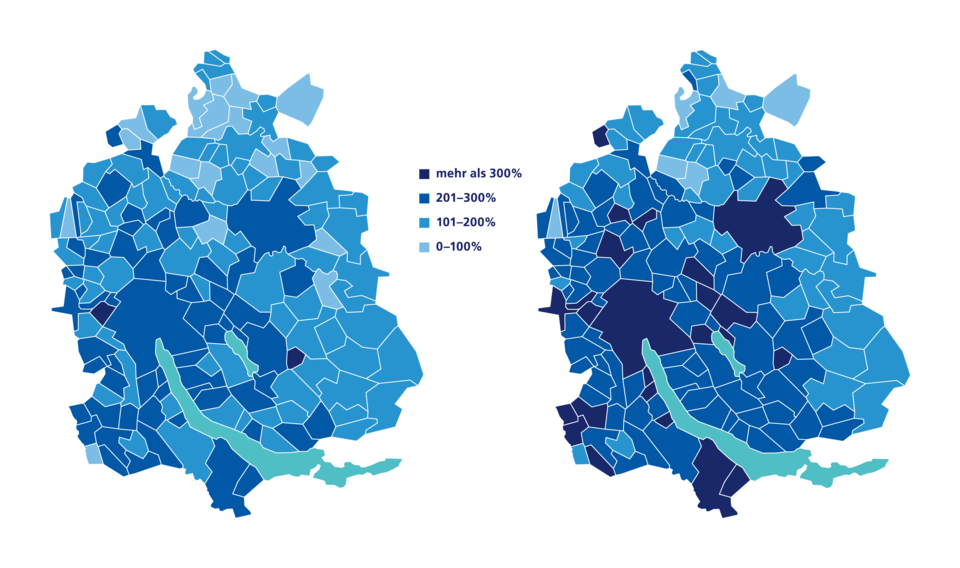
Land value map of the canton of Zurich

Sources: Canton of Zurich, Zurich Cantonal Bank

Owners of older properties benefit from lower building values

In addition to the land value, which will increase following the tax reform, the imputed rental value depends on the building value of the property, the so-called time-based construction value. For the calculation, the replacement value of the property according to the building insurance is depreciated using an age factor. Currently, property owners are allowed to claim an age-related depreciation of 1 percent per year for aging up to 2009, with a maximum of 30 years being credited. For example, a single-family home built in 1984 was already 25 years old in 2009, which corresponds to a creditable age-related depreciation of 25 percent. With the new tax regulation, an age-related depreciation can now be claimed up to 2026 for a building age of up to 40 years. For the example house, a new age-related depreciation of 40 percent would now be credited, as it will already be 42 years old in 2026. This means that 15 additional years are creditable due to the new regulation. The situation is less positive for a condominium built in 2022, for example. Previously, no age-related depreciation could be claimed here. Now, four additional years will be possible. The new building values ​​are therefore welcome news for owners of older properties. Specifically, owner-occupied properties built between 1986 and 2009 enjoy the greatest additional age-related depreciation (see chart below). Those who recently moved into their newly built home are unlikely to benefit from additional depreciation on the building value. This leads to a surprising result: Owners of older properties, who have enjoyed the greatest increase in value in terms of building value, are in a better position than new owners of new buildings. In addition to the age-related depreciation, it is often overlooked that the assessment of the imputed rental value for new buildings was also based on old data.

Time-based construction value: New buildings at a disadvantage

Additional creditable years Age depreciation according to year of construction
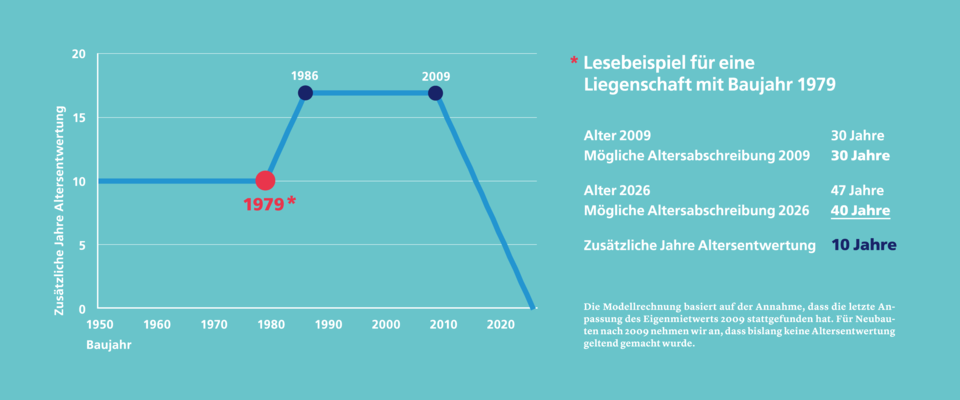
Time construction value - reading example

Source: Zurich Cantonal Bank

Moderate increase in imputed rental values ​​for most – some even pay less

We have estimated how the imputed rental value will change for all owner-occupied properties in the canton due to the adjusted location values ​​and the changed age-related depreciation. Despite the sharp increase in land values, the results, as the bar chart below shows, suggest a surprising all-clear for most owners. Residents of around half of the properties expect an increase in their imputed rental value of more than 5 percent. On average, it is +14 percent for single-family homes and +19 percent for condominiums. In our estimate, the residents of one in five properties will be affected by an increase in their imputed rental value of more than 15 percent. 27 percent (single-family homes) and 31 percent (single-family houses) can view the reform with more confidence, as they do not have to expect a significant change in their imputed rental value. Another pleasant surprise is that the property owners of the remaining quarter actually have reason to be happy: their imputed rental value is expected to decrease.
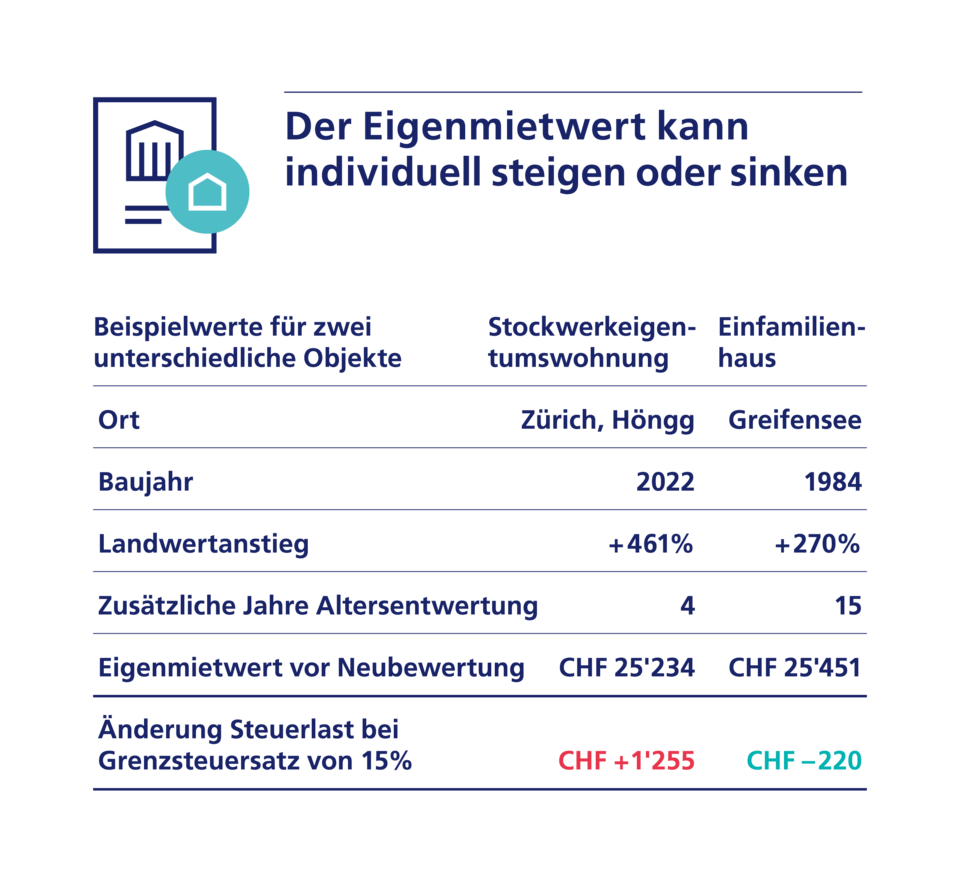
Example EMW

Two typical examples illustrate why some owners pay a higher amount while others can even expect a reduction in their imputed rental value. For an example apartment in the Zurich district of Höngg, built in 2022, the imputed rental value will soon rise by around 30 percent. At a typical marginal tax rate of 15 percent, this increase would mean an annual tax increase of well over CHF 1,250 – a paradoxical development in the eyes of owners, especially since many hope for the imputed rental value to be abolished soon. The increase is primarily caused by the significantly increased land value. However, the owners of an example house in Greifensee, built in 1984, can breathe a sigh of relief. Since the land value here is not increasing too sharply and, in addition, a significantly higher age-related depreciation can be claimed, the imputed rental value will actually decrease slightly.

Generally, imputed rental values ​​tend to rise primarily in metropolitan areas. The figure below illustrates this finding for the canton’s five largest municipalities. The city of Zurich stands out in particular. The imputed rental values ​​of the city’s rare single-family homes and condominiums are increasing for a large proportion of them. Tax practice here is thus closer to reality, which not only property owners have noticed: Rent prices in the canton’s largest city have risen more sharply in recent years than in the surrounding areas. Surprisingly, imputed rental values ​​for condominiums – with the exception of the city of Zurich – have changed less than for single-family homes, even though land values ​​for apartments are rising particularly sharply. However, the effect of the sharp rise in land values ​​is mitigated by the fact that the proportion of land per apartment is small. Many condominium owners in large apartment buildings in Dübendorf also benefit from this phenomenon, as their imputed rental values ​​are less strongly influenced by land values ​​and thus fall more frequently.

Depending on the municipality, the imputed rental values ​​develop differently

Percentage of single-family homes and condominiums where the imputed rental value decreases, remains the same or increases in the simulation calculation, in percent
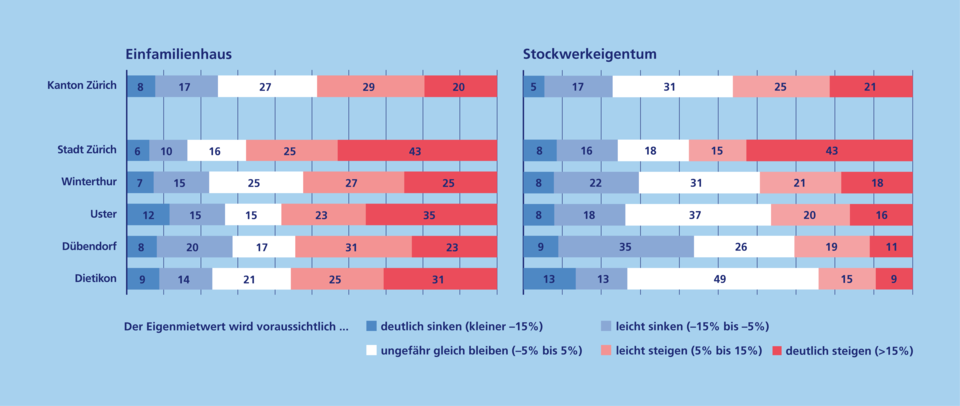
Imputed rental values ​​in the canton of Zurich: adjustments

Source: Zurich Cantonal Bank

Not so bad?

All in all, there is no cause for undue concern for most property owners who were surprised by the announcement of higher imputed rental values. Anyone who also feels that the determined imputed rental value is too high can request an individual assessment of the achievable market rent. This ensures that the determined imputed rental value is between 60 and 70 percent of this market rent. A hardship rule was also announced, which should provide relief in the special case of excessive living costs. Property owners facing a significant tax increase can also look hopefully to the federal government in Bern. With a bit of luck, the imputed rental value will soon be abolished for good.

1 The model calculation provides an indication of how the imputed rental value will change. It is based on information on location classes, land area, and building volume. In individual cases, the result may therefore differ from the actual increase in imputed rental value determined by the tax office.

2 Likes

Has someone observed “age-related depreciation” in the wild? :slight_smile:

1970s house with asbestos and old leaky windows may be cheaper, but not 40% less than others on sale.

Maybe they should un-cap the age depreciation. My house was built over 100 years ago, so I should have negative value and they should be paying me! :wink:

1 Like

Table extracted:

Confederation / Cantons Determination of Imputed Rental Value* Calculation Method Under-occupancy Deduction Different Assessment for Direct Federal Tax
Confederation 70% of the market rental value For federal direct tax assessment, cantonal imputed rental values are used Yes See Annex to Circular No. 172
Zurich (ZH) Max. 70% of the market rental value Single-family home: 3.5% of land and replacement value up to CHF 120,000, plus 1% on the excess
Condominium: 4.25% of land and replacement value up to CHF 40,000, plus 1% on the excess
Yes No
Bern (BE) 60% of the market rental value Imputed rental value = Protocol rental value (base rent) × Rental value factor No Yes
Lucerne (LU) 70% of the market rental value Rental value based on official valuation by municipal groups No No
Uri (UR) 75% of the market rental value, reduced by up to CHF 7,800 Condominium: based on tax office property valuation
Self-occupied apartment in own multi-family house: amount a third party would pay if rented
Yes No
Schwyz (SZ) 65% of the market rental value Rental value based on officially set rental levels by locality Yes Yes
Obwalden (OW) Less than 70% of the market rental value Imputed rental value = 3.8% of net taxable value
Net taxable value is a percentage of the total taxable value
Yes Yes
Nidwalden (NW) 70% of the market rental value Rental value based on official valuation, adjusted annually to market rental levels Yes Yes
Glarus (GL) 60% of the market rental value Rental value based on achievable standard rent Yes Yes
Zug (ZG) Minimum 60% of the market rental value Market rental value = 5% of market value Yes No
Fribourg (FR) Based on local or regional housing market to promote home ownership Rental value determined using a points-based system and municipal multiplier Yes No
Solothurn (SO) 60–90% of the market rental value Based on cadastral valuation considering property condition, development, and municipality group
- For properties valued ≤ CHF 240,000: 8.8% to 10.63% of cadastral value
- For properties > CHF 240,000: individual assessment based on cadastral units
No Yes
Basel-Stadt (BS) Imputed rental rate³ Single-family home / condominium: 3.5% of wealth tax value, max. CHF 72,100
Apartment in own multi-family house: amount charged to tenants for comparable units
No Yes
Basel-Landschaft (BL) 60–66% of the market rental value Imputed rental value = 17.09–63.23% of simple fire insurance value
Taxable fire insurance value = simple fire insurance value × correction factor (by municipality, age, and possibly condominium status)
Yes Yes
Schaffhausen (SH) Max. 70% of the market rental value Rental value estimated considering local rental levels and property value factors Yes Yes
Appenzell Ausserrhoden (AR) 80% of the market rental value Rental value estimated considering local rental levels and property value factors No No
Appenzell Innerrhoden (AI) 70% of the rental value Rental value based on official valuation No Yes
St. Gallen (SG) 70% of the market rental value³ Rental value based on land valuation, adjusted for market price developments Yes No
Graubünden (GR) 70% of the market rental value Rental value based on official valuation Yes Yes
Aargau (AG) 60% of the market rental value Imputed rental value = Standard rental value × 0.6
Standard rental value: estimated rent considering local rental levels and property value factors
No Yes
Thurgau (TG) 60% of the market rental value Rental value based on local rental levels and property value factors No Yes
Ticino (TI) 60–70% of the market value Not specified No No
Vaud (VD) 65% of the statistical value Rental value based on statistical value, considering municipality and property value factors, adjusted periodically for cost of living, rent, and construction costs No Yes
Valais (VS) 60% of the rental market Rental value considering local conditions and actual use of the residence Yes No
Neuchâtel (NE) 70% of the rental market Rental value = 0.8–3.5% of gross rental yield No No
Geneva (GE) Theoretical rent based on local conditions, not exceeding 20% of total gross income² Rental value based on local conditions and a questionnaire on the building’s condition No No
Jura (JU) In line with market rents to encourage home ownership and personal provision Rental value based on annual yield value estimation No Yes

* The imputed rental value is generally set as a percentage of the market rental value. The market rental value corresponds to the amount that would be paid to rent a similar property in a comparable location.

Footnotes:

  1. Zurich (ZH): A reduction is generally granted if the calculated imputed rental value exceeds one-third of the income available to the taxpayer and co-resident independently taxed persons for living expenses. No reduction if taxable wealth exceeds CHF 600,000.
  2. Lucerne (LU): Reduction available upon request if taxable rental value exceeds 25% of total income (excluding rental value), and is below CHF 19,400 (single) or CHF 27,200 (family). Minimum taxable rental value is 60% of average market rent. Reduction not available if taxable wealth exceeds CHF 55,000 (single) or CHF 110,000 (family), unless owner-occupied property constitutes over 75% of total taxable wealth.
  3. Obwalden (OW): Reduction granted if imputed rental value exceeds one-third of available income and taxpayer must regularly draw on assets to cover living costs. No reduction if taxable wealth exceeds CHF 100,000 (single) or CHF 150,000 (others), unless owner-occupied property exceeds 75% of total taxable wealth.
  4. Zug (ZG): Rental deduction (social deduction): 30% of rent (excluding ancillary costs), max. CHF 10,600/year.
  5. Basel-Stadt (BS): Reference mortgage interest rate plus surcharge, max. 4.5%.
  6. Schaffhausen (SH): For taxable wealth up to CHF 500,000, imputed rental value may not exceed one-third of cash income.
  7. St. Gallen (SG): Rental value reduced if it exceeds 30% of gross income and taxable wealth is ≤ CHF 600,000. For taxpayers at regular AHV retirement age, reduction of up to 40% possible if rental value is clearly disproportionate to income and wealth.
  8. Graubünden (GR): For taxable wealth under CHF 600,000, imputed rental value may not exceed 30% of cash income. Minimum value is 60% of market rental value.
  9. Ticino (TI): If no other data is available, rental value corresponds to 90% of the officially estimated yield value.
  10. Vaud (VD): Housing deduction: If rental value or net rent exceeds 20% of net income, it may be deducted up to CHF 6,400. The base value for deduction is capped at CHF 10,500 (single) or CHF 12,900 (married/cohabiting), plus CHF 3,500 per dependent child.
  11. Geneva (GE): The 20% effort rate is based on total gross income, but at minimum on the first tax-exempt bracket (CHF 18,479 in 2024 for singles; double for splitting taxpayers). This limit applies only if financing interest does not exceed the rental value.
1 Like

Interesting. But in Vaud, where I live, the imputed value the year we bought hasn’t changed a dickie-bird in the 25+ years since (pretty certain it was same as original owner). I certainly don’t want to open a can of worms and ask why.

We have, over the years, made improvements that we can’t claim as deductions and are saving the records as we will be able to offset some of the capital gains when we sell.

Does this change?

No. This is part of the capital gains calculation which is unaffected.

1 Like

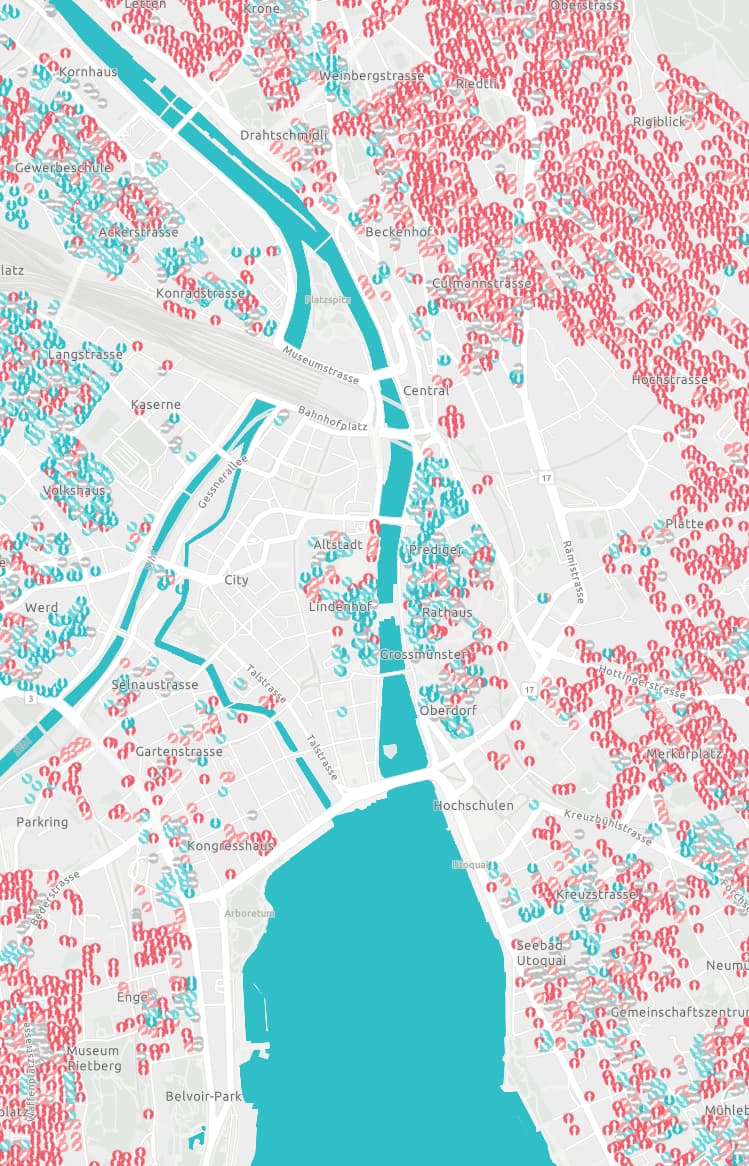
Mine is estimated to be down between 5%-15%:

You can check expected for any house in Zurich using this map!

3 Likes

There’s a lot of work gone into revaluing Eigenmietwert, but what if it’s voted out in September??

Big thanks to Phil for the map. Our place gets a grey arrow to the right = +or - 5%. While neighbours who totally renovated their house would be in for a 15% increase…

Then they’ve gone and wasted a whole lot of time and resources.

We live in an apartment building that has three addresses
Only two are shown on the map, mine not, of course
One of the other two shows falls of up to 15%, the other a rise of up to 5%

The whole building was converted from a factory forty years ago, so why they are different I do not know.

Yes, plenty of old buildings get demolished as it’s cheaper to replace than renovate to todays standard.

I have only seen single-family houses or old industrial buildings being demolished to build apartments. I understand the difference in revenue between renting an old house and renting 10 new apartments. Of course, capital investment and a bunch of debt, but the cash flow from the piece of land improves a lot.

1 Like

In Schlieren I saw old tennis courts being demolished for new apartments. But, old apartments for new ones will happen in Altstetten. So, it happens. I shut up now :wink:

It depends on where you live. In my village on Lake Zurich many apartments buildings are demolished one by one to build the newer apartments buildings.

2 Likes

I know someone who renovated their house. They regretted it as it cost them much more than had they just demolished it and rebuilt a new one from scratch.

3 Likes