I think your boss is right. I also think we are barely at the start of AI adoption.
Most people haven’t used AI. Vast majority that have may have only used via simple chat or embedded in products e.g. google AI search.
When it is more widely adopted as capabilities are built out, usage will sky rocket.
I asked AI to plan my holiday and just asked it to estimate how many tokens that used:
Bottom line
• Unique content: ~6.1M input + ~192K output ≈ 6.3M tokens total
• Billed input (actual sent to LLM): much higher — the 6 sessions with recorded counters sum to ~3.85M billed input; for the 4 older sessions whose counters predate tracking, cumulative-context estimate adds ~29M more, so true
billed input across the whole planning effort is roughly ~33M input tokens (~£3–4 at glm-5.3 pricing, based on the ~£0.85–1.4 per million blended rate implied by recorded costs)
• The 2026_09_03 session is the heavyweight: 52 turn nodes, ~850K unique tokens, ~119K output — likely the big itinerary-planning session
Looking at millions of tokens. Asking it to answer this already used 0.5m tokens.
Millions of tokens were used getting it to fill in my tax return for me. And millions on top getting it to write the browser_use extention that enabled it to use the tax website:
Session (Sep 23–24)
Purpose
Model
Turns
Input tok
Cached tok
Output tok
Cost
16h36 ibkr_trades_tax
first attempt, securities fill
glm-5.3-flash
9
90,152
482,857
3,390
$0.02
16h37 ibkr_trades_audit
main stocks session
glm-5.3-flash
47
1,625,034
18,758,030
132,581
$0.33
18h06 snapshot_fix
browser snapshot debugging
glm-5.3
38
424,434
5,366,795
159,686
$2.69
18h16 snapshot_fix
continued debugging
glm-5.3
40
428,199
5,689,196
162,267
$2.79
01h21 reconciliation
dividend reconciliation
glm-5.3
9
67,972
340,709
19,332
$0.27
01h46 reconciliation audit
PDF audit
glm-5.3
11
84,582
898,374
42,594
$0.54
01h52 reconciliation audit
PDF audit
glm-5.3
12
85,309
972,301
43,287
$0.56
13h29 rental table (1st)
rental section fill
glm-5.3-flash
33
153,596
1,954,656
26,248
$0.04
14h41 rental table (2nd)
rental section fill
glm-5.3-flash
21
130,745
2,450,736
64,263
$0.04
16h22 reconciliation
final reconciliation
glm-5.3
9
85,309
972,301
43,287
$0.56
Total
229
2,935,332
~37.9M
697,434
~$7.84
People are happy to pay $50 to have the electronic stock certificate. Here for <$8 it fills in stock section but also the rental property section as well as reading PDF scans from tax audit as well as PDF scan of tax account to make reconciliation and help draft response to tax authorities.
As it becomes easier to use, we will be asking AI to do more and more things. Shopping, holiday planning, taxes, any annoying computer admin.
the revolution has yet to come, but in the future everything will be out of the box available by an API. Graphical interfaces are good for humans, yet many prefer a command line (which can also be efficiently used by AI), but IMO every app in the future will be talking in json side by side with the human interface. Apps procrastinating this shift will soon be forgotten, other apps will irreversibly take that space.
Musk’s SpaceX operates its own data centers through which it sells computing capacity. SpaceX is a direct competitor to the neoclouds which also rent compute.
Musk was replying to a post on X by Chamath Palihapitiya, the founder of Social Capital, who laid out his views on the state of the data center buildout. He suggested that there will be “a lot of partially stranded compute and compute sitting in inventory in 2027 than is currently forecasted,” which will be “bought and paid for but effectively underearning (below total cost of capital) or collecting dust.”
“2027 will be a turbulent year because it will clear out a bunch of wrong/bad bets. It will also be a consolidation year for a few,” Palihapitiya said.
Zuck looking to raise more money to buy AI. Trying to race ahead and secure capital before competition from IPOs etc. arrives. But only a measly $97.5bn.
Musks data centers are genuinely superior. The organisation of cooling was next level, with huge industrial water cooling, custom racks, custom interconnects, all designed to make them efficient, upgradable, easy to monitor. Months were spent redesigning this packaging and network tech and testing with SuperMicro, NVidea before ordering and buildout. More like a water treatment plant than a conventional data centre. His will be the ones that survive when costs get cut to the bone. At least some Data centres are needed locally. Not all function can be offshore. The benefits of his forward planning will only show fully in 10 years plus during upgrades when further massive demands on infrastructure are made. Really impressive. Like the Ford Model T production line, not really appreciated at first. Monster cooling underneath and massive electrical power above, servers in the middle. https://youtu.be/Tw696JVSxJQ?is=PU2XkXYeBza7N-tx The real issue is what will happen to other people’s data centres that were designed half obsolete and in a hurry.
Much better than ordering a cut because this filters for people who are already mentally on their way out. And there’s no detrimental effect on general morale.
Q3 revenue of $127.6 billion misses $128.2 billion estimate
Google advertising revenue comes in at $82.01 billion
The Mountain View, California company reported negative free cash flow of $9.1 billion, versus analyst expectations that it would come close to breaking even, LSEG data showed.
Aggressive efforts to boost cloud capacity and fund AI development led Alphabet to burn $5.9 billion last quarter, the first time it went into the negative in 22 years as a public company.
One important capability is having cash and access to credit. A whole different ability is putting that cash to good use successfully. Building things takes years, spending more is no guarantee of faster or better results.
You have to decide whether Google and other tech companies are idiots and spending money on things that will not have a return. Or whether their return on capital will continue to be similar to what they have in the past and so imply that the capital expenditure they are currently making will lead to huge returns in the future.
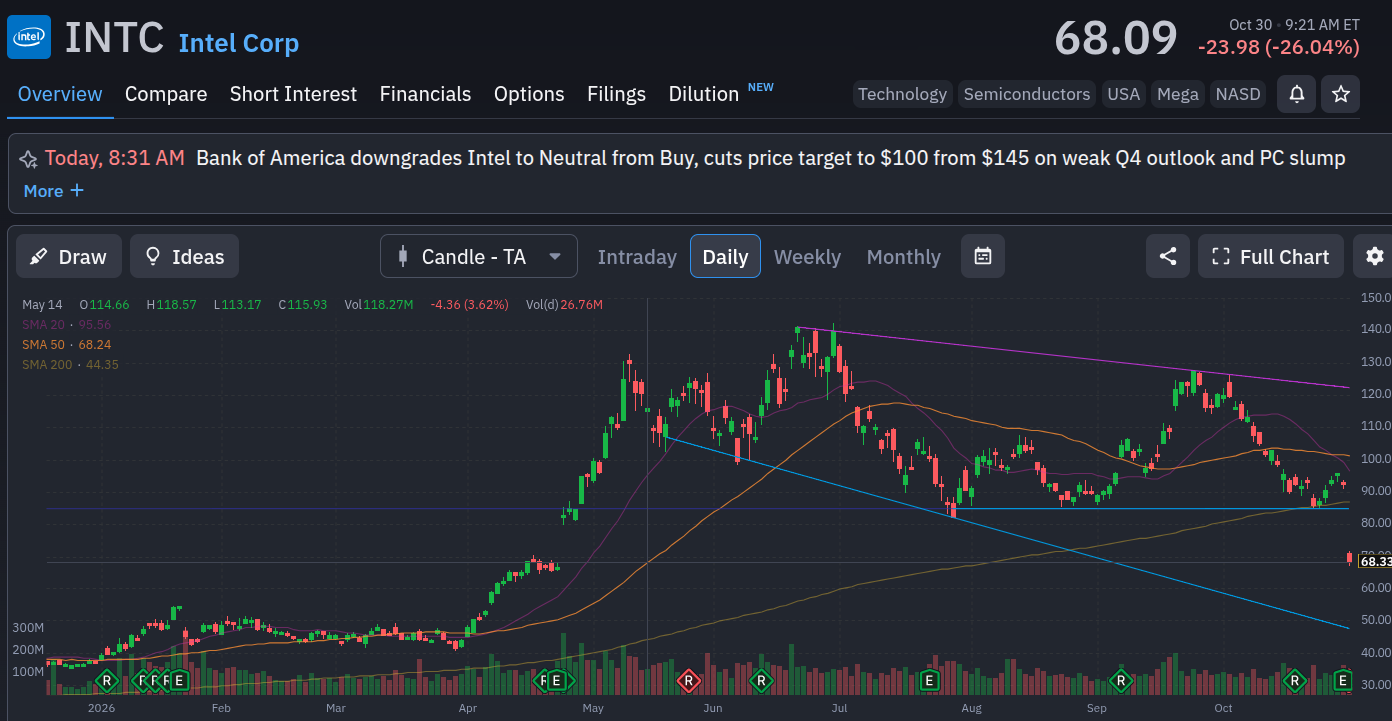
I was too chicken to short INTC in the AI bubble, but look at that chart. Price has gone right back down to when it gapped up in April - confirming the TA adage that all gaps get filled.
It it breaks down past the $67 range, next stop $50.