Which means there’s less chance of witnessing an accident or dangerous driving.
I used to live in a city in the UK - I witnessed many, many accidents - more people per capita, more accidents.
Why are you struggling so much with this?
Which means there’s less chance of witnessing an accident or dangerous driving.
I used to live in a city in the UK - I witnessed many, many accidents - more people per capita, more accidents.
Why are you struggling so much with this?
Looking through this thread I don’t think it is me who is struggling 
That’s one way to cover up your lack of understanding of statistics - make a silly joke about something or someone else.
The situation in NL seems to be very clear (pardon the mix of different years):
e-bikes are deadly for the seniors.
“Cyclists are 40% of the traffic deaths and 71% of the serious injuries [with many more believed to remain unreported]. 55 % of all fatalities amongst cyclists in 2021 were in a collision with a motorized vehicle and 45 % were not. However, 18 % of seriously injured casualties were in a collision with a motorized vehicle and 82 % in other crash types.”
And…
“Cycling safety is mainly a problem of older cyclists (85 % of all cyclist fatalities are over 50 years old, 51 % are older than 75 years).”
Note the increasing prevalence of e-bikes, currently believed to be at around 5 millions (population 18 millions).

Actually I said I do like some cycling routes here (very much). But otherwise just as a means/form of transportation and not recreational/family thing - car and public transport.
This is quite revealing considering the extensive network of segregated cycleways everywhere in the Netherlands.
Now it is getting even more confusing. There is a BMW e-bike …
So we’re not even safe on the cycleways!
Or not using them?
Yes, stunning. Even increased bike traffic volume comes at a price. Such is also to be expected hereabouts, e.g. with Zürich’s VeloVorzugsRouten (“innercity bike highways”).
I’m also very much surprised by the high total number, per capita it’s almost double CH’s (and rising lately).
As a side note, I find this 5-year summary table quite interesting. On the left you see the victim category, the bottom row names the “killer”.
Dutch cyclists kill 15 times per year, predominantly other 2-wheelers but also about one pedestrian per year. If this is mostly a matter of a senior e-biker killing another senior e-biker (as suggested by the lopsided death toll among seniors) this is bound to increase mucho going forward because so far only about 1/3 of the population has an e-bike.
There’s a flaw in this argument given that the two forests are not the same size.
I guess many people are not that much into cycling ? I don’t have any problem understanding this. As a physical/recreational activity is just one of the many options.
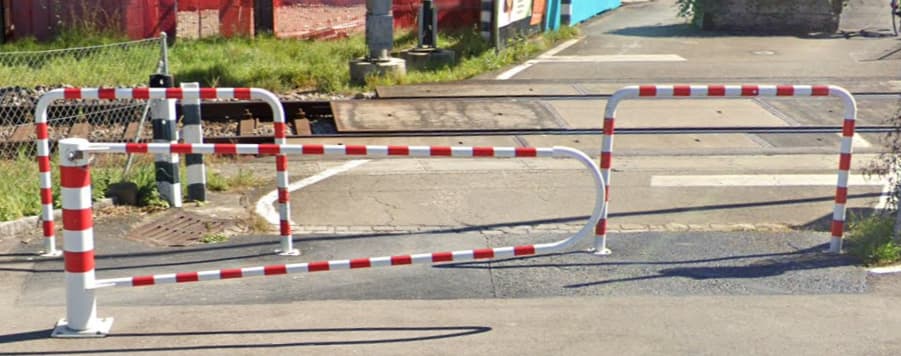
Accident frequency is soooo low. I’ve never seen one that ends in the hospital or the mortuary in Switzerland. I’ve seen fellow mountain bikers crash in the trails, but it’s laughing time. Only urban cyclist crash I’ve seen was on a structure like the one below. But the guy was not hurt, only picked up whatever was left of his self-esteem from the floor and kept pedaling.
So, if it weren’t for the news, my perceived bike crash rate that ends in hospital or mortuary would be zero. I’m not an omnipresent entity, I just see what is in front of me…and the rest from media. So, no higher chance to see a crash with my own eyes in spite of 3’667 of them happening in ZH annualy. That’s why rely on stats, because low frequency events are practically invisible.
Eh?
Not to explain a concept.
As a mode of transport, it is just one of the many options - but one of the few which is environmentally sound, reduces healthcare costs and so on.
Putting my serious hat on for a moment:
Serious hat off. Happy to continue the banter.
That’s fine. I’ve got lovely routes too off roads used by cars than meander through beautiful countryside and they are great for a Sunday morning ride.
But that’s recreation.
If you want to use a bike for commuting, for shopping or other activities and try and be less dependent on a car then you end up mixing with drivers - many who drive aggressively behind cyclists or are impatient and try and overtake when they really shouldn’t - missing you by centimetres (which for those who cycle, know can be quite unnerving).
Other countries have introduced laws to give a hierarchy of road users with pedestrians being the most vulnerable, then cyclists and lastly motor vehicles.
This gives the Police more power to prosecute drivers harassing cyclists but equally more power to prosecute cyclists cycling where they shouldn’t and endangering pedestrians.
I mentioned this before but it’s important if you are a cyclist: Most European countries have introduced a close-passing law making it a crime for a motor vehicles to pass within 1.5m of a cyclist at low speeds and a greater distance at higher speeds.
The UK allows cyclists and motorists to upload video of these occurrences (and phone use too) to a Police webserver and prosecutions can be made (in court) with the video as data.
The Swiss government has rejected a call for a close-pass law three times in the last few years. I find that shocking and rather pathetic. I’d like to think that Switzerland would lead the way in road safety and not take a back seat, especially as other rules such as quiet rules are such a nanny state way of dealing with problems that adults should really be able to sort out themselves.
I thought Switzerland had a 1m passing law?
There is no codified distance. There is some garble about “sufficient distance not to endanger”. Courts have repeatedly shied away from setting a specific distance.
There are many proponents of a 1.5m law like in Germany. In my view, no regulation required when there is a yellow lane. Different thing when not. Hard to police in any event.