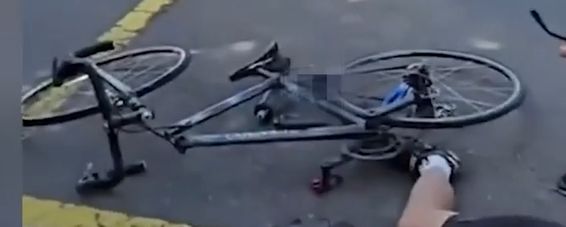
He might have additional levers, like the ones below.
That aside, it’s not a braking issue.

He might have additional levers, like the ones below.
That aside, it’s not a braking issue.
It looks like he was simply not paying attention.
I also had a near incident this morning. A motorbike signalled to turn off the roundabout and so I entered the roundabout on the bike. Then he realised it was the wrong turn at the last minute and swerved back aborting his exit and nearly hitting me.
I think it is. If he had braked, he wouldn’t have hit the car!
No, I agree, he wasn’t paying attention - I was just making an observation of an unsafe cycling position.
My brother did exactly the same thing when he was eleven - cycling into a parked car and snapping his frame!
Richard Branson had a bike accident fairly recently. He was holding the handlebars without his thumbs underneath, hit a bump and fell off when his hands-arms lost contact with the handlebars.
I saw the tail end of an accident at the weekend - checking the Police report later, a cyclist had gone down a hill without holding on to the handlebars and crashed resulting in an ambulance trip.
Back in the day, one of our scouts did that on his way to a scout meeting. Nutsack-to-handlebar-nut carnage. Think he would have preferred snapping his frame.
There’s a new 30 kmh zone in front of the train station in Aarau. I guess that makes it a left-wing city 
More seriously, there’s a lot of people around this area. 30 kmh is even comfortable for driving, worrying less about harming someone.
How fast should traffic travel in urban areas? 50 km/h? Or only 30? This question is a source of heated debate in many places. Left-wing cities often fight for a 30 km/h speed limit, while civil society and car associations insist on 50 km/h. And the public is making a strong case.
In Bern, for example, the Federal Supreme Court ruled in favor of the city in the summer of 2024: a planned 30 km/h zone in the Elfenau district was permissible. The judges considered the lower speed limit proportionate, increasing safety and reducing noise.
In the canton of Zurich, the dispute has long since escalated. At the end of March, the cantonal parliament supported an initiative sponsored by the SVP and FDP that aims to deprive the cities of Zurich and Winterthur of sovereignty over speed reductions on major arteries – with a majority of just one vote. A referendum is scheduled for fall 2025.
TBH, driving in urban environments is not a fun experience regardless of 30 or 50 kmh speed limits. 150+ kmh in motorways? Now, that’s appealing to car enthusiasts. 50 kmh is Vespa speed.
…Albert Rösti is now getting involved. The SVP Transport Minister is planning a far-reaching intervention in transport policy: 30 km/h speed limits will only be permitted in exceptional cases on so-called traffic-oriented roads throughout the country. 50 km/h speed limits should remain the norm. Rösti wants to regulate this in an ordinance. No referendum is possible against this – and therefore no popular vote.
Car enthusiasts such as TCS Board Member and FDP National Councilor Peter Schilliger welcome Rösti’s approach. “We are in a decision-making vacuum,” he says, referring to the many ongoing 30 km/h speed limit conflicts. “Now we’re moving forward.” The fact that there won’t be a popular vote doesn’t bother him: “If someone is dissatisfied, they can launch an initiative. That’s democracy in action.”
I don’t see how forcing a 50 kmh limit in urban areas will make people’s lives’ better. Full article via TA: Albert Rösti wants to slow down the 30 km/h speed limit – and risks a dispute with the cities
A referendum is always possible with enough signatures. They did it with the 100chf Autobah-Vignette. What they do with the results is a different matter.
There’s a stretch of road not far from Uster that dropped its speed limit from 50 to 30 earlier this year. It is signed as “lärmschutz” (to cut down the noise pollution), however it seems to have created an unforeseen situation that has choked the flow of traffic to the point that there is a near constant crawl of slow traffic when before the traffic just flowed through normally. OK, so if it had been an 80km/h road beforehand and they dropped it to 50 for safety reasons, I would understand the logic but I’m sure the slow-moving car park outside the houses of the residents has gone down a treat with them.
Yes, creating 20% less air pollution in a given area doesn’t help local air quality if you’re spending 40% longer in that area,
Wrong. 30 Kmh reduces pollutants overall, especially particulates which are one of the worst issues for urban health. Noise pollutoin is mssively reduced and the risk of death or serious injury from traffic accidents likewise.
30Kmh limits also have the benefit of encouraging cycle and public transport use and decrease congestion. Perhaps the ultimate irony is that true average speeds barely decrease due to lower congestion rates meaning more cars are able to drive at a smooth 30Kmh rather than the stop/start environment you get with a 50 limit
Just a couple of examples:
https://www.sciencedirect.com/science/article/pii/S002243752400152X?fbclid=IwY2xjawHHi8xleHRuA2FlbQIxMAABHfEIpTBDJxNYJ7QfKJWeyZBO0vRk21k2D5QfL3Mx8ZXOdqPlBV-TcqYA8w_aem_A4J7i_aum2F6Ct4q61CmCQ#:~:text=An%20interesting%20study%20conducted%20by,%25%2C%20respectively%2C%20were%20achievable.
https://etsc.eu/wp-content/uploads/6-Greece-ETSC-PINTalkRiga-30kmh-Pres4.pdf
https://www.transportenvironment.org/uploads/files/11-01-T30.pdf
I’m sure this is true in general but the road I travel along seems to bring the opposite effect. Maybe because the road is a bit narrow and there are a couple of badly placed pedestrian crossings along the stretch. Whereas the traffic was smoother and more efficient previously at 50km/h, now it’s just stop-start crawling crap. As for the enticement for cyclists, skaters, scooters, etc., there’s already a cycle path next to the road.
I think they probably just had some budget left at the end of the period and bunged in an ill thought-out traffic calming system where it never really needed to be. Either way, if I lived in one of the houses along that road I’d be pissed off.
Many motorists don’t want traffic calming areas and don’t want children playing in the streets.
There are parks for that, they cry.
This is in the UK:
Video:
https://www.instagram.com/p/DOyHc6Ik-C-/
There are kids playing ball literally metres away!
Not the first case though - there was one earlier this year where a child was killed, and another injured after being hit by a car on a Rugby field.
Child dies after car driven on to sports pitch in Cumbria | UK news | The Guardian.
Absolutely shocking.
Not quite sure what point you’re trying to make here, but referencing a résistance to traffic-calming measures and then using an example of people recklessly driving across playing fields doesn’t really help with… well, anything, really.
It’s not as if reducing speed limits, introducing more obstacles or whatever else it is that some people are objecting to is going to make the slightest bit of difference to joy-riders in stolen cars haring across public parks.
TBH, the world needs more bollards.
Thought that was quite clear - the irony of children playing, not in the street, but away from them in sports fields and parks and still ended up being put in danger from, or run over, by cars.
Incidentally, both of the incidences to which I linked had nothing to do with joy-riding and I’m still trying to understand what point you were trying to make by using that term in your reply.
Did you even read the articles in the links before replying?
Missed these news from last week. A comprehensive reform of driving licenses in the EU.
- Driving licence valid for 15 years
- At least two-year probationary period for novice drivers
- New digital licence may replace physical copy
- No escape from driving disqualification abroad
Driving licences should be valid for 15 years for motorcycles and cars, with the possibility for member states to reduce the validity period to 10 years if a driving licence is used as a national ID. Driving licences for trucks and buses will be valid for five years. EU countries may reduce the validity period for drivers aged 65 or older in order to submit holders to an increased frequency of medical checks or refresher courses.
Before qualifying for their first licence or when applying for a renewal, a driver should pass a medical check, including tests of their eyesight and cardiovascular condition. EU countries may opt to substitute the medical check for car drivers or motorcycle riders by self-assessment forms or other assessment systems designed at the national level.
In my family, everyone gets glasses around 50 YO. I hope I have a more years of driving without support, otherwise driving glasses. The crazy thing is that this is 15 years before any mandatory check. So, great news. Let’s see what happens in Switzerland.
Irrelevant in Switzerland though.
(Although a lot of EU people pass through here and drive into the country for work).
Welcome anyway.
Most relevant to this thread:
New training requirements
To qualify for a licence a driver’s test will now have to include knowledge on blind spot risks, driver-assistance systems, the safe opening of doors, and phone usage distraction risks. As a result of demands by MEPs, new training and testing requirements will place a greater emphasis on risk awareness of pedestrians, children, cyclists and other vulnerable road users.
From LeNews a few weeks ago:
Switzerland’s road deaths have risen by a third over the past five years, even as fatalities have fallen across much of Europe
The trend of increased road deaths in Switzerland compared with the drop in Europe as a whole is considered, by the BPA, to be partly due to different views of, and so implementation of 30Kmh limits in built-up areas.
They are being expanded across Europe but restrictions on lowering the speed limit are being put in place in Switzerland.
While many European countries expand 30 km/h zones, Switzerland is tightening restrictions on introducing them. Swiss lawmakers have also rejected making helmets compulsory for child cyclists.
Still safer than most though but the trend is worrying, especially as some of the current government thinking appears to be more in line with Trump’s thinking than of improving road safety like the rest of Europe.
For context, Switzerland remains one of Europe’s safest nations, ranking 7th out of 32 countries, with a 2024 road related death rate of 28 per million inhabitants.
Usually, I skip over this kind of news, but this headline got my attention.
Another tragic case of texting and driving. Driver kills pedestrian in a pedestrian crossing. Court says 800 CHF fine and suspended/conditional fine of 5’400 CHF. So, total for now 800 francs.
Wait a min, there are laws about speeding which purpose is to protect people. No one’s hurt, but speeding is gross negligence because it’s a breach of basic duty of care and it creates a high and foreseeable risk to others. So, speeding is fought with higher fines and even prison time.
Somehow, a driver kills a pedestrian for real while texting and driving and…only a small fine? The court decided that texting and driving is NOT a high and foreseeable risk to others.