Sprüngli are part of the Lindt group so they aren’t.
They actually aren’t. Lindt and Sprungli are a different business from confiserie Sprungli since the late 1800s
1 Like
I always thought they were part of the same group but yes, you are right, they are totally independent.
That’s good because I love Luxembergli !
Coop, virtually everything they sell under the Halba brand.
Chocolats Halba is a Coop subsidiary. This 2013 report by Erklärung von Bern lists them in the highest bracket in terms of “Human Rights in Cocoa Production”. Chilld labor isn’t explicitly mentioned, but Halba already had re-forestation programs in place and pre-financing of the farmers together with long-term contracts and pricing, so it seems reasonable to assume that avoidance of child labor is included.
Correction:
The “93% with sustainability label” is Halba’s statement, not Coop’s, as well as last year’s production volume I mentioned. For details feel free to check out Halba’s sustainability report.
3 Likes
I learnt something else today - Sprüngli use Felchlin in Schwyz as their supplier and they have a factory shop open to the public selling chocolate etc for use in cooking:
https://shop.felchlin.com/Fabrikladen/
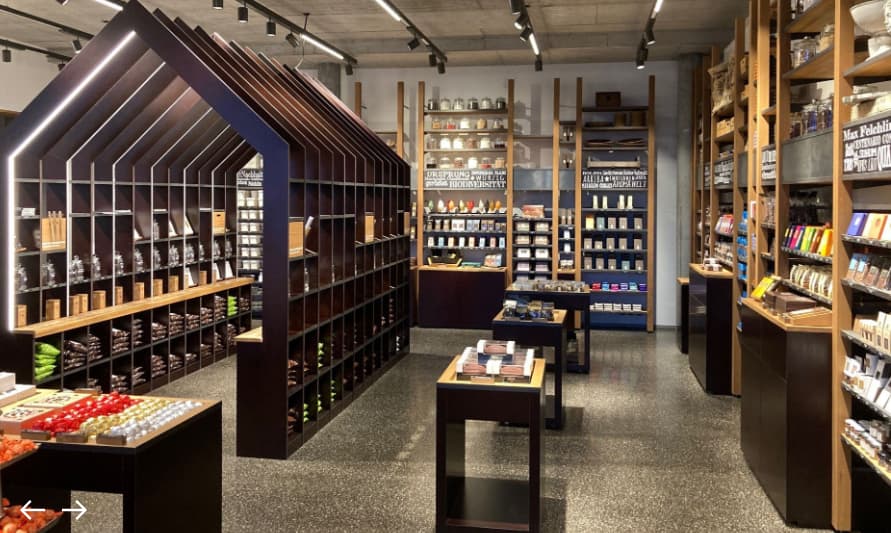
I’ll have to pay them a visit.
3 Likes
Yes I understood that as well. So is it more eco-friendly to produce sugar syrup in the African countries and ship it all around the world instead of using local sugar and finish the product locally? The article already hinted that it won’t be too economical anyway…
From the environment’s point of view that’s not waste, that’s just natural biomass that feeds the ecosystem. Processing it industrially would produce more waste - CO2 from burning fossil fuels for transport, chemical byproducts, etc.
I’m not saying it can’t be an interesting option - I’m sure the industrials will do their numbers, it’s just that I find it hard to believe in eco-friendly claims that involve more industrial processes… Particularly when they would be carried out across continents in 3rd world countries that heavily rely on fossil fuels…
2 Likes
Also, depending on what happens with the “waste” so far, this innovation could deplete the soils even more if some used to be used as compost or similar.
1 Like
I think ultimately we are both saying the same thing from a different angle. I think it wont work (maybe a niche, high end producer might use it as a differentiator) as the bulk of the manufacturers will continue using cheap, subsidized sugar. You are challenging it from a eco-friendly point of view and I tend to agree.
2 Likes
Right now I remember Choba Choba (in Peru) but I’m sure there are more.
1 Like
Not heard of it, will try them. But at Fr. 2.20/100g something tells me, the southern cocoa producers are still not earning more.
I guess they can afford to be be less greedy since they’re part of a much bigger organisation that is already highly profitable. Anyway if you try Halba, I recommend their milk chocolate with orange if you like that sort of thing.
The problem is that one can’t gauge how much of the retailer price trickles down as $ for the farmer. As I mentioned, producers (with a few small exceptions) use traders to source cocoa and the commodity trading business is by definition most easily described by rape the producer (cocoa farmer in this case) and squeeze the customer (the chocolate manufacturers)
1 Like
Read their measures (under Policies), they actually mention how much they pay and how that’s determined. I find their transparency impressive, that alone is promising and probably reliable given how much Coop has to lose if they lied.
While generally appropriate, it looks like your mistrust is misplaced in this case.
1 Like
That’s fair, I didn’t actually read this. I take your word, but out of curiosity I’ll read it later.
Edit: quite an impressive level of transparency, Halba/Coop is something I haven’t even thought to be as open as they are. Thanks @Roxi, now I’ll have to gorge on Halba over the weekend for research purposes! 
In all fairness, I didn’t see how much of the margin trickles down to the farmer, I saw them pledging and gradually covering more countries in which they will ensure a fair income, which is undeniably a good start.
In an “ideal world” the producer of such a rare and valuable commodity should be able to reap most of the benefits, however in the case of cocoa, the pyramid is upside down.
They mention that in their “Massnahmenplan Existenzsichernde Einkommen”. How much they pay is determined together with Fairtrade International, $2120 as of 2020 (for the area it got applied to at that time). That translates to $2120 per tonne cocoa beans, Hansa pledges to keep paying a price that secures livelihood.
For reference, the price with delivery New York (i.e. including transport, duty, quality control, and whatever else may be necessary) was in the order of $2500 per tonne in recent years (equivalent for London). But due to bad harvests in recent years stockpiles are depleted and prices have skyrocketed this year, $10’000 was recently surpassed for the first time ever.
You might think that current market prices should be what they get paid, but in that case you’d also need to remove the guaranteed minimum and other advantages like interest-free prefinance, education, the building of additional income streams by produce diversification, etc. Careful what you wish for, you might get it - in this case the status quo ante.
That’s the price the supplier is paid.
Fair Trade is better than nothing but it contains no minimum wage requirements, only that child labour is not used.
There isn’t a morally good reason why all chocolate in Switzerland isn’t Fair Trade.
Shame on Lindt.
2 Likes
I think Fairtrade sets a country specific “living wage” standard, its not only child labor. For me, personally, this is the first step in the right direction and is absolutely necessary, BUT, I hope and believe the next step is for the farmers to start to reap the real benefits from the high-value, rare and increasingly harder to produce commodity, that is cocoa.
There’s a minimum price for the cocoa beans paid to farmers but not a minimum wage.
I have not looked for any data to see if there is a correlation between fair trade cocoa and workers wages.
They do other good stuff though:
- Fairtrade cocoa farmers are paid a Fairtrade Minimum Price for their goods, which acts as a safeguard when market prices drop. Organic production is incentivized with a higher Minimum Price.
- On top of the Minimum Price, farmer organizations also receive a Fairtrade Premium which they invest in projects of their choice. Many farmers have used the Premium to improve their businesses and production, replacing old trees and investing in better facilities for crop collection, storage and transport, or processing.
- The confectionary industry is highly consolidated, and Fairtrade works with key industry players to enable them to source large volumes of sustainably produced cocoa. More sales mean more benefits for farmers.
- Fairtrade is also pushing the envelope to establish living incomes for small-scale farmers. If we want cocoa in the future, cocoa farmers need to earn a decent and viable living from their work.
- By supporting smallholder farmers to organize themselves into small producer organizations – such as cooperatives and associations – farmers can negotiate better terms of trade and reach wider markets.
Maybe you should have informed yourself before speaking. Just maybe.
In all fairness, yourself Tom and myself are on the same page on the overall problem and on the fact that Fairtrade is the right approach and that more needs to be done. I don’t think anyone was criticizing Fairtrade or accusing them of anything.