Zurich started wanting advance payments of tax at least 15 years ago, sure other cantons do to,
1 Like
1 Like
It seems professional journalism supported by fact-checking stroke here.
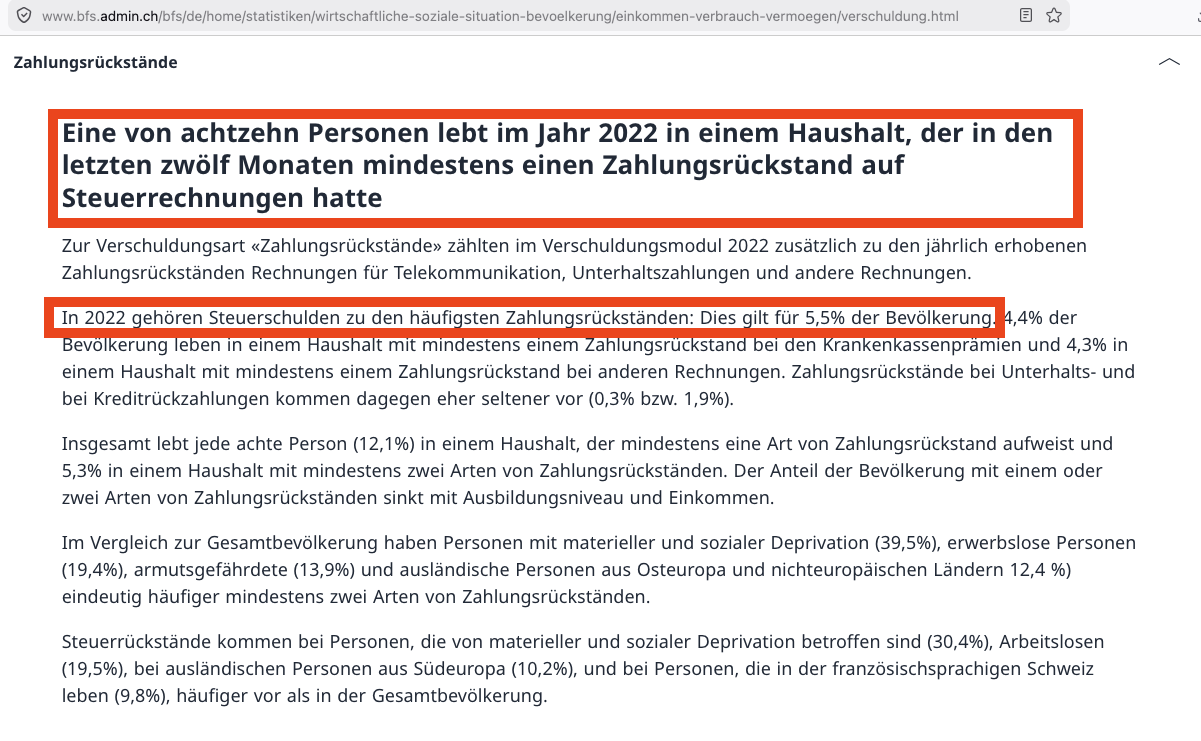
Someone added 5.5 +4.4 when it’s only 5.5%. Well, that’s the number.
EDIT: the last paragraph, about that people with enough money to pay but choose not to…

Did you fact-check 
1 Like
You got me on that one haha I suspend my disbelief and trust in Deloitte junior consultants.
Well, those average or median wealth numbers are completely biased by non-liquid assets: real estate and 2nd/3rd pillar retirement savings. Asset-rich but cash-poor is a rather frequent situation if not careful enough.
1 Like
Tax payment varies hugely by canton/gemeinde. Only when we moved from BS to OW in around 2007 did we realise just how ‘generous’ the Basel regime was at that time. In Basel we still owed for the tax year of 2005, which was payable at some point in 2006 (but we were overdue) but in Engelberg we suddenly found ourselves needing to pay the full amount for 2006 as well, plus payment in advance for 2007, all within the sace of about three months. And just when we’d put down chf125000 as a deposit on our first Swiss property.
(details may be inaccurate, but something like that. The fact was that our acounts all went down to almost zero, were only saved by an annual bonus payment in April).
Now, here in Valais, we’re expected to pay quarterly during the year, based on the previous year’s values.
So I’ve no idea what BS is like these days, but don’t be too keen to complain about it - it may still be better than elsewhere, certainly if you’re only paying 10% witholding tax it sounds like it’s better than here.
1 Like
Both the canton of Zurich and the Canton of Bern are very much not left leaning. The cities are, the Cantons are not.
The problem is that you don’t help those people by making them even more dependent on the state. It’s a self responsibility to manage ones finances or to get screwed over - many things work like that in life - a little darwinism forces people to be on their feet and think a bit, instead of running on auto pilot. The overall benefit of society is still larger I’d argue.
Sure, but we usually structure our policies around the concept of “self responsibility” or “Eigenverantwortung” in German. This is the opposite of that. Opt in would be fine, opt out is the state reaching where it has no business to, imho.
This is true, but I have a feeling it won’t.
Most of your posts seem to be accidentally advocating for this, though, but you don’t seem to be aware of it.
I know a couple of people who’ve held very high-paying pharma jobs in BS for 20 years, got laid off at 55-60 and are now seriously out of money, trying to bridge to pension. Yet the watches, cars and big houses are the telltale signs of bad management.
Most people are no better than a toddler when it comes to money, you tell the toddler “I will give you one piece of candy today, or three tomorrow, what do you prefer?”, they invariably go for CANDY NOW!
1 Like
if I may put in my CHF 0.02’s worth, these high earners have also to meet and continue expectations of ‘peers’. That is not a cheap proposition (e.g. how often does one see C-level leaders looking like someone off the street?). Swiss tax rates are progressive.
Being asset rich, cash poor does not help. But living off ‘credit’ is also recommended by many financial planners.
And yes, money management smarts are prudent for everyone.
1 Like
You remind me a lawyer friend of mine had a lifelong dream of getting a Rolex, he used his first few salaries to get one (back 20 years ago when an “entry-level” Rolex could be had by walking into a shop, and cost 5,000 EUR). He doesn’t wear it anymore for ages, however says he does wear it whenever he meets clients in person, says it’s good for business. It may indeed be good for business!
Was an article in 20Minuten a couple of days back
Do you believe these numbers? Based on their methodology I have high doubt. Not suitable to be used in a serious discussion.
While this does exist, in the mean it’s ofc nonsense… the main tool to buold wealth is your income and people with higher incomes also tend to have more wealth.
But on a different note, being house poor is the worst thing I can immagine. Tying up 7 figures in a house, while having 0 savings is the classic middle class trap. Funnily enough, real estate seems to work very well for normal people, as it forces them to save.
I haven’t seen you post anything to disprove it.
More often than you think. Real wealth is invisible, unless we’re talking about hecta-millionaires. A deca millionaire in Switzerland might just own a house on a lake and live like a normal person.
In Switzerland, this can make sense (if the interest is very low), but soon we’ll lose the ability to deduct debt.
I feel like that’s a myth… how many people care about watches, even among wealthy people, it’s a very tiny percentage. Many people think they need to get watches, golf, sail, etc. when in reality, you just need to spend less 
When we moved here here (a billion years ago) I spent the first months in shock - sticker and cardio  - at the difference between Swiss and Chicago prices. One day I was at the Coop, shopping cart liberally sprinkled with Prix Garantee products to help ease the pain, when I ran into the wife of a colleague of my husband’s. She looked at my cart in horror and warned me that shopping for discounts was frowned upon, reflected badly on my husband and his company. Apparently I should buy only the expensive brand names…
Whiskey Tango Foxtrot?
By the bye, the comment that one makes so much more in Switzerland than in other countries does not necessarily hold true, especially for folks seconded here on short term (so called expat) assignments. The principle at OH’s company was that the employee neither loses or gains from the assignment, compensation is based on a theoretical COLA from your home country. Unfortunately for many, the US COLA was based on NYC not Chicago or Tennesee or Texas or North Carolina. So everyone coming here from outside NYC actually ended up taking a haircut.
Just sayin’.
1 Like
See comment on Prix Garantie if you think it’s a myth. The higher the ladder one is the more shallow assholes they encounter, who wouldn’t be caught dead using anything other than Gucci toilet paper. Appearance and image matter a lot in several environments. “He rolled up in a Range Rover and wears a Rolex so he’s probably a good lawyer”. Sounds and IS stupid, but can also be true at the same time. Edit: I’ve known idiotic people who won’t go to a pharmacy or Dr’s office unless they look good, I tried explaining that the science doesn’t need to look good to be good science, to no avail.
Aren’t you contradicting yourself here? The main tool to build wealth is saving and investing (edit: which you do agree with by the “need to spend less” comment), otherwise anything can be spent away, no matter the income. Just look at actors, musicians and sportspeople who’ve pissed away tens/hundreds of millions.
From my point of view, buying a house was one of the best things we did. Versus frittering away dead rent every month? Err.. no thanks. Not going back to that.
2 Likes
The issue here is overestimating the ability to pay the debt.
Asset-rich but cash-poor is a vulnerable position, it may even be a risk for the “safe asset” the house.
EDIT: I had the time to find an article from earlier this year. People who own and inhabit their property, but depend on Supplementary Benefits from AHV or health insurance subsidies by the canton, are at risk because of rising property prices.
Plenty of cases of millionaires in paper that got AHV supplementary benefits until one day they didn’t. Having a house is nice. But we don’t eat floors or balcony railings, also we don’t pay health insurance with a wall or 1 m2 of the garden.
2 Likes