Fully agree. I will definitely vote No. A married couple should be able to choose whether they are taxed together or apart.
1 Like
Is there a choice?
I thought the only choice was to get married, not how you’re taxed?
Is taxing couples with different income more beneficial for kids?
And where else in Europe parents should pay 2500 for Krippe?
Not at the moment. But it was one of the proposals.
1 Like
Then that would work better.
Given that most families can no longer survive on a single wage, it’s a bit of a gut punch when you are working and you have to pay more tax just because you’re married.
I guess it works for a SAHM/F, so would be good to choose that you get taxed accordingly.
There is.
No marriage tax penalty in the canton I live with a B permit. If we apply for C, our tax situation changes. I would get a lower car insurance price and maybe some other perks but…not worth it.
1 Like
I’d certainly go for a choice, but that isn’t on the table.
No only. The bigger the difference in income, the more chances that the couple will be paying more taxes if the new law passes.
Digging into it a bit deeper, though, it seems there will be an overhaul of the rate tables and deductible criteria as well as allowances for children, etc. Probably will vary from canton to canton, too.
I read that somewhere, but the math was not clear.
Below 15k annual the income tax is zero, a bit higher in some cantons.
Around 50-60k the difference to the average income (~80k) is not that much. Of course, the difference to a 150k annual income would be large, but is a household with 200k annual disadvantaged?
So, the problem seems to be between 15-20k and 50k annual income for the 2nd earner, right? Statistically, how many marriages out there with the precise combination of incomes to make it worse that today?
Yes, but they will be split between spouses.
To me the solution is that instead of marriage being the determining factor for joint taxation, it should be children. Encourages both marriage and supports families. Win-win.
I wonder if they’ll need to rethink AHV pension for married couples as a if this passes too and remove the cap of 150%. The bigger concern will by that time will probably be who is going to pay for AHV pension if fertility rates continue to fall as they are.
What a rubbish. Compare that to traditional devoted religious society where breaking marriage was a social suicide. Which children could have better outcome, those living with single parent after marriage breakup, or those living in a house at permanent war or at best witnessing cold indifference and neglect instead of the warmth of a family. I don’t have to read an AI slop to have my own opinion.
Luckily in Switzerland, marriage is totally optional, divorce socially accepted, I don’t see any problem. I see people would like to retain tax advantage of two singles and benefit from law protection of a married couple (mainly insurance, inheritance) but it’s like “I want to have a cake and eat it”
3 Likes
You can call it AI slop, but AI gives references to all sources. Like I said, almost every study on this matter concludes that the children of married couples have better than the children of unmarried couples. And yes, that includes cohabiting couples. Facts don’t care about feelings etc.
That’s not to say that the child’s outcome is predetermined by the parent’s situation. In the same way that smoking 20 a day does not mean you will definitely contract lung cancer one day.
Have better what?
And when you say ‘almost every study’, what about the others?
This is what Perplexity has to say:
Children of married couples tend to experience better outcomes in areas like cognitive development, emotional well-being, and socioeconomic stability compared to children of unmarried couples, including single-parent or cohabiting families. However, these advantages often diminish or disappear when accounting for factors such as parental education, income, and relationship stability
What an odd comparison.
It’s not rocket science to figure out that children of married parents who hate each other’s guts but stay together because they ‘believe’ in marriage, are likely to be messed up kids, compared to kids of unmarried parents who are stable, loving and respectful.
Marriage is an irrelevant detail, it’s how the parents respect and support each other that is relevant to children’s outcomes, not a bit of paper and a ring on the finger.
4 Likes
What a rubbish, that’s folks reasoning and not science.
Janet Yellen’s (yes, the former FED chairwoman) wrote a data backed paper on demise of shotgun marriages and increase of out wedlock children (and how abortion and the pill helped change the social norms and expectations that left women worse off).
Basically men are trained now to profit from free sex with no strings attached, no babies to take care of. Kind of suboptimal for children whose suport is shouldered by their mothers only.
Diploma in ‘Unable-to-keep-it-in-your-pants’? 
This is the capitalist model. Men pay for sex, there is no real difference between in or outside of marriage. Concepts like love, sharing and commitment are dangerous socialist ideas.
Opinion piece from the NZZ today. After some estimates, married couples without children (under 18YO) would pay lower taxes, high-income unmarried couples or single-earners with children would pay more taxes.
Figures are also available at the tax administration. They show who the big winners would be: primarily married retirees and in second childless married couples.
In terms of figures: Retired married couples make up only 15 percent of all taxpayers. However, they account for 36 percent of the total discharge (245 out of 625 million Swiss francs). It is similarly positive for double-earner couples without children, who are also disproportionately relieved: They account for 8 percent of all taxpayers, but are to receive 16 percent of the total relief.
Things are different with families. Double earners with children would also be relieved on average, but not as disproportionate as pensioners and childless people. Clearly negative, however, is the balance sheet for the families of well-earning unmarried people and single-earner pairs, in which a partner more or less achieves the entire income alone: According to the estimates of the federal government, they must expect an average tax increase.
Back to politics, the NZZ opinion implies but does not put upfront demographics. The numbers from Swiss Federal Statistics Office are the following. It is not known if the couples living together are married or not, but there are more couples without children under 25YO than couples with children under 25 YO.
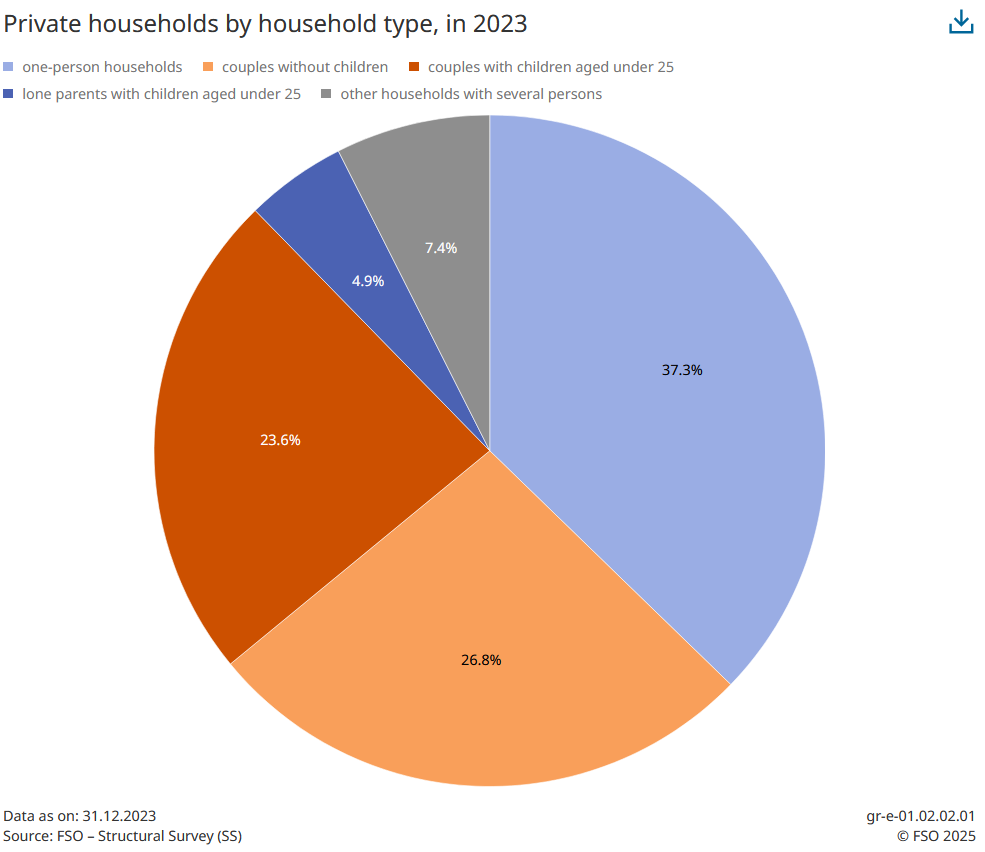
The expectation is that married and unmarried couples without children support individual taxation (26.8%), either because they’re married or because the. Among the couples with children under 25YO, some of them are married, others not. There are no public statistics about this, but there are some estimates around 40% of couples with children being unmarried.
Thus, half of the couples with children may be motivated vote yes and the other half no based on current conditions. That leaves only a minority of voters with an incentive to vote no.Will the people that will pay lower taxes think about unmarried couples with children or think only about their own gains? We’ll see on March 8.