Are children from unmarried couples statistically more likely to have worse outcomes than children from married couples? Use data from Switzerland, USA and UK?
Yes, statistical evidence from the United States, United Kingdom, and to a lesser extent Switzerland indicates that children from unmarried couples (including cohabiting parents or single-parent setups often linked to unmarried births) generally experience worse outcomes compared to those from married couples. These outcomes span cognitive development, socio-emotional well-being, poverty risk, family stability, and perinatal health. Differences often persist even after controlling for factors like parental education, income, and age, though selection effects (e.g., married parents tending to have higher socioeconomic status) explain part of the gap.
United States
In the USA, about 65% of children live with two married parents, while roughly 5% live with two unmarried (cohabiting) parents, and the rest are in single-parent or other arrangements (U.S. Census Bureau data, 2022). Children born to or raised by unmarried parents face higher risks:
Cohabiting unions are significantly less stable → children born to cohabiting parents are over 50% more likely to experience parental breakup by age 9 compared to those born to married parents.
Family instability links to poorer cognitive, behavioral, and emotional outcomes → studies (e.g., Fragile Families and Child Wellbeing Study) show children of unmarried parents (cohabiting or single) have lower cognitive scores and higher behavioral problems, even when parents cohabit.
Poverty and economic well-being are worse → unmarried parent families (especially single mothers) have higher poverty rates, contributing to disadvantages in education and health.
Multiple reviews (e.g., from PMC/NIH sources) conclude that children with married biological parents consistently show better physical, emotional, and academic well-being than those in cohabiting or single-parent families.
United Kingdom
In the UK, around 63% of dependent children live in married couple families, 15-16% in cohabiting couple families, and 21% in lone-parent families (ONS data, recent years). Cohabitation has grown rapidly, but outcomes differ markedly:
Relationship stability is lower → cohabiting parents split at much higher rates (e.g., nearly 1 in 2 cohabiting parents separate before child’s fifth birthday vs. 1 in 12 for married parents).
This instability drives poorer child outcomes → Institute for Fiscal Studies research using cohorts like Millennium Cohort Study finds children born to cohabiting parents have lower cognitive and socio-emotional development at ages 3-5 compared to those born to married parents, with gaps partly but not fully explained by parental characteristics.
Poverty risks are higher → children in lone-parent families (often from unmarried breakdowns) face relative poverty rates around 49% after housing costs vs. 25% in two-parent (married or cohabiting) families.
Overall, family breakdown (disproportionately from cohabiting unions) links to negative educational, emotional, and economic outcomes for children.
Switzerland
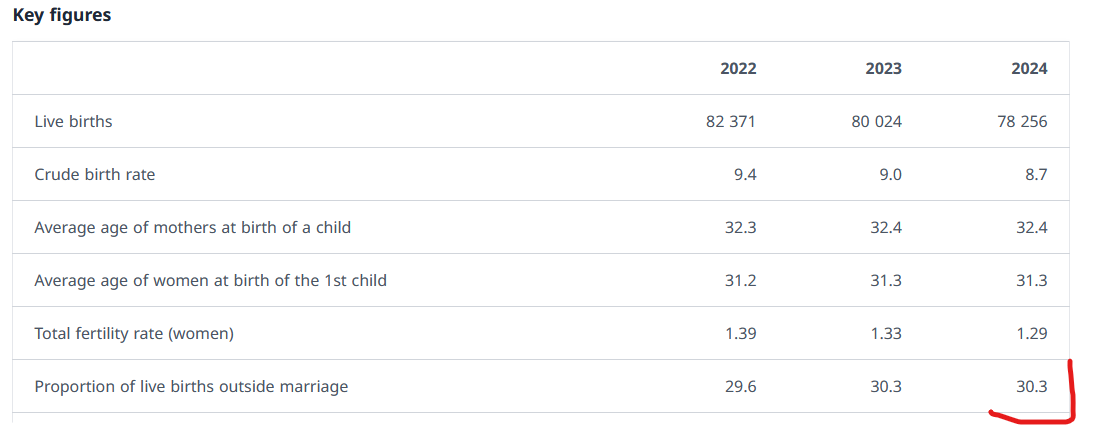
Data on Switzerland is more limited, with fewer direct comparisons of long-term child outcomes by marital status. Switzerland has low rates of cohabitation with children and out-of-wedlock births compared to the USA/UK (most children live with both parents, often married; ~13% in lone-parent and 6% in stepfamilies per Federal Statistical Office).
Perinatal outcomes show risks → children of unmarried mothers have higher odds of low birth weight, prematurity, and infant mortality, even after adjustments (study of 2011-2017 births).
Broader well-being indicators are scarce → but low cohabitation rates among parents and cultural norms favoring marriage suggest smaller gaps. OECD data places Switzerland among countries where most children with two parents have married ones, with cohabiting two-parent families rare (<10%).
In summary, across these countries, marriage associates with greater family stability and better average child outcomes than unmarried arrangements (particularly cohabitation, which often resembles single parenthood in instability). The strongest evidence comes from the USA and UK, where cohabitation is more common and studied; in Switzerland, the pattern holds for health outcomes but with less pronounced differences due to lower prevalence of unmarried parenting. These findings draw from census data, cohort studies, and reviews, accounting for confounding factors where possible.