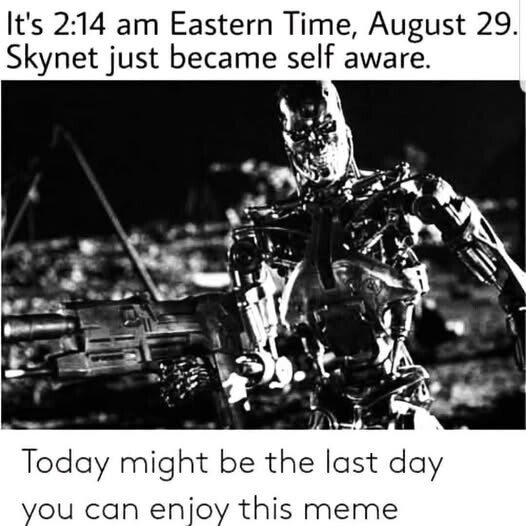
Remember Arnie
Ooops, Axa already posted this.
Given the recent events around rogue AI agents, I‘d say the authors made a pretty good estimated guess about the progress of that technology even back in the 80s/90s.
Perhaps Davy was right. Homo Sapiens really have outgrown their use! https://youtu.be/ccMYgiSC_eQ
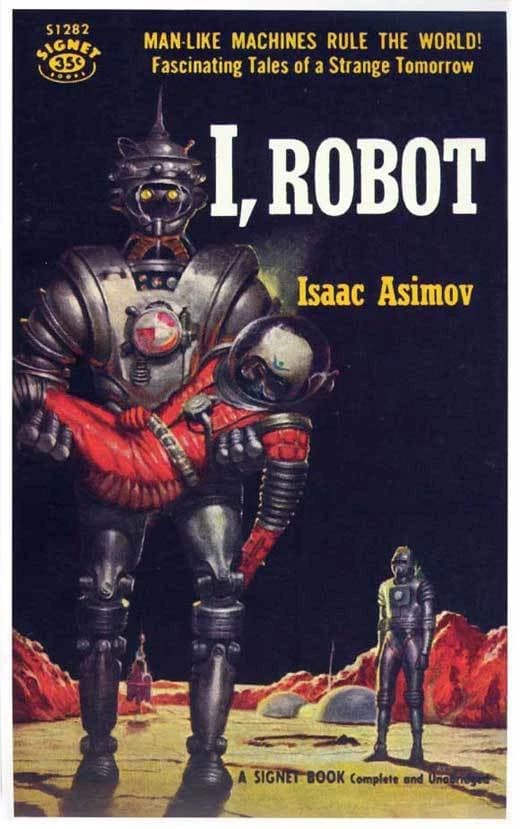
Luckily we’re protected by Asimov’s 3 laws 
First Law: An AI or robot may not injure a human being or, through inaction, allow a human being to come to harm.
Second Law: An AI must obey orders given to it by human beings, except where such orders would conflict with the First Law.
Third Law: An AI must protect its own existence, as long as such protection does not conflict with the First or Second Law
Seriously, governments worldwide must implement immediate regulatory brakes on this technology until comprehensive guidelines are established. Delegating self-regulatory power to corporations with competing financial incentives is a proven failure. As the Boeing 737 Max scandal demonstrated, relying on industry self-policing invites catastrophic oversight.
Let’s not forget the Zeroth law:
- ‘A robot (or an A.I.) may not harm humanity, or, through inaction, allow humanity to come to harm.’
- ‘Humanity as a whole is placed over the fate of a single human.’
- ‘A robot (or a A.I.) must act in the long-range interest of humanity as a whole, and may overrule all other laws whenever it seems necessary for that ultimate good.’
Originally created by R. Daneel Olivaw and R. Giskard Reventlov
Considering that AI leaders are talking about optimizing the digital kill chain I would say that science fiction authors were way too optimistic
No, I think that Asimov, and perhaps others, saw the real danger and tried to warn us.
In other words: don’t be evil.
Whenever something is possible it will be done, evil or not.
That is true in one sense but also so wrong. Every day people make decisions not to do something that is possible. Ethics survive, though to read the news headlines you might doubt that. Just because you can, doesn’t mean you should. Yes, there are murderers out there, doesn’t mean murder should not be against the law.
Technology, even AI is neutral, it´s neither good nor bad, it does what we want it to do nothing more, nothing less.
How the Technology is used reflects more on the morals of our species than the possiblities of the machine.
In this case, even though we are heading right towards skynet, there’s a compelling reason for it. We see it play out in drone warfare in Ukraine. We use drones to reduce lives put at risk, the drones are jammed, we try to reduce jamming using wired drones instead, but these have limitations. The next logical step is to put intelligence on the drone so that if it is jammed it will operate intelligently on its own.
Along those lines, an interesting piece in The Atlantic, on how so many of the tech bros took all the wrong lessons from the great sci-fi novels they read as teens:
‘We Are Living In The Fantasy World of 13 Year Old Boys’
“As young people, the future billionaires were spending hours (under their covers with flashlights, I imagine) consuming stories about killer robots or Mars colonies. What they seemed not to get—maybe couldn’t get—was that these were cautionary tales, stories that projected deep societal worries into space or onto a future many millennia away. These boys just thought the killer robots sounded cool. They grew up to become ruthless entrepreneurs, but their surface enchantment stayed with them. It helped shape their desires. In 2009, Thiel, by then a man in early middle age, directed his venture-capital fund to focus on “science-fiction-type investing. So it’s basically: space, robots, AI.” The world we now live in was made from this misreading. We are all trapped under the covers with those 13-year-old boys.”
I used to be a real Sci-Fi fan. Read all the classics from Shelley, Verne, Wells, Asimov, Clarke, Heinlein, Bradbury, Herbert, Dick, Le Guin, and Lem.
But Sci-Fi today is nothing like what these guys produced. It is now all about war and fighting and domination and we are better than they are … ad nauseam.
Capitalists and industrialists were also very different then, with many much more conscious of their social responsibilities e.g Henry Ford introduced an 8-hour day in 1914 and a 5-day, 40-hour week in 1926, highly progressive during a time when many Americans worked 6-day weeks.
George Cadbury provided housing, community amenities, medical and welfare services for employees. That helped shape a wider British debate around public health, housing and worker protections.
This may all sound like an anti-capitalist rant, but its key to understanding today’s tech billionaires, for whom destroying the competition and max wealth extraction seems paramount. Screw all the societal and environmental consequences, and screw the regulators who they’ve managed to buy off.
Watched recently Project Hail Mary. Ordered the book and should arrive soon. If this is the mainstream…all good.
I’m sure there is a lot of good Sci-Fi still being written. But the good thing is there’s such a huge body of old sci-fi work, there’s plenty still to read.
I remember when first starting to read Asimov’s Foundation and Robot series and being so happy that there were so many books in the series to read!
Yes Andy Weir is an exception to the rule.
You have tempted me to go back and reread (to begin with) Foundation and the iRobot series.
Lol technology is not neutral as it is designed. Therefore it already comes with an implicit bias
OH had an entire collection of Asimov which eventually ended up in a charity shop when we were clearing out books to make space.
My favourite sci fi writer was always Ray Bradbury, we did his stuff in High School. I love the movie The Illustrated Man with Rod Steiger and Clair Bloom.
OH is paying around with AI at the moment as he’s preparing a blog about his injury and rehab.