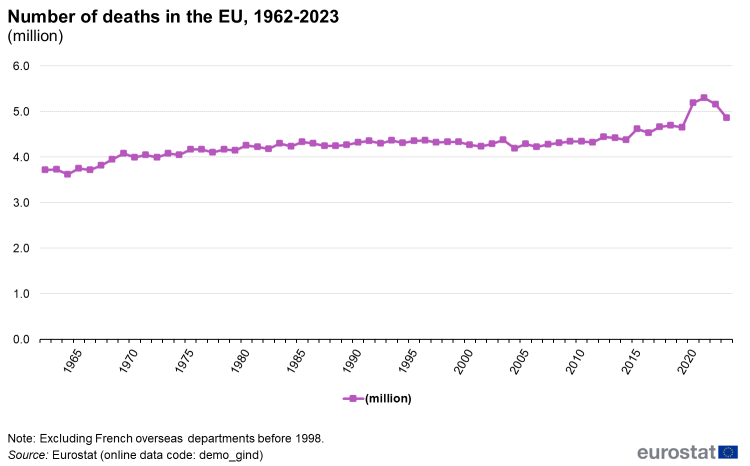
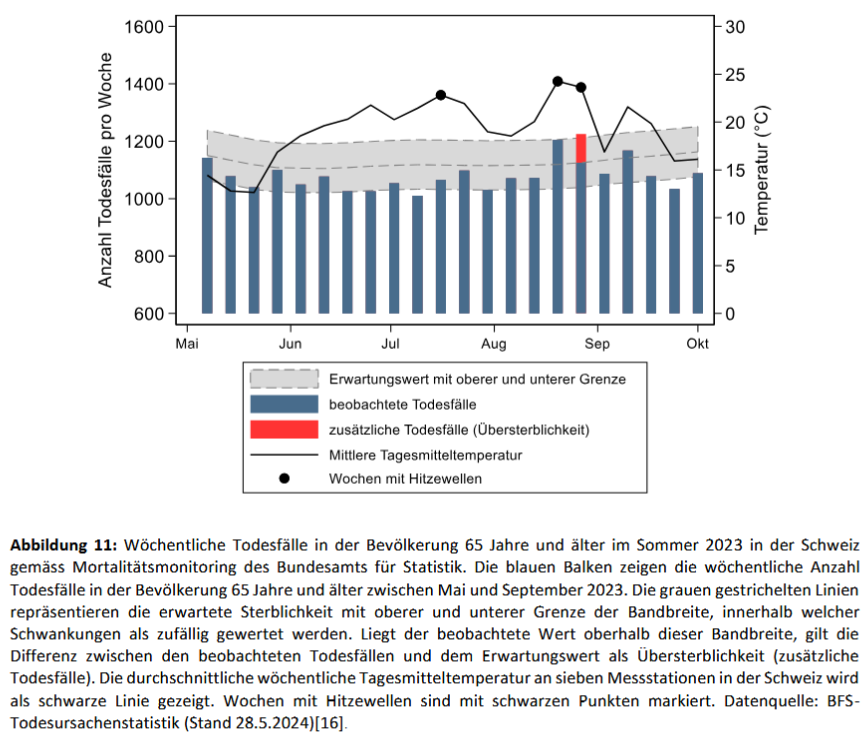
Switzerland has good numbers: Hitzebedingte Sterblichkeit. This is a report for summer 2023 which may have induced excess mortality on 75+ YO.
This graph from the Swiss report shows how the deaths related to heat are estimates. A similar number of people dies every week of the year, with a slightly higher average on winter (respiratory diseases). During Spring and Summer weekly deaths fall unless there’s a heatwave where peaks of weakly deaths occur. Of course, it’s only a correlation. Have a drink someone says “correlation is not causation”. From the Swiss numbers from summer 2023 (550 deaths attributed to heatwaves) and around 70k deaths per year, heatwaves are correlated to 0.8% of annual deaths.
Maybe the guestimate of 175k annual deaths due to heath in Europe is too high. Extrapolating Swiss numbers to Europe gives 50k annual deaths. Lower, anyway relevant numbers. Maybe elders are killed by heat too in hotter countries, but harder to measure it without robust data gathering and stats.
Of course, the death cause is open to discussion. There’s a reason the population above 75 YO is more vulnerable to heatwaves: circulatory disease, thyroid issues, and a litany of diseases. Anyway, there’s a reason people with circulatory disease dies more during a hot summer day than during a nice Autumn day.
They clearly are a lot compared to other regions, that’s the point of contention. Your all-cause mortality is neither here nor there, that’s just vapid whataboutism.
The EU meanwhile says 2700 deaths annually, they couldn’t negate the WHO’s nonsense any clearer. Moreover, the majority of them are due to cold according to the Graun.
Average annual temperatures in central Europe are low compared to other places. It’s normal to have -15 in winter and 35+ °C summer, albeit only a few days. While human bodies have the adaption to heat written in genes, said adaptation needs to be awaken by exposure to heat to be functional. Our urban lives contribute with little to nothing to adapt to heat. One day a 35+°C day arrives and catches us unprepared.
From a certain perspective, the nice and temperate weather of central Europe makes people vulnerable to heat waves. People in warmer countries are exposed to heat all-year round. Regardless of their will or intentions, their bodies are adapted to higher temps because there are a lot very hot days per year (not so nice weather).
Well, 35°C from next Sunday to Wednesday. Take care everyone. It’s not a lot, but without physical adaption and proper habits, it may be deadly. Cars are ovens.
This week I suffered what was probably the in-between line between heat-exhaustion and heatstroke.
On Sunday, I stupidly cycled for three hours, hard in the mountains, and then spent most of the afternoon in the sun in the garden doing a few jobs.
I slept badly in a very hot bedroom too.
On Monday morning I felt fine but as the morning went on I felt a bit feverish so went home at lunchtime (by bike) and I should have been sweating profusely but my skin was totally dry and I had been shivering on the bike (in 32.C).
My pulse was way up too (120 rather than the normal 50-60) and my skin was red.
I knew then it was the heat and not a virus so I got in the cold shower (not nice when you are already shivering) and then lay down with wet towels over me where I stayed for the next eight hours (with a few more showers and lots of cold water with isotonic powder). My temperature only went up to 39.
After a fever all night, and a cool shower every hour or so, I felt much better this afternoon.
For those that don’t know, heatstroke is when the body cannot regulate it’s temperature anymore (sweating stops for example) and full-blown heatstroke (40’C, confusion etc) requires immediate medical attention as it can be fatal.
The problem is not so much the heat on its own, in fact humans can manage high temps without much trouble.
Problem is that here we revolve arounf a 9:00-17:00 workday, perhaps a four hour siesta would help. But the biggest problem is this heat bulb phenomenon where the heat and humidity mitigates our ability to sweat.
That us when people atar dying.
The other evening before bed, I stuck my feet in a shallow plastic bin filled with cold water and ice. Heaven! And I slept very well, despite the warm night.
European life expectancy is some 4 or 5 years longer than the US, also (partially as a consequence, partially due ot our lower birth rate) our average age is some 5 years older. Which means we have proportionately more old people therefore more heat deaths would be expected. Americans get their heart attacks earlier from other causes.
As a roving tech-weenie I find that freezing those sqishy bottles of fizzy water with some kind of juice is great.
A little thing I learned on Malta, it keeps frozen for a long time and is ice cold when you need it.
I used to do that for OH when he had to go out on the build site in Dubai at 100 degrees. Also in the little cooler was a supply of wet terrycloth towels that had been frozen. Drape one around your neck…they don’t last long, but they give instant relief.