Bees & Swarming --- It is that time of the year again

Yes, it is that time of the year, when bees swarm.
Probably nobody will have to face a swarm on their hedge, or on their bicycle, or hanging from the balcony rail, but, if you do, do NOT panic; bees are absolutely not interested in you.
Why? because they are, like many youngsters in March 30 (or June 30, or September 30), moving out of their flat, to a new one.
Yes, really.
So they are just following the scouts (and their queen) to their new house, and making a ‘quick-pit stop’ in-between.
If you see a swarm of bees, you have 3 options:
(1) if it is in Zurich or Zug, call me! :slight_smile: ,
(2) call the firefighters. They will come and remove the swarm for you -for free.
(3) if you have a beekeeper friend, call him/her; he will be very happy to come and pick up the bees.
In any case (1,2,3), seeing the operation of swarm removal is, on itself, an adventure. And the whole reason why the bees are swarming, and what happens next, is a real story that dwarfs game of thrones.

Two years ago, I retrieved 18 swarms in about 2 months (from mid april, to mid june). Last year there were no swarms, so this year is meant to be a good one also…

Help nature reproduce! And if you want to know more, I will be happy to post further info. (For example, did you know that the colony sends ‘scouts’ to look for suitable housing weeks in advance, and that the scouts determine suitable locations with a strict set of criteria (distance, orientation, height), and actually even measure the volume of the potential hive…?

And for the ones who have never milked a cow, picked up potatoes, or refuse to leave paved roads, this is how an ‘urban’ swarm looks
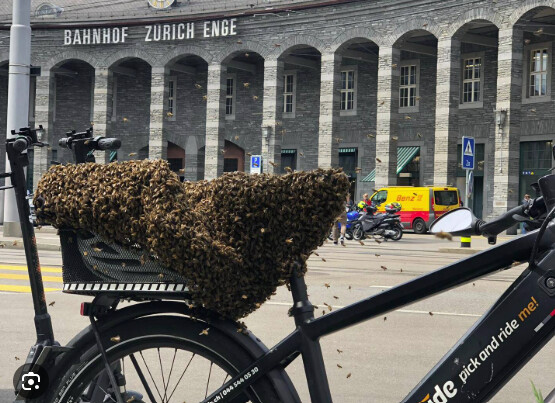
and this is how a swarm looks in nature…

14 Likes

Yes, please post more info! Any tips on specific planting in the garden we could use to keep them happy?

1 Like

The neighbours behind us had a swarm in their apple tree a few years ago and it was an incredible sight. They called the fire brigade who came along with a local beekeeper and they evacuated it safely.
It was fascinating to watch.

Wow! I would love to see that. By the way this year is projected to be a good one for the Maikäfer beetle, or cockchafer as I just found out.
They used to swarm in their bazillions, scooped up on snow shovels as cattlefeed or turned into Maikäfer soup, or bread.
So that is exciting.

We already have Maikäfer, picked out of the air by the sparrows, found squashed on the sidewalks, and sharking on my not-even-open-yet lilac blossoms. Normally we see the metallic green Rosenkäfer before the big brown Maikäfer, but this year has been different in so many ways. We have many species of native bees, bumble bees, and honey bees (and bee flies, the most interesting!), who are all visiting the last of the grape hyacinths, narcissus, and tulips.

1 Like

So… “The Bee Movie” was a lie?

BLECH!!! However, rich in protein for the birds that catch them and leave their carapaces on our walkways.

Don’t knock it until you have tried it.

Cockchafer?

:rofl:

2 Likes

@Slammer unfortunately, I odn’t have Netflix… but I am reading the argument… soooo woke! :smiley:

I checked, it’s in the dictionary!! :rofl:

My memories of them is that the boys liked to stuff them down our shirts on the way home from school.
And as far as I know they are very dislikable, they eat everything up similar to locusts, so go ahead slammer, put them in soup and bread, all you can eat.

1 Like

Yeah, sorry about that.
Or in beds.

Thanks for sharing. Just a couple of weeks ago, we took the kids to a bee-keeper for a short workshop on how they look after the bees. It was fascinating and there seems to be an endless amount to learn about bees.

1 Like

the last one… they can be easily trained (2 days) to detect explosives…
too bad the summer bees live only 3 weeks

We’ve had bees swarm in our garden on two separate occasions. The first time it happened, I reached out to our neighbor—a young man in his early twenties—who I knew had recently taken up beekeeping as a hobby. He was more than willing to come over and collect them. Noticing that he seemed a bit unsure in his movements, I asked if he was confident about what he was doing. He assured me that he was—after all, he’d watched a YouTube video on how to handle it.

1 Like

Wow, is every yellow box a bee box? Or boxes? That’s a lot!

Also, curious to see that bees are urban. Most boxes are next to houses, only a few in the forest. Is there a reason for this?

During the workshop we were told that most new amateur bee-keepers give up after a year or lose their bees and completely under-estimate how much work is involved.

I had to admit, I was the same. I just thought you stuck a hive there and just leave them to it.

1 Like

Thanks for the lengthy explanation :slight_smile:

Yesterday I watched, enthralled, as a massive bumblebee went to my pink and alba bleeding hearts (dicentra) and poked the top of each blossom (called a locket) in two places to suck out the nectar. She seemed to know just where to poke in, because she did it to each flower in the same spot, right at the curved top of the heart.

I keep reading the title as " Swearing — It is that time of the year again".

Oh f**k, I’ve been stung by a bee again!

2 Likes