Ok, I know I will regret this, but now I am interested.
I don’t know if you’ll regret it, but i am sure you won’t forget it…and there goes your ‘honey cravings’ 
Let’s start with the basics: Everybody knows what honey is, no?
(A) Spring honey, is the regurgitation of the flower nectar (i.e. puke) by the bees. – ok, ok, to clarify, bees have 2 different stomachs; one which is their ‘digestive system’, and one which stores, and transforms the nectar through enzymatic metabolization. But, like in humans -for other functions-, both stomachs share the same entrance.
(B) Summer honey is the regurgitation (i.e. puke) of tree-lice poo that has been eaten (on their enzymatic stomach) by the bees.
Now, If i still have here any more readers (or honeylovers) 
in order to lower the concentration of water, bees ‘pass the nectar’ from bee-to-bee, through their enzymatic stomachs, like in a human french kiss. You can see it in this photo. Honey Bees-Trophallaxis-Honey001.tif | THE HONEYBEE PHOTOGRAPHER - ERIC TOURNERET
It is called ‘Trophallaxis’ But, unless with humans’ french kisses, instead of being more humid, it is actually less – the bee’s tongues have a different structure than ours (obviously), and foster the evaporation of the water. The ‘receiver’ bee will keep on transforming the nectar on their enzymatic stomach, before she passes it to another bee…and that can happen 40, 60 or 100 times before the actual honey reaches the honey storage cell. How would you call that, a teenager’s petting orgy? the result? what the greeks used to call Ambrosia – ‘the drink of the gods’
Yet, I can tell you, there are even more gross foods that we eat on a daily basis
1 Like
Oh, that wasn’t so bad, only I seem to remember the description I read as a kid not that graphic.
1 Like
The story of the day today is the salvage attack by bees to passers-by that happened last weekend in s small village in France
Attaque d’abeilles à Aurillac : les trois ruches de la ville déplacées - ici
26 unsuspecting people stung (multiple times), and three of them who had to be carried to the hospital .
The question is ‘why’? ‘an official investigation has been started - particularly as the bees belong to the town hall!, but the bees, in any case, will be either euthanized, or moved away from the city-center-townhall location’.
The most plausible hypotheses is not the ‘Africanization’** of the bees, but an attack of the Asiatic wasp to the hive, which made the bees go into defend mode, and attack everything that moved around!
This same Asiatic wasp, which is now colonizing Switzerland. It was originally only in the cantons of Jura and Genf, but this year have reached already even Zurich and Central Switzerland. Last week Asiatic wasps were already found in Schwammedingen (Zurich) and Hunenberg (Zug).
And we are talking serious sht with these btches Des frelons asiatiques attaquent une ruche | National Geographic
(graphic content, viewer discrection is advised)
**see previous posts
1 Like
One of my many worst nightmares, one of those buggers in my mororbike helmet
1 Like
Is that worse than a lit cigarette end thrown out of a car window?
Far worse, had a wasp, just a normal freaking wasp fly in a few weeks back on the Autobahn, unable to stop that thing did a number on my face. And (quite) some years back I had a yuge hornet bounce off my helmet amd fall between Dick and tank.
Have you ever jumped off a moving motorbike, held onto the antlers and ran beside it untill it stopped?
I did.
1 Like
I remember seeing a video a few years ago of a few hornets destroying a hive.
Japanese bees developed a novel defense:
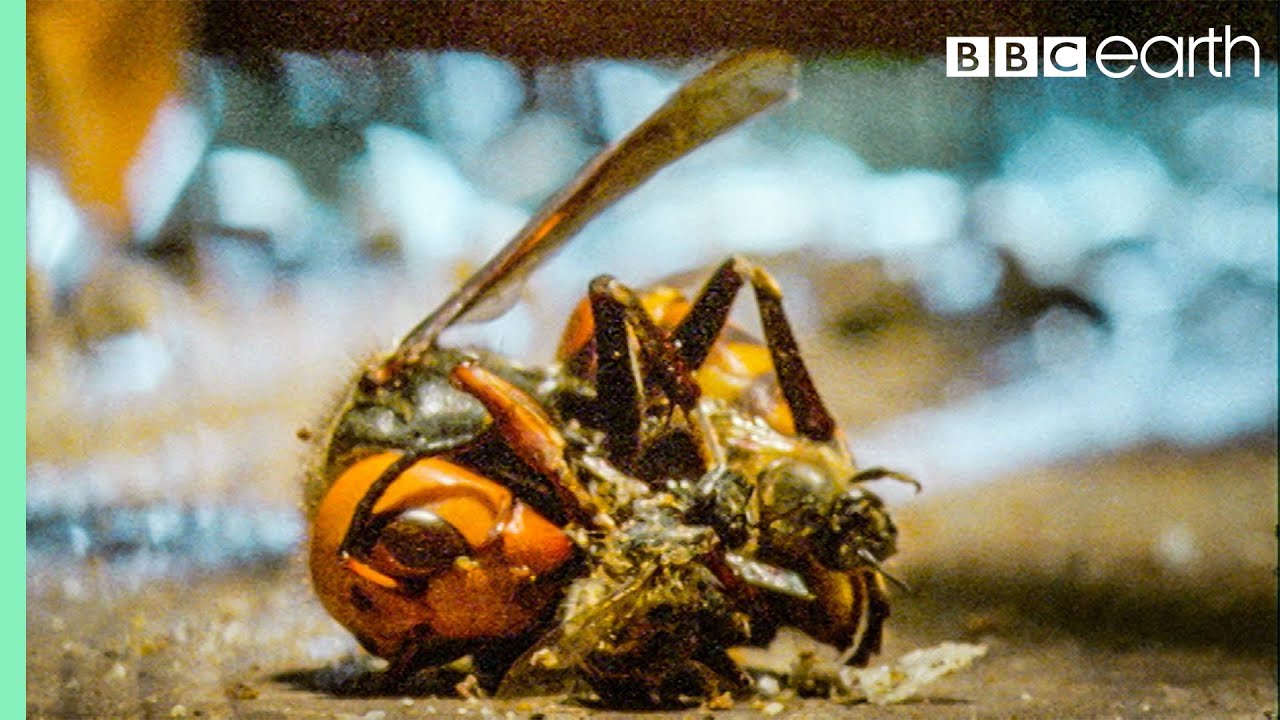
And ours hasn’t. That is why they are so deadly
geee! I was a biker myself, and, hats off! that’s really profi!
I asked the veterinarians of the Kanton, if it would be possible to import Japanese bees – they would ‘teach’ the behavior to our bees.
For the time being, I have just received ‘administrative silence’. I don’t know if it is because they are clueless, or they are stunt that the request came from a non-swiss beekeeper. Now that I think, i wonder if that request might be held against me on my naturalization process. "you don’t want to bring your elderly parents to the country, but you want to bring 30,000 other inhabitants’?
4 Likes
How would that teaching function, wouldn’t you have to mix swarms for that? Swarms that fight each other, I presume, certainly when one is perceived to invade the other’s hive.
1 Like
Nah, undercover agents
aha! someone who knows!  indeed, you cannot ‘mix’ swarms; (well, there are ways of mixing swarms, using the ‘newspaper’ technique.
Yet, first of all, by ‘observation’. (or, at least, if there is an attack, or a first attack, the other hives would see the behaviour of these bees.
Also, the bees exchange information - much more than what we know or see.
And thirdly, there are behaviours that are innate -or passed genetically. Is this ‘balling’ innate? Well, we don’t know. But that’s another chance, to split the colony - so the eggs can be used to create more (Japanese) Queens, and give them a chance.
In several Kantons (mine among others), there is a strict ‘no Queens from outside (our Kanton)’. So asking to bring a Queen from another country… I might have black-sheeped myself
2 Likes
I doubt asking would matter, that is the right thing to do. It is what you then do after receiving no or a negative response.
So you’d place the domestic bees to be present (hives next to each other, “don’t mind us, we’re just looking”) when such an attack happens? Wouldn’t you need those giant hornets as well then?
and, yes, I would first house the hive ‘next’ to our other hives. The japanese bees have also what it is called an ‘hygienic behaviour’ that most of the european ones do not have – they get rid of the varroa mites from each other. This is because those mites, come actually from Asia (another invasive species), so they had years to ‘learn the way’ of protecting themselves.
Although most likely the Kanton will refuse to bring any bee – further and beyond to ‘protect the autoctonous species’, because they could arrive also with other mites or virus that do not exist today in Europe…
interesting that we allow humans (who carry also viruses) to roam freely around the world… but not animals!
1 Like
A few years ago I saw a clip by a Russian beekeeper on how to get rid of (most of) the mites. He repurposed large water bottles from water dispensers (perhaps 20 liters volume or so) to house the bees, hanging them upside down. His point was that the dead bees (possibly the mites as well, don’t recall) would drop and automatically be removed from the hive through the bottle mouth thanks to gravity.
No idea if that even makes sense. Does it?
Thanks Roxi, for the idea. There are a lot of mites that infest sometimes the colonies. Unfortunately the varroa mites are like ticks (actually from the same family), and they grip like them! They have a very disgusting but very successful strategy, and most of the mites crawl from cocoon to cocoon; only a minor percentage sit on the actual bees. They feed mainly (and reproduce) inside the bee cocoons, feeding from the lymph of the nymph (and infesting it with viruses on the process). These viruses are sometimes light…and sometimes they modify the gene code of the developing bee, making them be born with deformed wings (a la Thalidomide). These mites (and viruses) didn’t exist in Europe 50 years ago. When my grandfather (who was also beekeeper, among other things) tought me beekeeping, there were no yearly (4x) treatment against varroa…because it didn’t exit 
In any case, it is a very unpleasant but fascinating way of studying nature. If you are keen on seeing how these nasty mites adapt and feed from the bees (like lice do from other animals…or humans), you can see it here >> Varroa Mites Are a Honeybee’s 8-Legged Nightmare | Deep Look
2 Likes