When it’s free there must be a catch… I had hard time pulling it out. It was impossible, it’s a permanent adapter, so put it on only if you never intent to use the device in EU. I put it on just to test the device, but then I had to destroy it, which wasn’t easy
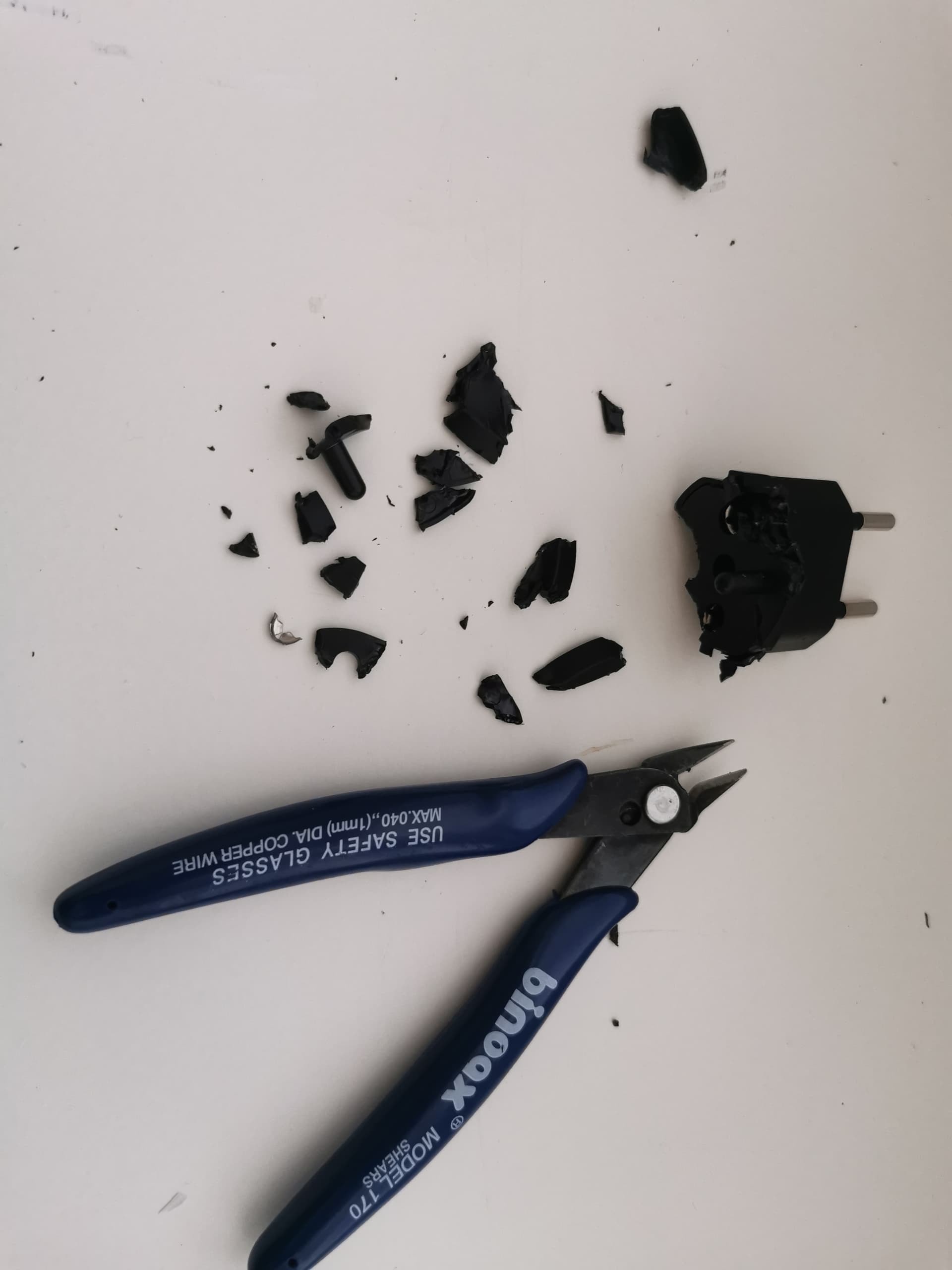
I think that’s the point. If you could remove it then it wouldn’t be permanent, would it?
Swiss laws require it.
It’s not just Digitech that provides these. I’ve had them from lots of retailers. (Perhaps change the thread title.)
I prefer to cut off the EU plug and replace it with a Swiss one. Cots me a few francs but a more friendly plug.
2 Likes
It’s a permanent adapter. It’s supposed to be the time saving alternative to cutting off the plug and wiring in a Swiss plug.
The unfortunate thing is that all the ones I have seem to have the cable pointing the wrong way so that it hogs all 3 outlets preventing other appliances from being plugged into the same group of 3 socket.
1 Like
Beware of doing this as it often invalidates the warranty.
1 Like
I concur the cable pointing in the wrong direction blocking other plugs in a triple socket.
And, well, I’ve seen these adapters actually loosen and slip off creating a dangerous gap.
Any recommendations for a good quality screw-on replacement one? I have multiple high current appliances that are crowding out the timid slim native Swiss plugs 
1 Like
Well, I see that my message did not convey the problem. I bought a device with an EU plug with the intention of using it in the EU. They included a free adapter, so I decided to test it. Nowhere on the adapter, nor on the adapter packaging, was there any warning that it was permanent!
If you buy in CH and they provide the adapter, it will be a fixed one.
On the package it probably has the word ‘fix’ on it.
Otherwise, the adapter has a plastic shroud as a kind of installation mechanism.
I guess now you know! 
the word fix should have given it away.
I guess the wrapping is too small to print “if you buy a device in Switzerland that you want to use in the EU and could have bought cheaper in the EU, don’t install this adapter” in three languages. And up until the day you started this thread I guess nobody expected, this could even be necessary.
But now that you proved it is, your thread will help. 
careful sichuan, you don’t want to go down in history alongside the woman who made it necessary to add “don’t microwave your cat” warnings!
You offered an other warning that came too late 
Hold on, the product has specifically EU in the product name in digitec catalog to differentiate it from a locally adapted one (with Swiss plug), so there was no misunderstanding.
Yeah, it must be some strict law which forced them to drop the adapter in the package just because you buy it in Switzerland. It was sealed in a foil, with some fine print. I don’t have it anymore, but who would make the effort to read it.
Those adapters are cheap, probably dirt cheap when bought by the thousands. It may well be less expensive to add one to every EU item as part of the standard workflow, than handle requests individually. And safer and convenient.
It can be difficult, and expensive, with rules and regulations.
I worked for a company where we shipped hi-tec equipment with US, EU and UK power leads.
We didn’t want to due to environmental wastage but having three separate products (a UK one with a UK cable, a US one with a US cable and an EU one with an EU cable) would have required three separate UL certificates for electrical compliance running into thousands of pounds in fees and time.
It wasn’t worth the bother.
1 Like
yes, they must indicate that. With mobile phones for example that can make a difference some people don’t want. So it’s not only about the plug. It’s to informe the Swiss customer, that it is not entirely up to Swiss standard.
It’s cheaper for them to buy in bulks with EU plugs and they pass on this price advantage. Adding a Swiss plug is demanded - in the old days they were sometimes missing - by the Swiss custommer as it’s really frustrating sitting in front of your new coffee machine not being able to use it. (Been there, worn the t-shirt)
In future if you buy a device here, want to reexport it to the EU but try it here, use a travel adapter.
You can’t blame that one on anybody but yourself, take it like a man 
Still think it’s good you posted it, if it’s a problem for one there will probably others.
Not quite. It’s the law.
Translated:
Electrical products, market surveillance
1. Can devices with foreign plugs be sold in Switzerland?
No, electrical devices in Switzerland must be fitted with a Swiss plug, a Euro plug (low power, max. 2.5 A, L+N) or a CEE plug (mainly industrial). Otherwise there is a risk that the user will carry out dangerous manipulations to insert the foreign plug into the Swiss socket. At most, a so-called fixed adapter can be used with certain foreign plugs (e.g. Schuko plugs). The fixed adapter becomes a non-detachable unit with the foreign plug when plugged in once and must be returned free of charge. This is tolerated by the ESTI as long as the protection type, protection class and current strength match. Device connection cables (so-called cord sets) must not be fitted with fixed adapters. So-called travel adapters, which can be separated from a Schuko plug, for example, are also not permitted for this application.
Conclusion: Devices with foreign plugs, incorrect fixed adapters and incorrect cord sets endanger the safety of people and will be immediately banned from sale by ESTI. Insist that your device is delivered with a proper Swiss plug.
https://www.esti.admin.ch/de/themen/faq/elektrische-erzeugnisse-marktueberwachung
1 Like
You can also buy an adapter to connect the Swiss plug to the EU socket.
1 Like