That the oil prices go up. Should force alot of car drivers to give up their cars.
For most people public transport is more expensive than driving a car
3 Likes
How so? I spend CHF 1100 per year on a public transport abo but my little runabout car costs far more than that on maintenance, fuel, tax and insurance.
Not sure I am unusual in those costs.
Combustion fuel demand is >90% price inelastic in the short term.
1 Like
and in Zürich at least, just a parking space costs about CHF 2000 per year
Is your car exclusively used by you or is it a family car?
To make a fair comparison you need to take the whole household’s expenses on public transport versus the car(s) costs into account.
Just me.
I guess in economic terms: you have a high fixed cost and low variable cost.
So for very low usage, it would be expensive (cheaper to get a taxi), but I wonder whether also at the very high usage it also flips e.g. you get a GA and have unlimited travel after paying for the GA card.
Not yet. Last Saturday I had to drive through the Gubrist tunnel and the traffic is there.
I don’t think people would sell the cars and switch to GA (“give up”). Instead people that drive a lot (30-40k km per year) would reduce their driving. People that drive less but some of the driving can be substituted by public transport, they would do it. The outcome would be roads with less traffic. Great!
Currently we have a car, wifey has GA, I have Halbtax Plus and a bicycle  If gas prices go really high and it seems they’re not doming down for 1+ year, I would pay more into the SBB abo, keep the car parked, return the plates to the cantonal office, and stop paying insurance. This hibernation state can be sustained for a really long time.
When I drive I go east, wifey take the train to the west. Comparing the car against the train makes no sense, except for the weekend.
Numbers matter. Depreciation + insurance + parking + maintenance (new summer tires this year) + fuel. With current prices (~2CHF /l) fuel is about 15-20% of annual cost. If gasoline goes to 4 CHF/L, fuel would be 26-33% of annual costs. Thanks for reminding me about depreciation, I’ll go sit on the corner to cry for a while…
PS I guess the breaking point is if annual fuel cost > yearly depreciation. That would make rethink my choices.
I remember reading a study in school (> 10y back) where the actual price back then would have needed to be about 5 CHF per liter to actually cause a statistically significant reduction in car usage. I imagine this to be at about 7-8 CHF now - so no, unless we 4x in gas prices, almost no one will leave their car at home.
1 Like
The last time I used public transport to get to work cost me two and a half hours one way and only 20 minutes by car.
5 Likes
Well, you don’t live in Switzerland.
Weekday mornings I can be into Geneva from my small village in half the time as driving. Bus–>Train–>Bus/Tram.
Not saying public transport is so good, just the A1 into Geneva is just so bad.
When I go to the office, I make 1+ hour on the way back home unless I stay in the office until 19h00. On the train, 45 mins every time.
We are extremely lucky with the excellent public transport in this country - it is impressive and it is very easy to live here without a car.
2 Likes
That really depends on where you live, some places would be really inconvenient to live in without a car.
1 Like
That’s true, but if you would like to live car-free here there are so many possible options to choose from
As foreigners, we have the freedom to choose where to live, so not hard to go live in a well-connected place.
Locals are more restricted because feelings of attachment to birthplace. Some places are effectively poorly serviced by public transport.
Only 2% of Swiss population have no access to public transport, so you have to try hard to fall within that.
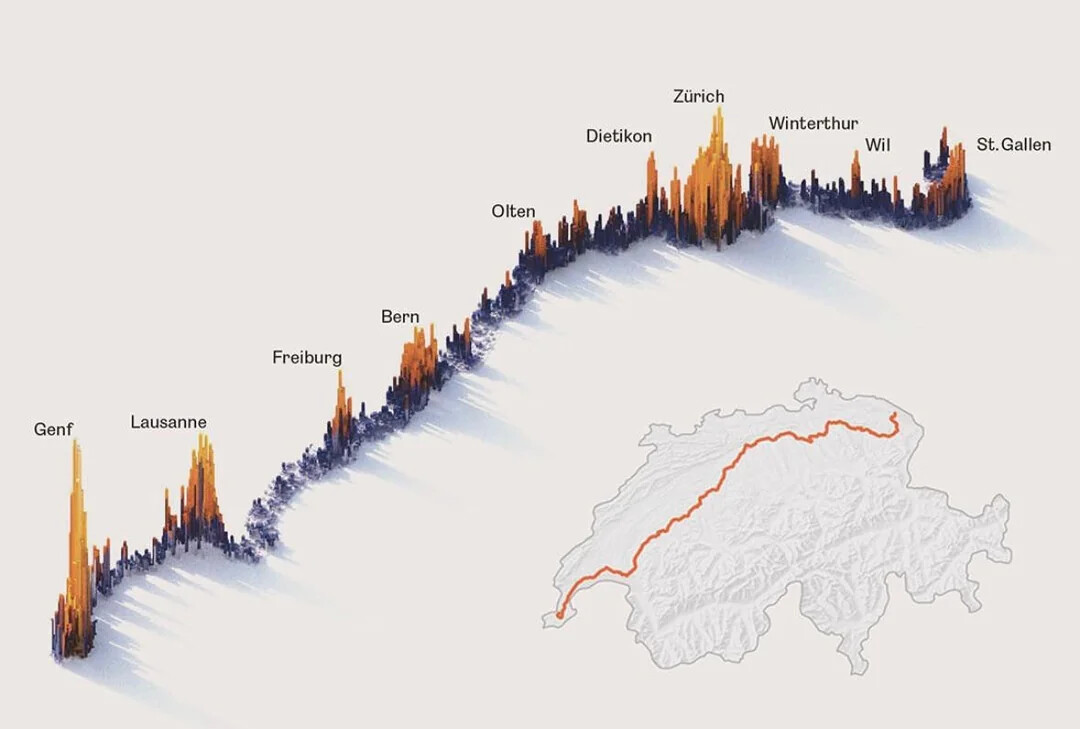
About a third live within 5km of this rail route:
1 Like
When I lived in Neuchâtel, the bus service stopped around 19h00. Later, only train or tram with longer walking distance to home. And I was within 1 km from the train tracks used by the IC5.
After moving to Aargau, German course after work ended at 20h00. Train frequency and connections are lower at that time, so the way back home increased by 30 mins.
So, well-connected by public transport means from 6h00 to 19h00, unless you live in big urban area.
1 Like
The ‘viable’ public transport number drops it by quite a bit, something like 84%.
1 Like