Once again disaster has struck the spanish HS (high speed) train network, 13 years after the Santiago de Compostela accident, which killed 80 and left 180 injured.
Unlike the earlier crash, which was major driver negligence (he was on his phone and missed the speed reduction for the curve), this is quite mysterious as it appears the REAR cars began to derail first…possibly indicating a technical failure.
My heart goes out to all who are impacted.
This draws parallels to the Eschede ICE disaster in Germany, where the metal tyre fails.
One peculiarity with spanish HS trains is that many are variable gauge (Iberian railways are generally broad gauge, but HS trains are standard gauge). I do wonder if this might have contributed here.
The whole thing can be read as a PR piece for trains. CO2 emissions reductions, growth in passengers carried, time savings compared to air travel, cars sucks, etc. Maybe, this is just a reflection of the management culture where these numbers are the ones that matter. Numbers about worker health, maintenance and safety don’t get bonus to CEOs.
The issue with trains vibrating too much is potential bogie failure. Last July, some trains in the Madrid-Barcelona line were retired from service because fractures were discovered in the bogies. Trains got sent for full inspection and repair, and the max peed was reduced to 250 kmh on a 190kmh section between Madrid and Barcelona.
What could a locomotive driver know? If a report says the track is OK, people bouncing around in the driver seat can be ignored.
It seems the story is well-documented. It’s sad, because of the victims. And also because people that want to make HSR grow, end up killing the very thing they want to make grow.
The thing with HSR is, the quality of the perway (permanent way or tracks) is more critical than the rolling stock and needs to be flawless..the slightest irregularity will be amplified exponentially as speed increased.
The move to MagLev will hopefully eliminate these issues. (a long way off I know).
Last cabins on the fast (205km) hit by resonance catastrophe, wobbled and smashed into the oncoming slower (100km) train…its engineer immediately killed. Locomotive went into a ravine, cabins pancaked, most of the dead were on the slow train. Look at the Guardian home page. Track renovation didn’t get rid of the problems; it exacerbated it.
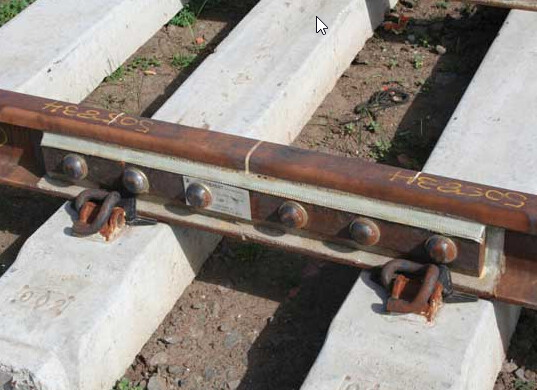
Focus now seems to be on a broken “joint” in the track.
Modern rail track isn’t bolted together, it is thermite welded together. The exception is insulated joints critical to ensuring electric signalling functions properly. But even here they are usually pre-fabricated and welded into place.
There are special track vehicles that can detect flaws and exceptional wear on rail tracks. Would be interested to know if they had cut back on these inspections.
Yup, looks like a bad fishplate, but I read that the relevant section of track had been renovated recently. Also the unions claim their members had complained of vibration and warned that they thought the tracks were worn.
I doubt it was a fishplate or a weld, most likely a crack caused by poor alignment or tamping. Thermite welds are pretty bullet-proof, as are the pre-fab insulated joins:
ABC newspaper from Spain urgently needs a technical writer. I had to clean a bit the original article from today, and automated translation:
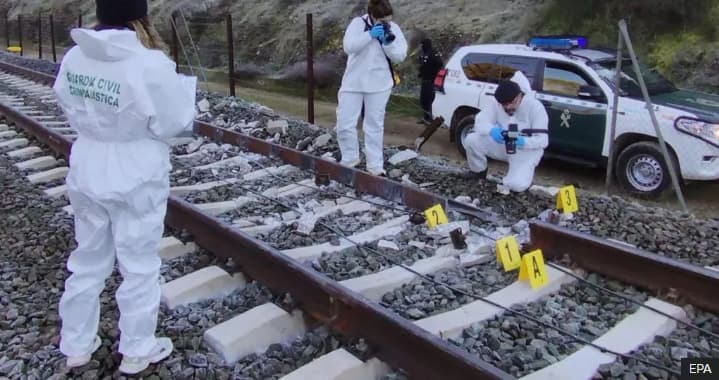
The (rail) weld at kilometer 318.7 broke at 7:45 p.m. on Sunday.
Experts are now working to determine the cause of the fracture. The fracture leaves no doubt as to where the tragedy originated. It is consistent with fatigue and deterioration of the material. Although the Ministry of Transport indicates that it remains to be seen whether it is a cause or a consequence, all signs point to the former (cause of the crash).
Sources close to the investigation, consulted by this newspaper, indicate that the Iryo train’s bogie—a mechanical component attached to the underside of each train car that allows it to move along the track, absorbing irregularities—was caught by a switch that acted as a lever at the precise point on the track where cars 6, 7, and 8 of the Freccia Rossa derailed. The Iryo bogie was propelled more than 200 meters.
Apparently, a rail switch came loose and got stuck in a car bogie. But, still a hypothesis. Engineers need to determine if a loose/broken rail or railway component derailed the train cars. Or if something broke in the train cars and the subsequent derailment broke the railway.
That track can’t be more than a couple of years old, sleepers and ballast look practically new. The weld has definitely fractured (foreground weld is in tact).
Once the cast is removed, thermite welds need to have the excess slag ground away, especially on the head and inner flange side. if this wasn’t done properly, each wheels passing would have hammered the join with incredible force.