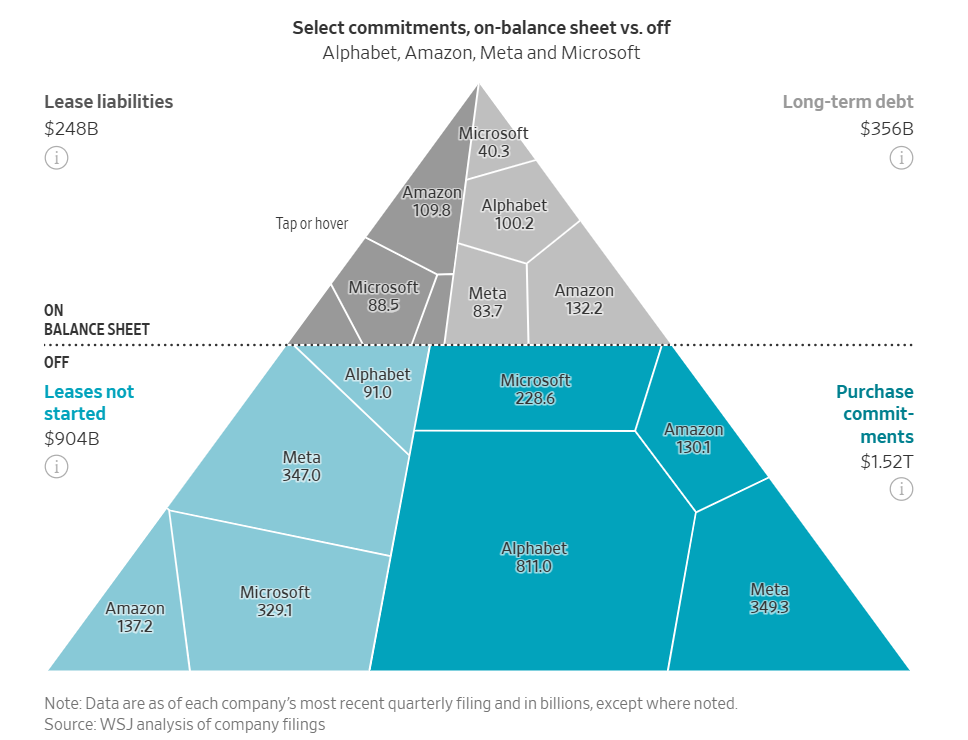
instead of just issuing bonds off its own balance sheet, Meta formed a joint venture with Blue Owl called Beignet that would develop and own Hyperion. Meta owns just 20 per cent of Beignet, but made a rock-hard commitment to lease Hyperion for at least 20 years. That guarantee allowed Beignet to issue an amortising $27bn bond, but this debt doesn’t actually appear as debt on Meta’s balance sheet, even if it is on the hook for the payments.
Goldman Sachs ran the numbers and counted up a trillion dollars of purchase commitments which don’t appear on the balance sheets of Big Tech.
The sheer scale of AI borrowing is believed by some to impact US Government borrowing as Big Tech debt issuance competes with Government bond offerings potentially boosting interest rates at a time when the government is trying to keep interest rates low.
On top of that, AI investments plan to ‘pay off’ by replacing employees which potentially undermines future government tax receipts if employment decreases as well as potentially increasing unemployment benefit costs.
Well duh, Goldman, wasn’t this obvious from day one? And besides the reduced tax revenue and increased unemployment benefit spend, what about consumer spending that’ll crater? If I am caught on a bad mood moment, like I am now when reading this, I’d say Zuck et al don’t give a shit, this road seems to be the road to technofeudalism. Caper in gilded palaces and let them plebs eat cake.
I’m not exposed to any of these companies but I am exposed to some (Life) insurance companies that buy the securitized debt of this shit. Started scaling down on those.
Very interesting. Since most of the lease of datacentres has not been paid for the 1st time yet, it’s not on the balance sheets. Since it’s not on the balance sheets, the terms of payment are not publicly known. No quarterly reports!
Anyway, the companies have rather large expenses in the pipeline as contracts to buy future services. Hopefully, there’s an exit ramp to get out of these contracts without too much damage.
Some years ago I consulted for one of those and one of the main questions was “what are the exit ramps of this contract?”. Hopefully, they are managing risk in a similar way today. I maybe wrong, but purchase commitments are just a loose contract where the software company accepts to buy 1x of services at X price, and reserves the option to buy until 100x at Y price. So, the datacentre developer takes this contract to a bank/investment fund and asks for money to build it based on some happy revenue estimates.
The 1.52 trillion USD purchases commitments number may look ugly, but the real liability for alphabet, MS, amazon, and meta may be smaller. Datacentre developers are already making their money, the ones who should worry is the people lending money to build the datacentres.
All these shenanigens in the US contrast with China where AI development is largely state run and controlled. And rather than seeking quick returns from AI, their goals are technological self-reliance, domestic-chip production, boosting industrial productivity and national security.
And then there is Europe, which is now waking up. The EU is proposing up to 7 large AI gigafactories across the EU, with public/private funding of more than €30 billion for those facilities.
“A life-size cat figure in the garden of Huttenstrasse 9, Zurich, where Erwin Schrödinger lived from 1921 to 1926. Depending on the light conditions, the figure appears to be either a live cat or a dead one.”
The “Dead” State: Because the sculpture consists of thin, cut metal layers, when you look at it from a sharp side angle or under specific dim, overcast lighting conditions, the flat perspective collapses. The cat silhouette completely vanishes or blends into the background shadows, making the cat “disappear” from sight—representing the unobserved, collapsed, or “dead” state.
Don’t count on it. As long as China is a threat to US national security it will be a fight, oh sorry, an investment to the finish. Of course with tax payer $s.