Yes, in the canton of Zurich there are 12 of them. Kids learn them at school and even have a test. They are also listed in the brochure for the naturalization.
In England terms, a Bezirk is closest to a District although usually with less political importance. A District Council is a subdivision of a county, usually comprising a handful of towns. Cantons are closer to counties but with much more independence.
If you insist on a comparison, flawed as it will be, the cantons are the UK’s kingdoms. They’re the building blocks of the Federation and the “united” part, respectively.
Now Brienz could be obliterated.
This is 1 in a million event, the missing guy was found, RIP.
After the collapse, I never expected anything to be found.
1 Like
Well, they found enough to identify him, I guess.
Still, a sad thing. All he wanted was to take care of his sheep.
1 Like
It seems that NZZ opinion piece from 06.06.2025 questioning the idea to rebuild is still echoing.
This quote was particularly interesting. It’s not about wants and desires, it’s about the physically and economically feasible. Not really smart to throw good money after bad.
Mr Kalbermatten points to the example of some areas of northern Italy where this loss of culture has happened. "[Now] there are only abandoned villages, empty houses, and wolves.
“Do we want that?”
People is subsidized to go live in villages with decreasing population. I don’t remember where I read that protection structures in Switzerland are budgeted to match the value of the structures they’re protection. For example, 10 homes of 1 million each imply the construction of a landslide protection structure of 10 million. So, no people and thus politicians are not comfortable with ghost towns and rewilding.
The frequency of events will take control of the narrative. Only 1 big landslide so far this year. If ice melting season ends like that, no one has to think about statistics. If more events happen, how sustainable is to throw good money after bad?
I wonder how much asbestos in underneath that rubble. Some houses were a hundert years old, so I’m sure there were also newer ones from that time.
Getting ready to start building a new village.
1 Like
What?
Last I read, small rockfalls from the Klein Nesthorn continue and are frequent. It probably won’t be next summer, but what assurance of the mountain not falling down again on top of them in 10 years?
Fully rebuilding Blatten would be illegal due to the Second Homes act.
It used to be 2/3 holiday homes, only 36% were primary homes. Since a good number of the houses survived, it may well be illegal to build even one new second home.
This is true, but not a problem : They said they will modify the law in this case if needed.
When they voted the Second Homes laws, they included a long list of exceptions, but nobody thought of rebuilding due to mountain destroying an entire village.. The main question is if it is a good idea to rebuild on the same spot or elsewhere.
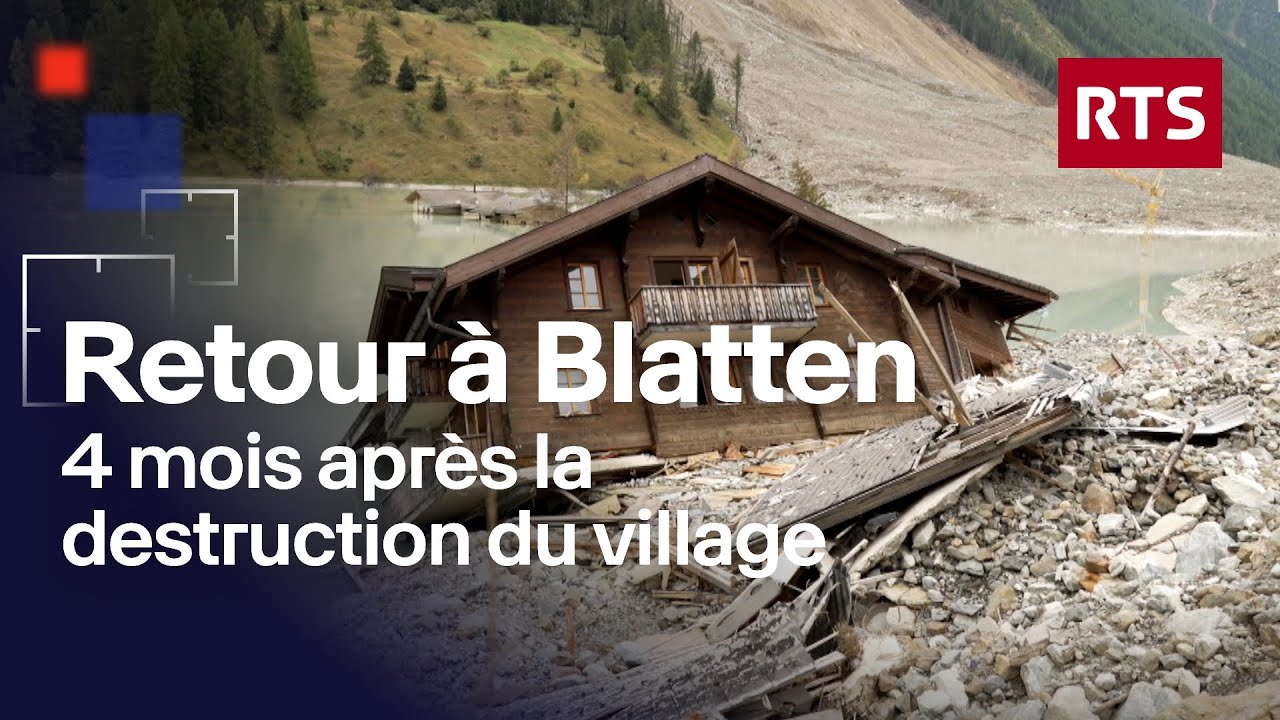
A RTS reportage 4 months after the landslide.
At 5m45s, a guy who works part-time as “observer of natural hazards” literally observes landslides, and river floods. Mr. Observer (Benedikt Jaggy) saw a landslide on May 14 and reported it to geologists from cantonal office of natural hazards. After the report, specialists saw the mountain moving in photos. The value of looking while being attentive must be highly praised.
And now, Brienz (GR).
A week ago the surveillance team said: it’s imminent now.
Yesterday,it was next hours or days.
Today, damned rocks are moving 8 to 10 cm per day. 24 to 36 hours.
Yesterday, a part of the landslide moved 17m in one day.
The speed of the eastern part rose from about ten centimeters in the last week to up to 17 meters a day on Wednesday lunchtime. “We see an exponential acceleration,” says Gartmann. Such a dynamic is considered a typical sign of a major crash. At any time, a massive rockfall could also take place without warning.
Poor camera, it’s on a very vulnerable position.