I was born in the country like this. Thank you, but no.
3 Likes
More than that. Seniors will have to work. A lot. Unless you believe that “intelligent” robots will constitute the workforce.
This will be the zenith of civilization. Living on a rat-fucked planet with four billion Grandpa Simpsons and no children. And a robot wiping your ass.
Like the environment, population should not be a left/right issue.
The dystopian visions are all there, our job is to try to stop them happening. The present retirement/pension situation was set up for a world that has changed - it is not just seniors that will have to work (a lot of us do so at the moment, paid or unpaid) everyone is going to have to adapt to a future that we cannot fully predict.
You don’t say.
There was a time they could?
As to the chorus in everybody’s song like “the old have to work”, “the pension age must be raised” … turn to the next thread where it says “finding a job after 50 is impossible” etc. etc. For 60 years old it’s definitely so.
Higher pension age would only shift the problem to unemployment insurance (and that pays a lot more than AHV here does and is also financed by payroll deduction) and it would collapse quite quickly I assume.
I think as long as we are a country of employees working at high age is difficult.
What could be changed/stopped fast is those possibilities of early retirement. Once launched for physically heavy working people like building site personnel, more and more office-personnel is making use of that.
Not that I own any property in this country, but, why 2040?
2 Likes
Maybe komso thinks by then everybody in Switzerland is too old to get a mortgage.
2 Likes
A 2nd thought on this.
The young do the opposite of parents. The trend may reverse one of these days.
So, any comment like “come on people, get having more kids before we go extinct!” is not helping 
1 Like
You mean “children are a pita, just look at how you were” would help? 
I came across this article today and thought it was an interesting perspective about the falling birthrates across the developed world and the things governments are trying to incentivize people to have children or to have more children.
The Real Reason People Aren’t Having Kids - The Atlantic
I would guess:
- Availability and reduction in stigma in use of contraceptives
- Women entering workforce/studying and therefore delaying when/if they have children
- Social changes such as online dating, MeToo movement and social media
1 Like
I would add: kids are a luxury item these days, if you can afford them, fine.
MeToo movement as a reason not to have kids? You mean, that the number of kids born as a result of rape is going down?
That it has reduced the approaches to women outside of things like dating apps.
Look at India, contraceptives are far from being accessible to everyone and TFR of 1.9. It’s something else 
I guess we live in a time where children have been gated by societies, and then act surprised about why no children. In some cultures marry first, children later is policed with heavy social pressure. In others the social precondition is having a stable life, children later, also under social pressure. There are several mechanisms at play, but the older the mother, the lower the number of children regardless of country around the world and across time.
The TFR is calculated from 5 year buckets, the components to calculate it are “age specific fertility rates”. This data from the US spanning 60 years starting with mothers born in the 1930s shows something interesting. The fertility rate of women older than 30 has not changed significantly in a long time. It has even been lower in the past.
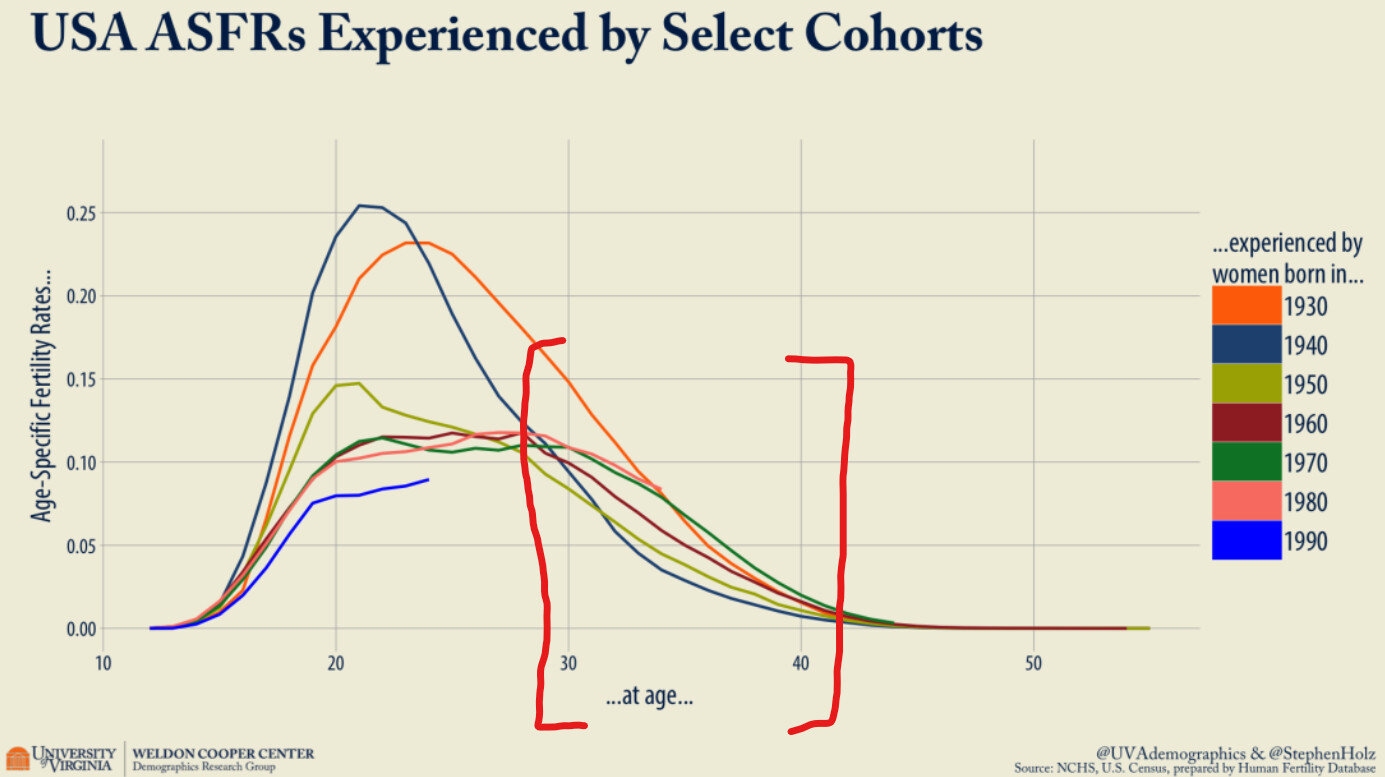
What has changed dramatically is the fertility rate of younger than 20 and between 20 and 30. Plenty of reasons to avoid teenage mothers, but the big questions is what happened to 20-30 YO?
Since women above 30 have not done anything different since a long time ago, maybe it’s time to reevaluate that society pressure of marry before children, or have your live in order before children because the missing children are from potential mothers between 20 and 30, or how men/society are treating women between 20 and 30.
1 Like
But isn’t it obvious? If you have a first kid after 30 you will have less kids in total than if you have a first kid at 20.
I know single mothers who come to Switzerland in their 30s with a teenage kid, marry again and have another kid(s) with an age difference of 10, 15, even 20 years to the firstborn (the biggest age difference in a family I know personally is 22 years). It wouldn’t be possible if she had a first kid after 30, got divorced (50% probability), was looking for a new partner. And even if she found one, how old would she be at the moment of the second marriage? 45?
2 Likes
At least in Europe the cost of living has continued to increase but wages haven’t kept up. The average Joe can’t run a household with kids on one salary and the system makes it difficult for both parents to work.
As for marriage - for me it was a nice frock and a party with friends and fam for one day, but our relationship is exactly as it was before we had rings on our fingers. I guess this is true for most couples.
This article is quite frightening. It suggests that finding meaning in life is only possible if you find God and having a large family is possible and good because you have found meaning in your life. Sorry this might convince JD Vance but it is rather Handmaidens Tale for me. A falling birth rate and ageing population brings problems. These problems are minor compared to the issue of too many humans. We do not need more humans. There are enough issues getting the world to work well with the numbers present at the moment.
Finding meaning is a libertarian ideal, not something to be imposed.
1 Like
Well, different countries might have different reasons especially if they are at different development levels. In some countries it was required to have children to have labour and also as a pension. As countries developed, this changed.
Clear contrasts might be Niger which remains mostly rural small scale farming with TFR of close to 6, versus neighbouring Algeria which modernized, created state pensions/social security and TFR dropped to around 2-3. Factors include:
- urbanization
- expansion of female education
- declining child mortality
- later marriage
- improved access to family planning
- broader economic and social modernization