I read the last topic on the matter from 2023 and boy, has the world changed since. I fear it was placed in the wrong forum (Accommodation) so asking here in Finance, Taxes and Banking instead.
We are approaching term of our 10yr mortgage and wish to switch from the current fixed to SARON. The current bank has signaled initial readiness to 1) use the new value of the property (now 50% higher than at buy time) and 2) grow our mortgage +500k. that we could invest and get better returns.
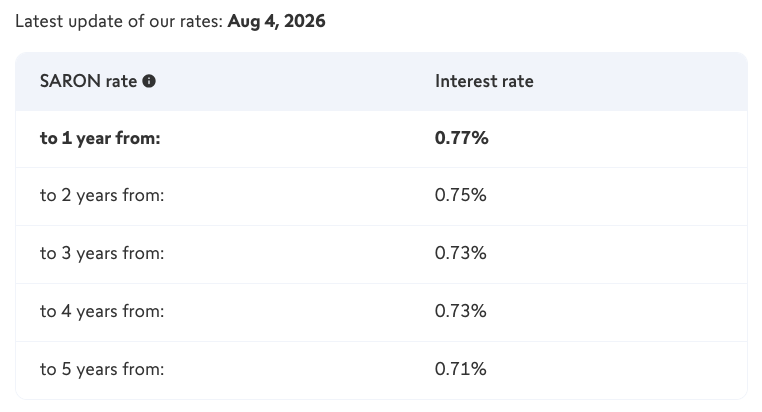
Now, the usual suspects of MoneyPark, Comparis et al, quote SARON bank margins starting as low as 0.75% while our current bank quotes 0,95%. The “might” consider a lower 0,90% if we transfer all our brokerage to them (against the generous 0,35% portfolio fees per annum). They propose to “give” with one and “take” with the other hand, which is another way of refusing lower than 0,95%.
For 10 years, we have never missed a deadline or paid a day late with our bank. Granted, we do not have much business with it (due to said lovely brokerage fees). We are willing to shop and move - but cannot arrive at ground truth on the “advertised -vs- known” bank margins, or simply answering “where them 0,75% folks talk about”.
Do you have any recent (as in post-Hormuz) experiences in SARON bank margins?
Have you any knowledge who may be offering them on the lower spectrum (sub 0,80%)?
I don’t have any direct experiences with saron rates. However, from reading other finance forums, I get the impressions that 0.75% was a sign of the past. For the past month, the rates start at 0.85%. Your .95% is therefore still a bit on the higher end, but not completely out of proportions.
the best we got offered for a 10yr fix was 1,78% - granted, we’ve only spoken to like 5 banks or so but… high. SNB has officially committed to next years being zero-or-near zero, so SARON is the preferred for now.
what would be the thinking behind a 10yr fix at 1,5% (fingers crossed) versus a 0.90% SARON?
If Trump manages a world wide recession with stag inflation then interest rates will go through the roof
It looks like the Strait will be closed for the foreseeable future but whether foreseeable is a week or a year I have no clue although I tend to believe longer
the chaos monkey can go “kaboom” indeed, whatever enriches him and his family… fair point.
I was reading the SWAP /SARON charts and thinking = there is likely no moment where SWAP (the basis for FIX mortgages) would be cheaper than SARON. Table I was looking at was on UBS website here > How high is the current SARON interest rate?
I think so if you are just saying the SARON line is always under the 10 year line.
But when you fix the line stops moving and should be drawn horizontally out for 10 years. The question is how much time will the SARON line spend above or below this new fixed reference in the next 10 years?
Correct me if I’m wrong. But I think there is a general consensus that saron is the cheaper choice in more than 50% of all mortgages. Of course, if you are part of the minority who pays more with saron, a fixed mortgage is the better option.
… enriches me too, I am an oil sheikh since last year, hold stocks of 13 oil companies. If you can stand the volatility it is a very lucrative business.
I have part of my debt in an UBS SARON mortgage. It is just a tiny bit cheaper than the interest Interactive Brokers charges me, but has a 13 month cancellation policy. Thinking seriously to replace it with just margin debt at IB (or sell some oil stocks to cover it…).
But then I like to be an oil sheikh. Did fill my tank at around 100 at the first or second (or was it the third?) time the war was declared over. Now it is like 144.
Bless you, for chiming in - I read the Simply Investing thread with so much respect and reverence for the wisdom shared, I cannot think of a better forum to be in! Thank you for the observation - I also agree SARON is generally cheaper according to my math + observations. If I manage to lock the Bank Margin well, I should be comfortable with 3-4 rate hikes, and I am a believer that they will not last long; CH is the safe-haven for the world’s money, and for the past 10 year’s we’ve all been waiting for the “real estate growth to come to a plateau”. Well, boo-hoo, prices are still creeping up - just saw a 2M 70sq.m. apartment in Zurich listed. I’ll be damned.
The more I research, the more I see that the SARON is less scary than the fine print of the bank papers, that might double-dip you in penalties should you skip a renewal or pull a cancellation should the rates spike. I don’t know how to prepare for these Ts&Cs and feel blessed for signing whatever the bank put in front of us 10 years ago and it worked. Not sure banks are quite the same now - sadly, not sure if there is anything a customer can do, like ask for minor adjustments of the language (alright, now I feel like the Mask).
I feel leaning towards the risk of signing SARON, leaning on a few things: 1) 2023 was the highest of years for SARON. I ran the math, and I can live with the monthly “rent” at these levels. 2) considering how the world is, and how we still keep it together - I do not think we could go above 2023 levels.
Big thanks to @jonnahtan for the links, will be setting appointments with both, and reading the other forum.
I’d be interested to see a longer term chart of the SNB policy rate and overlay on that the different oil shocks to see what impact they had in the past and for how long. IMO, the Iran situation remains a big unknown.
I hope you realise that is because SARON was only used by SNB from 2019. Interest rates have been much higher in the past.
There is a comparison between Fixed term (5, 10 Y) and SARON mortgages from VZ, stating than during the last 30 years or so (indeed, the rate used in the past was LIBOR, and then switched to SARON), it has always been cheaper to have SARON than fixed rate. Of course, there are periods where the SARON rate is higher than a rate fixed beforehand, but these peaks tend to be temporal, rather than a sustained increase. Then, you need to be able to absorb those peaks for SARON to make sense.
Floating would have done better than fixed for the last 30 years as we’ve been in a falling rate environment since the 1990s (really since the 1980s).
The rate hikes of the 80s was to control the oil shocks and inflation of the 70s. Since that time we have:
Alternative energies
Growth of US oil
Dotcom crash, GFC and Covid crash - each resulting in stimulus measures.
Let’s take stock of the current situation:
Iran situation still unresolved
Ukraine blowing up Russian refineries. Let’s not forget that RU was the largest exporter of refined oil products. They haven’t just stopped exports, they’re now importing diesel.
Sanctions on RU oil, gas and now also discussions on RU LNG
EU LNG stores low - waiting for better prices before filling up (good luck!)
EU diesel inventory also at lowest point since 2015
Refining crack spreads now at $60
Oil product prices are not falling even if crude prices are fluctuating