Simply stock trading

Yeah, those all-time-highs. My portfolio is just at 96.45% of its all-time high, but for the year my gambling strategy is up 31.65%. Almost double the Nasdaq100 without a single AI stock…

Nice, but only numbers. Not too much correlation to the indices means I can lose big when everybody else makes money. Usually it is the other way 'round… :wink:

1 Like

The universe has a sense of humour. CRWV up >11% since I bought today. Outperforming everything else in my portfolio.

3 Likes

I worked directly with Sergey in War Rooms post the China / Aurora Google hack in Dec 2008 / early 2009. He’s fun, especially when he’s wearing his five toe rubber shoes, or when he’s driving to the office in his original Tesla Roadster.
I with mixed feelings remember one night when tracing logs when he got really excited about his browser DNS logs pointing to him navigating to sites nobody should really navigate to based on DNS lookup logs from his laptop.
Turned out it was just Chrome’s overzealous lookup algorithm trying to greedily guess-resolve alphabetic URLs typed in by the letter into potential IP addresses that would eventually resolve a potential domain (to be typed in fully) to an IP address before he finished typing in the full domain name. We all took a deep breath when finding out he wasn’t compromised, maybe just a couple of weeks into discovering Google had been compromised.
I distinctly remember this event as this happened right around Xmas 2008, maybe even on Xmas eve … and I cancelled our planned Xmas holidays because of these events.

Anyway … I like your way of looking at this, but I am pretty sure Sergey didn’t come back to “get his hands dirty” – he may have gotten back because he personally cares about this, somehow, but not in an existential way, and he may even put an additional day or two a week to complain about engineers not working enough hours on this, but … well, from a billionaire’s POV, you don’t need to get your hands dirty ever again.
You may hassle other people to get their hands dirty, because, well, you just feel you’re right because you have been right in the past when you felt it was necessary to hassle other people to get their hands dirty, but IMNSHO that’s really all there is to it.

As always, my little glimpse into past events informing future evolving events is probably not accurate. Allocate your capital as you see fit.

I think you over fixated on 2 words and missed the point of the post!

In other news:

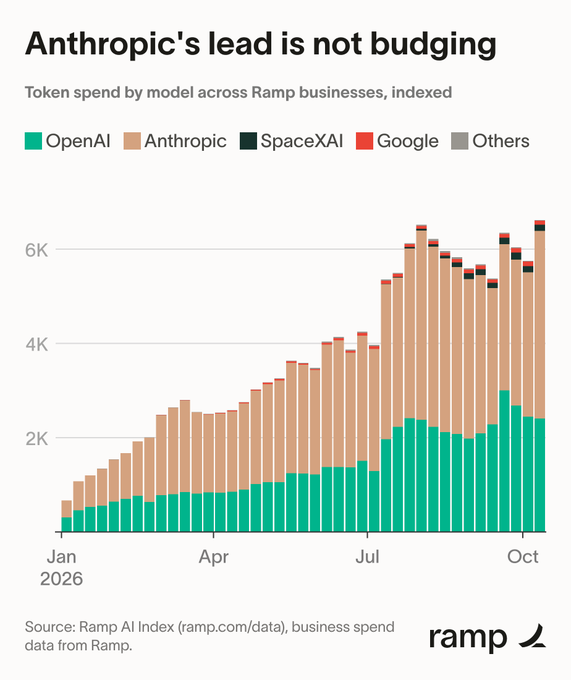
Token spend seems to be levelling off and openai eating into anthropic’s share (at least in this subsample).

1 Like

I wonder how much is also down to improvement of the models. It reminded me of this post from Dylan Patel back in April:

First, my mind was blown that at small 20 person consultancy company was burning an annualized $11m in tokens in the first place. After Opus 4.7 dropped, the increase in token efficiency meant that 1/3 of the tokens were required to complete tasks leading to reduced token use.

EDIT: clicking around I found this interesting quote from Dylan which adds color to the token economic discussions above:

Many were surprised when Anthropic released Opus 4.5 at a price of $5 per million input tokens and $25 per million output tokens in late November 2025. Previous Opus models such as 4 and 4.1 (released May 2025 and August 2025 respectively) were priced 3x higher at $15/$75.

However, we think Anthropic’s margins have actually increased on Opus tokens despite the lower ASP thanks to software improvements across Trainium and Nvidia GPUs as well as replacing Hoppers with Blackwells.

Anthropic’s margin expansion so far has come from cost reductions; they can generate the same tokens for cheaper. Despite the Opus price cut, their ASP/token has also actually gone up because most of the volume shifted from Sonnet to Opus.

Even if XPU providers start dramatically raising prices to better capture their share of the throughput improvements, Anthropic still has another lever to pull to further expand margins: they can continue shifting volume to more expensive SKUs.

As mentioned earlier, the gap between the price of a frontier-level token vs the economic value of the work that can be produced by said token is the largest it’s ever been. Anthropic can either re-up the price of the base Opus family or introduce new products. We already saw the latter with Opus fast being priced 6x higher than regular Opus, and Mythos being announced at $25/$125 (5x regular Opus pricing). Both these SKUs are higher margin than regular Opus, yet the most AI-pilled businesses are still more than happy to pay the increased prices because the productivity gains outweigh the cost. If Anthropic let us pay $150/$750 for Mythos fast, we would.

The age of low gross margins for frontier model providers is over. Real agentic AI has permanently increased the market-clearing price per token, and there’s no going back.

My emphasis. Willing to pay 6x to get premium tokens faster and 30x over previous top model.

EDIT 2: found this other quote:

The most obvious argument for why the labs won’t be able to capture higher margins despite increased utility per token is competition. However, we don’t think this is how things will play out for two reasons.

First, it’s become clear that the frontier model maintains pricing power. Regardless of what the benchmarks may say, open-source models are still noticeably worse than their closed source counterparts for real knowledge work, and there’s no reason to believe the gap will close any time soon. Kimi K2.6 ($0.95/$4) exerts very little downward pressure on Opus pricing.

This fits in with my 2-speed token market hypothesis.

Second, compute constraints means that no single frontier lab will be able to serve the entire market. Anthropic is already beginning to alienate large swathes of the market today by locking Claude Code behind a $100+/month subscription and blocking third party harnesses like OpenClaw. Token demand will far outstrip supply for the foreseeable future, which means any lab capable of providing true frontier quality will be able to charge based on the economic value delivered by the token rather than competing away each other’s margins.

This is an interesting take: labs maintain pricing power as token demand outstripping supply will limit ability to undercut competitors.

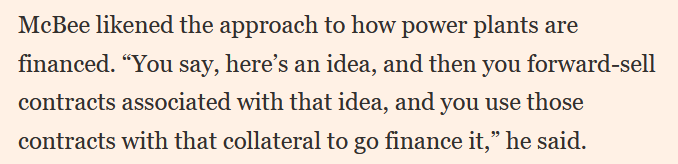
Interesting read, I would be worried at someone who uses simple words to describe Power Purchase Agreement (PPA). No need to be creative, no need to dumb down the thing, it’s a damned PPA and it’s just fine. In the case of Coreweave, is it a Calculation Purchase Agreement (CPA)?

  • Here’s an idea: for example a gas turbine power plant
  • Forward-sell contracts associated with the idea: a PPA where a buyer agrees to buy X amount of MWh for 10-20 years from gas turbine power plant.
  • Financing: go to the bank or investors with PPA (promise of future revenue) in hand to get a loan, build the power plant and start getting revenue.

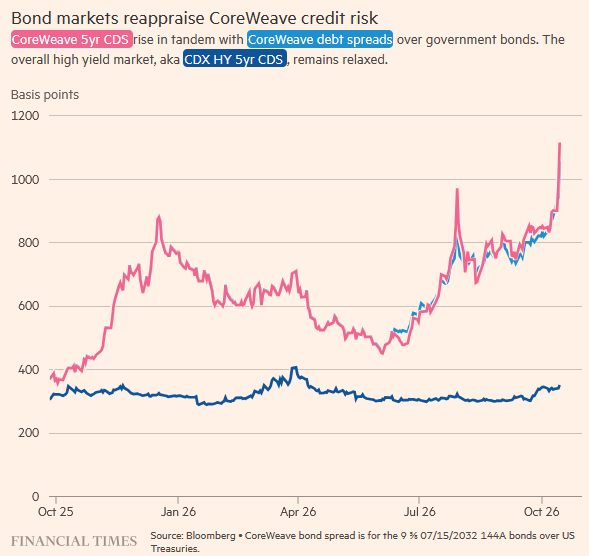
2 days later at FT Alphaville, the pot of unlimited capital seems to be found at the end of the rainbow.

CDX HY 5yr CDS (boring time series in blue) = a S&P managed CDS index composed of 100 high-yield (junk-rated) corporate issuers, equally weighted.

Thankfully, insurance is a very regulated business (boooooo! government regulations) where insurance companies are very limited in their choice to buy financial assets. An insurance is not allowed to buy this debt, right? RIGHT?

1 Like

@HedgieMarkets’ take on CoreWeave’s debt:

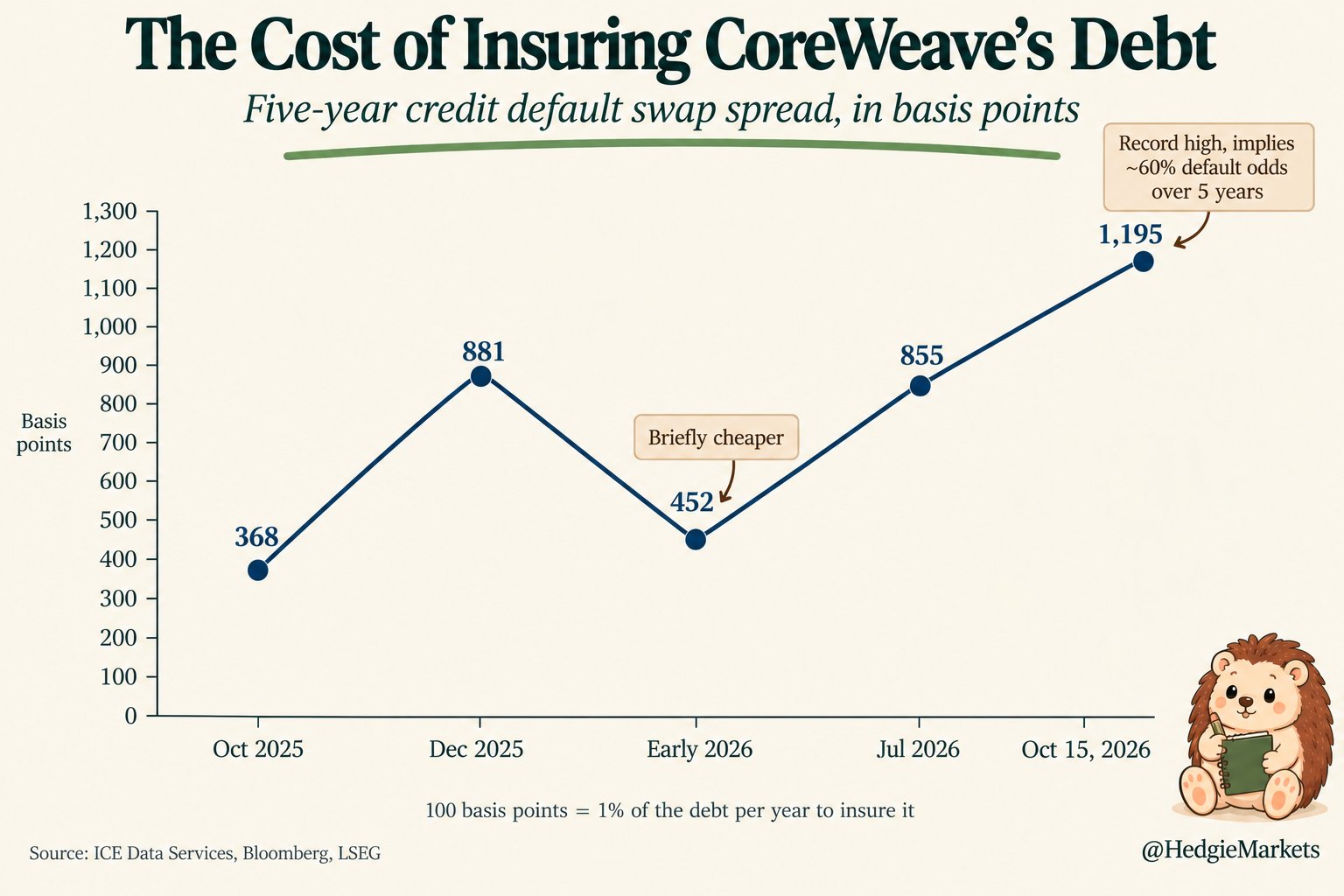
:hedgehog:The cost of insuring CoreWeave’s debt against default hit a record today. Its five-year credit default swaps reached about 1,195 basis points, which markets read as roughly a 60% chance of default within five years, up from about 30% a year ago. Some of its 2031 bonds now trade around 79 cents on the dollar and yield 15.6% to 16.2%. Nvidia CEO Jensen Huang said in Sweden that CoreWeave’s capital costs are falling and Nvidia has no need to bail it out.
My Take
Jensen isn’t a neutral voice on this. Nvidia owns about 10% of CoreWeave, CoreWeave borrows money to buy Nvidia chips, and in 2025 Nvidia agreed to buy up to $6.3 billion of any cloud capacity CoreWeave can’t sell through 2032. That already works like a backstop, even if Nvidia won’t call it one. He has a point that some CoreWeave project loans got cheaper earlier this year, but these same bonds yielded 14.5% when I wrote about them yesterday, and today they’re above 16%.

Amazon, Alphabet and Meta also saw their default insurance hit records today, though from tiny levels, because they can still pay for a lot of their building out of cash flow. CoreWeave carries about $50 billion in debt and still loses money, so every new dollar it borrows now costs 15% or more. I think it ends up selling more stock or handing lenders more collateral long before it gets the investment grade rating its cofounder told the FT he wants.

Hedgie🤗

1 Like

Should my captain ever manifest in flesh and blood I would buy his cristal ball:

My last double down, which I hated as always, had to buy at all-time high.

Sorry, that much posts in between, here the double down:

1 Like

Ouch! Debt default insurance is expensive (pun intended).

1 Like

Wouldn’t he have two balls, though?

I’ll see myself out …

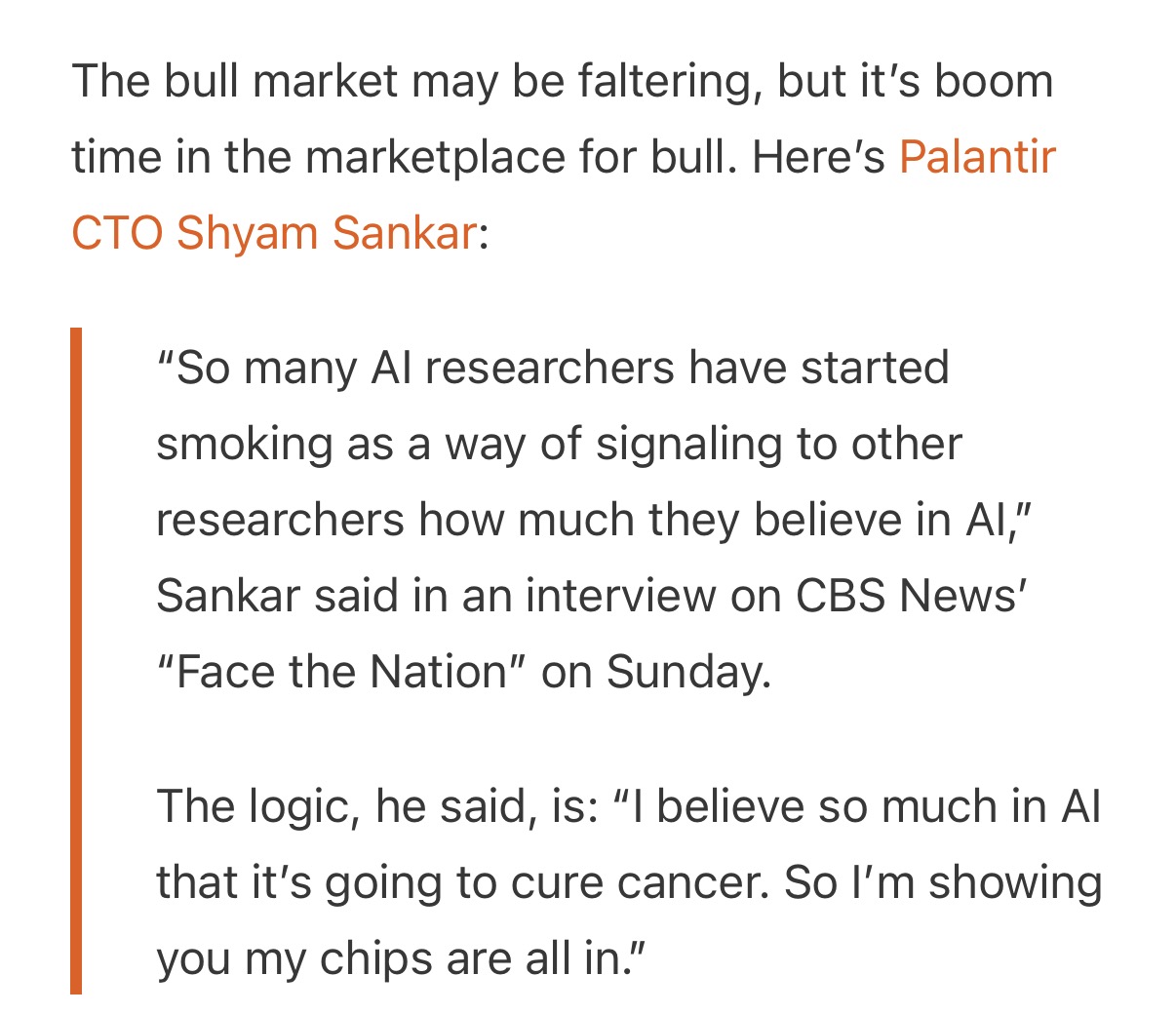
Man, even I, with all my tobacco stocks, have got AI exposure through those stocks …

:cigarette:

Idiot. If he’s really serious, he should infect himself with HIV.

1 Like

What’s wrong with injecting lead paint or raw asbestos?

Also, since you seem to express being angry feeling agitated, here’s an (AI generated) ad for an anger management program that an AI hosted on CRWV suggested in case you are interested: AI Therapy with music :musical_notes: …

Sounds like bull!

I think with modern medication it’s no longer a big deal, not the death sentence it used to be.

Maybe we should take the CoreWeave bashing to a separate topic since @Phil_MCR seems to be the only one trading it, but I came across this today:

Coreweave CEO Michael Intrator says the market is acting irrationally by selling his stock.

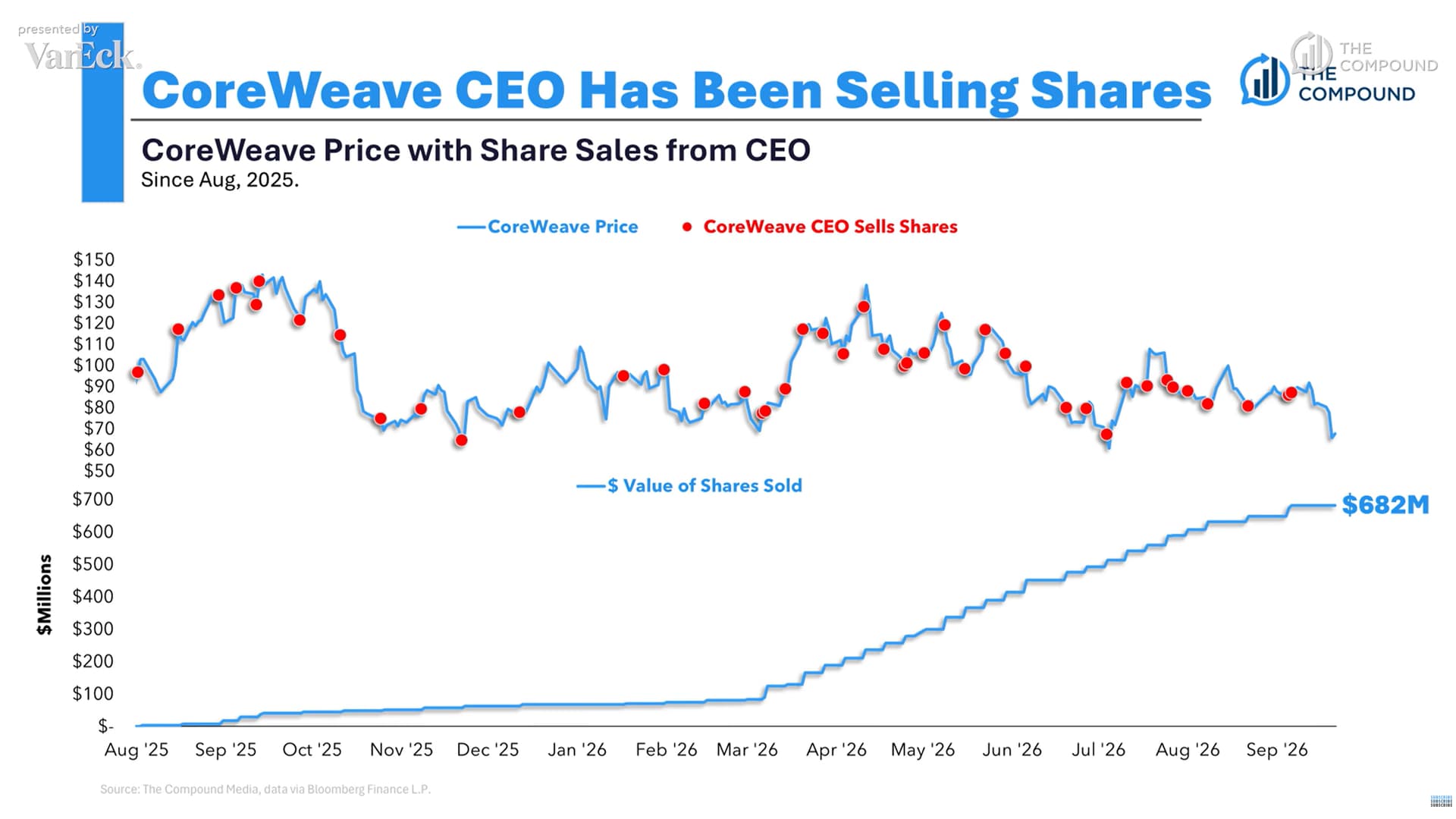
A run through SEC filings reveals Michael Intrator has been “acting irrationally” as well, selling $907 million worth of CRWV shares this year alone.

His cofounders Brian Venturo and Brannin Mcbee have also been acting irrationally. The trio has sold a combined $3.3 billion of stock since the IPO. Venturo is the second biggest insider seller of any American company this year.

Their benefactors at Magnetar Capital have also been acting irrationally. They have sold more than $5.5 Billion of Coreweave stock since the IPO.

A lot of people seem to be acting very irrationally.

(Source)

The numbers don’t add up with the graph below, but directionally, it doesn’t change the story.

To be fair, I’d probably be selling, too, and this looks to me mostly like an automated sales schedule anyway that these companies allow you to have (i.e. auto-sell every quarter or month whenever and whatever the price).

Still doesn’t exactly imply confidence that the leadership team believes in the story … . I mean, c’mon, isn’t, say, 100M enough for living expenses for the next couple of years if you believe the company is going to the moon Mars and you just hold on to the rest of your stock until it does?

Instead, when reaching about 100M in Spring this year the CEO ramps up the selling significantly?

(Source)

2 Likes