From quoted article:
With the country’s inflation rate at just 0.1%
Absolute bullsh*t. My cost of living has increased an order of magnitude higher than that. Driven by grocery prices and health insurance.
The unions wouldn’t be able to negotiate the ‘cost of living’ pay rises that they do if it was only 0.1%.
It’s way more than that for your average Joe.
Health insurance costs aren’t even included in CPI figures. So they could go up 1 million percent and it would have no impact on the CPI inflation figure!
They certainly have an effect on my pocketbook.
What does Switzerland use as a measure for calculating inflation? Because I also see higher prices for groceries and health insurance.
The Statistics Office claims to track 100k prices monthly, which obscures the methodology.
After some processing, the results become tractable and…rent is the big evil.
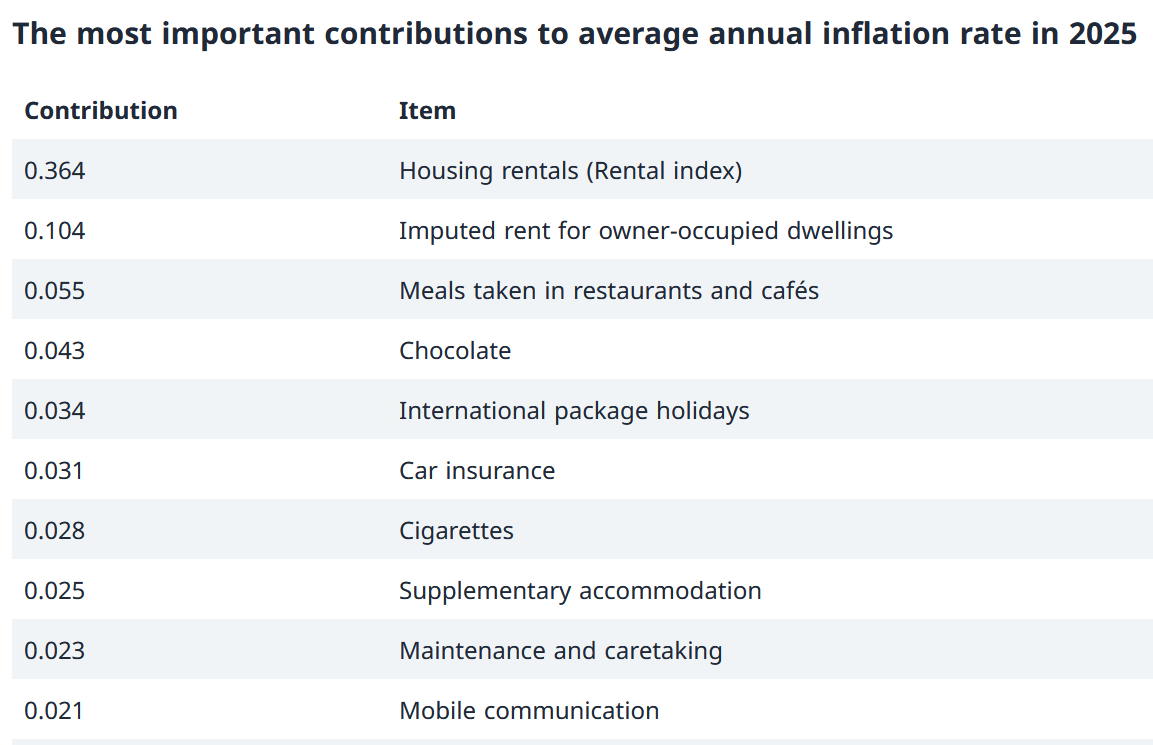
International Package Holidays
So, because of the strength of the Swiss franc our inflation magically becomes lower?
Insanity.
Wait min. In spite of the strong CHF, vacations abroad became more expensive (at least when you buy from a travel agency)
My biggest costs are: tax, childcare, housing, health insurance.
Health insurance is one of the big ones and isn’t even included in the CPI.
I don’t know if BFS does this, but other countries make a ‘hedonic’ adjustment so while an iPhone has increased in price over the years, because you are getting a better product for your money they adjust this to reduce the increase i.e. effectively instead of taking the price of an iPhone which is increasing, by adjusting they effectively take the price of a Nokia brick instead.
Also items are added into the basket and other things taken away. I heard complaints from some that it always seems that things that are going up in price are taken out of the basket and things going down in price are being put in.
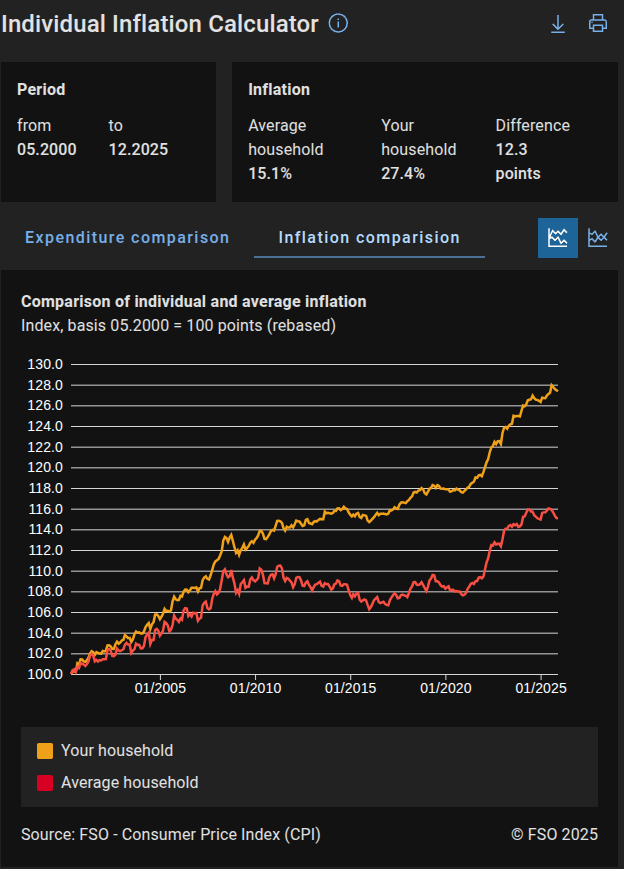
There’s also a personal inflation calculator here.
Would this have anything to do with the bloodbath on the SMI today? Or is that something else?
Could be linked, stock prices will change with the value of the currency it is measured in.
Grocery prices have been sinking since mid-2024. There were big hikes in 2023 which is probably sticking in the memory and of course current prices are still largely at or only slightly off those levels.
Chocolate and Coffee will be the main exceptions atm due to the world price and short supply.
The link between exchange rates and inflation is clear, although which one drives the other is open to discussion.
Living on the French/Swiss border[1] and both making and taking payment in both countries I’m always conscious of current rates, which have changed steadily even just over the last few years, but in effect the price differential on most things has remained remarkably stable.
So although shelf prices in the French supermarket are noticeably higher in Euros due to French/Eurozone inflation, once converted to CHF the overall trends are mostly comparable with price changes within Switzerland.
Basically, over time, the inflation rate will balance with the exchange rate. As inflation hits prices in surrounding countries but remains virtually zero here it effectively devalues their currency against the franc, so imports and exports remain roughly the same cost. Again, over time, so sharp changes can occur and may sometimes take a year or two to renormalise.
[1] OK not technically “on” it, but I could literally throw a stone from the Swiss Douanes post into my back yard.
nice one, almost 3% for smokes (the majority of which cost is tax driven so wtf) and no reference made to mandatory health insurance that keeps flying year after year…
Not according to Paul
The ever-increasing value of the CHF should result in lower consumer prices. It would suggest that the exclusive middlemen are making an obscene profit.
Now is the time to allow parallel imports.
Parallel imports are Not banned
The biggest block is the manufacturers who crack down on the foreign suppliers.
In 2012, the
Swiss Competition Commission (COMCO) fined BMW approximately CHF 157 million ($182 million) for restricting parallel imports of new BMW and Mini cars into Switzerland from the European Economic Area (EEA).
The German manufacturer violated competition laws by contractually prohibiting EEA dealers from selling vehicles to Swiss customers, forcing them to pay higher prices.
The Federal Supreme Court confirmed this decision in 2017.
They need to specifically allow parallel imports. COOP and Migros, for example, must be allowed to contract with any supplier.
Digitec does it.