My base level Model Y has a Lithium Iron Phosphate (LFP) battery so its safe and actually recommended that you charge to 100%.
Years have passed and there’s real-wold data available now. The failure of car batteries seem to be overestimated. On average, batteries don’t loose much performance after 150k km.
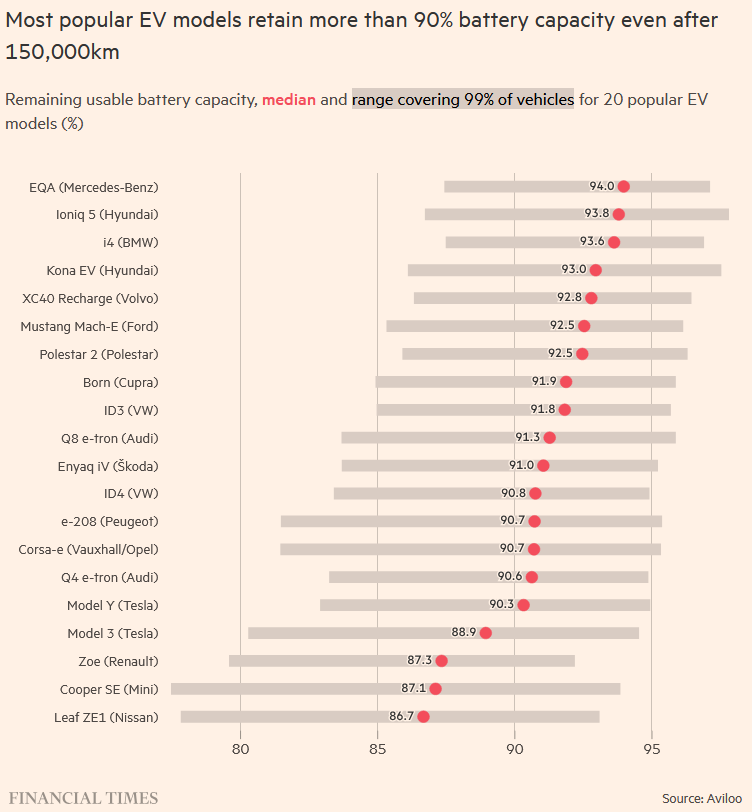
EV batteries last longer than drivers feared
Study suggests most used vehicles can retain about 90% of original usable battery capacity after 150,000km
3 Likes
I actually wanted a Tesla with a lower capacity LFP battery because they can take far more abuse than nickel-based (NMC/NCA) batteries, and they degrade far more slowly. My battery SOH figures demonstrate that admirably, 55,000 km over almost 3 years and the battery is still at 97.3% capacity
n.b.I charge exclusively at public DC fast chargers, which many say is terrible for battery health.
1 Like
I’d even say, given the fact most people buy a battery that’s too large for them anyway, the battery will likely outlive the car - even on very low range battery models.
And, how’s Switzerland doing?
Pure ICEs are going extinct. 2019 market share: 93%, 2025: 31%.
YTD 2026:
ICE: 26.1%
BEV: 24.8%
PHEV: 12.4%
HEV: 36.7%
Others: lost in rounding decimals.
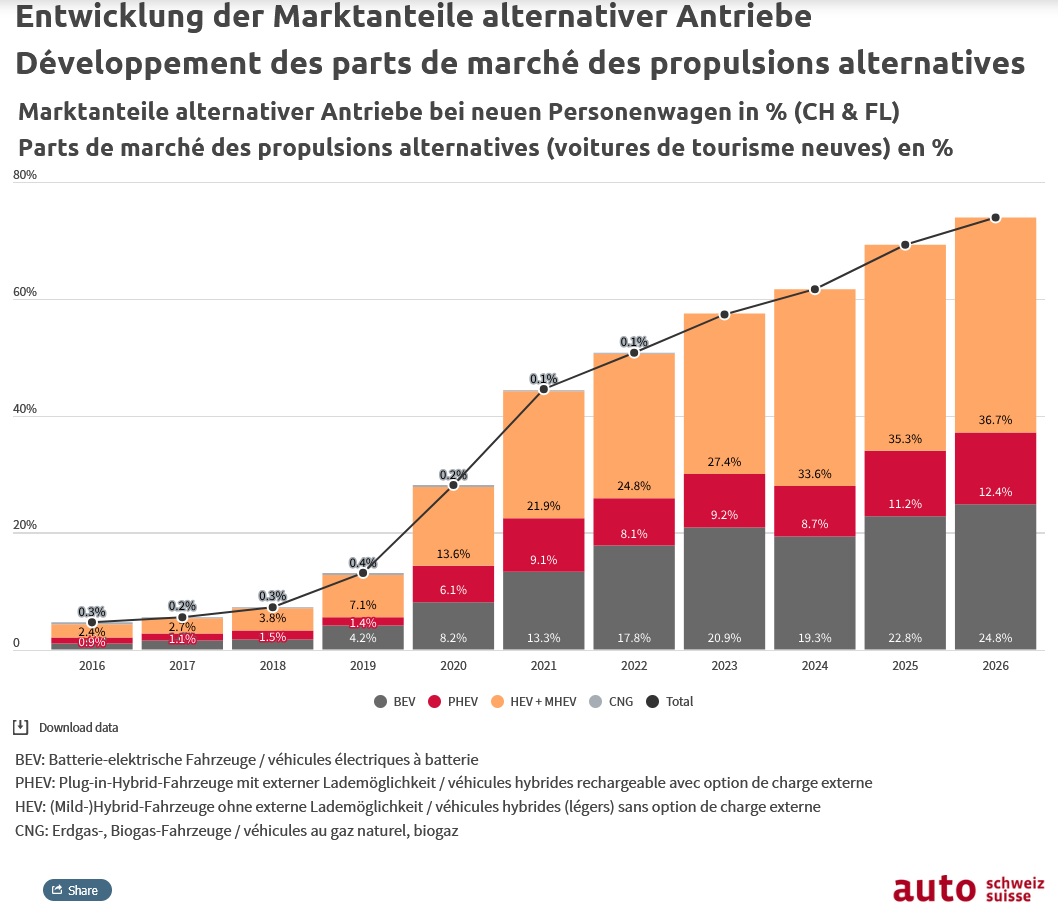
And something happened to BEVs in 2023, it’s almost like a ceiling was hit.
2 Likes
What follows is also taken from Auto Schweiz (https://www.auto.swiss). In particular from their statistics section on Alternative Antriebe).
ICE still make up 2/3 of the new registrations.
Your chart and this text are massively contradicting, the only way the chart might be accurate is, if it pictures the ratios within the alternative energy sources but that covers only a third of the new registrations.
Plug-in vehicles account for about one-third of new registrations
In 2025, plug-in vehicles accounted for a market share of just over one-third (34 percent) of new registrations in Switzerland and Liechtenstein. This market share is broken down into 22.8 percent for all-electric passenger cars (BEVs) and 11.2 percent for plug-in hybrids (PHEVs). This puts plug-in vehicles just behind hybrid vehicles, which accounted for a total of 35 percent of new registrations in 2025.
It makes sense. Look at the 2025 numbers from the chart from auto.swiss. So, Steckefahrzeuge (rechargeable, plug-in) is indeed a third of new registrations.
Steckerfahrzeuge = BEV + PHEV = 22.8 + 11.2 = 34%
1 Like
Hydrogen is the future!
Hydrogen cars suffer from the same early-adopter range anxiety that once plagued EVs. If you live in a city with plenty of hydrogen stations, you’re golden, but venturing out into rural areas quickly becomes a logistical nightmare.
From an energy perspective they’re far less efficient than electric e.g. efficiency of a hydrogen car is around 35-40%, whereas a battery electric vehicle operates at 70-80% efficiency.
Finally if you choose to ignore the carbon instensive process of hydrogen extraction and only focus on tail pipe emissions, they look good. OTOH generating renewable electricity is far easier than green forms of hydrogen e.g. I have a colleague in Vaud with solar cells on his roof, and it comfortably keeps his two EVs topped up to 100%.
1 Like
Hydrogen transport and infrastructure costs are substantially higher than electricity. You are better off burning the H to generate electricity.
1 Like
It’s a subsidy grab, and a technology designed to perpetuate the status quo.
Nothing ever came from it, after 30 years of pouring money into.
2 Likes
Remember the Hindenburg Zeppelin.
Good for a city bus with the same route everyday.
Hydrogen may not be as efficient as electric cars today, but hydrogen can be stored for longer periods compared to electricity. Also, it’s about not carrying all the eggs in the same basket.
I agree we need diversity, but building out a hydrogen filling infrastructure that is ubiquitous enough to satisfy consumer range anxiety will be the challenge. I credit Musk for doing that with EVs, but who is currently driving hydrogen adoption other than Toyota?
Sorry! Am not so old. But do recall my dad mentioning something about it.
1 Like
That’s precisely the link shared by RobBob: Volvo Trucks.
This is due to High Pressure Direct Injection (HPDI), a technology where a small amount of ignition fuel is injected with high pressure to enable compression ignition before hydrogen is added. Volvo is already using this technology in its gas-powered trucks, with more than 10,000 units sold globally.
If you say this is useless for me, you’re absolutely right. No one of us will ever buy a garbage truck, a city bus, a box truck that brings goods from distribution center to local shop, or farm machines. These are not vehicles for every household, anyway we need them. A city bus drives 200-300 km/day and a whole city network can be serviced with 1 or 2 recharge points.
On average, a commercial truck in Europe emits 1 kg of CO2 per km when loaded. My idiotic & wasteful ICE: 220 grams CO2/km. But, I drive 10-15k km/year. A commercial truck easily 100+k km/year. So, the truck emissions of a single truck are comparable to 30 or even 40 idiotic and wasteful ICEs. A single commercial vehicle can have a lot of impact.
2 Likes
Nobody.
It’s hideously expensive. If there was any profit in it, Toyota would have built that infrastructure.
Just as Elon built the charging infrastructure and is building the charging infrastructure for commercial trucks.
I’ve said some pretty nasty things about hybrids since they seem to be the worst of all worlds, because whichever way you cut it, you’re hauling around either an engine on EV power, or a battery and motor on petrol power. Double the complexity, double the failure points, its not a car I’d be comfortable owning out of warranty.
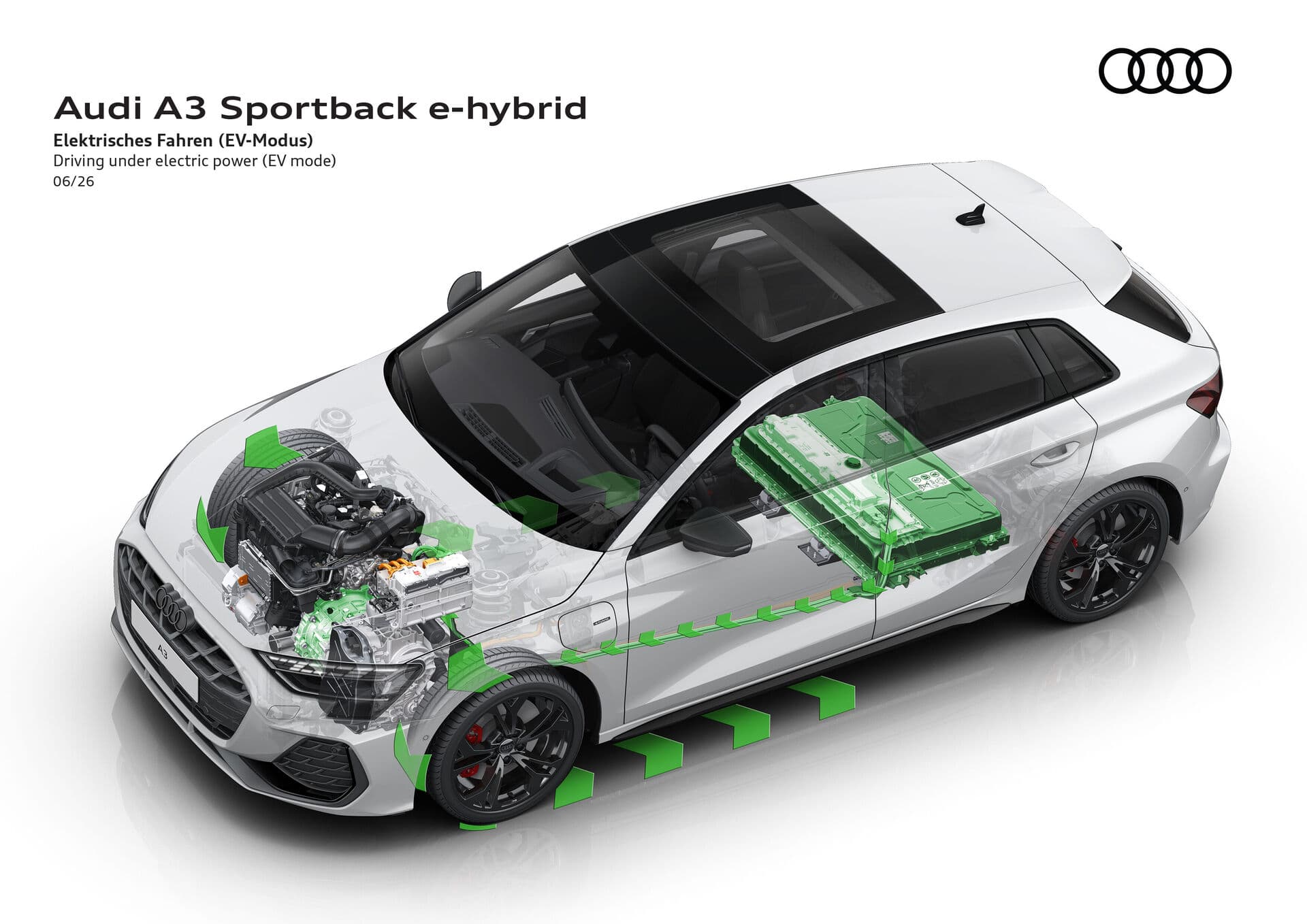
Anyway since I’m in the market for a hot hatch, and I like the Audi S3, I thought it might be fun to try the highest output A3 hybrid, the A3 45 TFSI e. And I have to say I was very pleasantly surprised. The usual low speed jerkiness of the VAG DSG gearbox is completely ironed out by the fact that the gearbox is mated to the electric motor so the initial shove and traffic crawl is purely EV and the engine seamlessly blends in when you floor it. And since its plug-in, you get a real world 100 km pure EV range thanks to its 20kw battery. Combined with its 1.5 petrol engine, that’s a respectable 272 bhp and 400 nm torque. And unlike the Toyota hybrid engines and CVT gearboxes, they’re not loud and whiney.
Anyway, I like to give credit where due. This is one serious little hybrid that manages to combine the best of both worlds. Still not sure if its enough to sway me as its FWD, and I did feel the car scrambling for traction on perfectly dry roads, not a problem with the Quattro AWD S3.
2 Likes
How long is the warranty on the drive train?
You do not want to own this out of warranty.
So, unless you drive out of town, it’s an EV. 400 Nm of torque is enough for the S3, even if a bit heavier because hybrid system.