It is typical of a non scientist ignoring the clearly written conclusion of a study
Instead cherry-picking some tiny part of the study to dispute the results
3 Likes
I’m a non-Scientist too but the conclusion was pretty clear.
2 Likes
Isn’t that what California Dreamer always did?
4 Likes
Yep, he might have changed his name but everything else is the same.
1 Like
I did not intend to belittle non-scientists.
I just find it sad when people who do not know scientific terminology nor have a strong mathematic background try to disparage scientific studies.
1 Like
No, I appreciate that.
I tend to just read the summaries and conclusions which are usually written more in layman’s terms.
Also, I try and find out who funded the research as that can be quite revealing.
1 Like
A very good idea.
1 Like
God helP America with this health minister
RFK Jr. Unloads the Truth About Ivermectin to The Hill: “It Was Really a Miracle Drug”
“There are now 100 studies that show that Ivermectin had profound benefits. Generally speaking, a 70% to 85% reduction in hospitalizations and deaths,” reported Kennedy. “It was really a miracle drug.”
https://x.com/Ivermectinkart/status/1953529290202448230
Every properly conducted Ivermectin trial showed either it was ineffective or was abandoned before completion due to concerns about health problems in the group taking Ivermectin
1 Like
I asked the AI Perplexity if his statement was true:
Robert F. Kennedy Jr. recently claimed that “100 studies” show ivermectin had “profound benefits” for COVID-19, reporting reductions of 70% to 85% in hospitalizations and deaths, and called it a “miracle drug.” These statements are not supported by the best available scientific and medical evidence.
- Major health authorities, including the World Health Organization (WHO), U.S. Food and Drug Administration (FDA), Centers for Disease Control and Prevention (CDC), and the European Medicines Agency (EMA), have all reviewed the evidence and do not recommend ivermectin for the prevention or treatment of COVID-19 outside of clinical trials[1].
- A Cochrane meta-analysis—considered a gold standard for evidence review—examined clinical trials up to April 2022 and found no beneficial effect of ivermectin for people with COVID-19. Larger, well-designed trials published since then have confirmed this finding even when ivermectin is given at higher doses and for a longer duration[2].
- A recent review from Oxford University also confirmed that ivermectin lacks meaningful clinical benefits in COVID-19 patients and does not reduce recovery times, hospital admissions, or deaths in a vaccinated population[3].
- Some observational studies, such as the one from Itajaí, Brazil, have claimed large reductions in COVID-19 deaths or hospitalizations with ivermectin use[4]. However, these studies have been widely criticized for methodological weaknesses, such as lack of randomization, potential confounding factors, and possible data irregularities. Many early studies that suggested benefits have been retracted, found to have errors, or evidence of possible fraud[5].
- Independent scientists reviewing the key studies promoted by ivermectin advocates found that none of those studies showed convincing evidence, and many had “either obvious signs of fabrication or errors so critical they invalidate the study”[5].
Summary: The consensus of high-quality scientific reviews and clinical trials is that ivermectin is not effective at reducing COVID-19 hospitalizations or deaths. There is no solid scientific basis for claims that it is a “miracle drug” against COVID-19 or that it reduces hospitalizations and deaths by 70%–85%. Regulatory agencies strongly advise against its use for COVID-19 outside of properly conducted clinical trials[2][3][1].
Sources
[1] Ivermectin and COVID-19 - FDA Ivermectin and COVID-19 | FDA
[2] At a Higher Dose and Longer Duration, Ivermectin Still Not Effective … https://jamanetwork.com/journals/jama/fullarticle/2801828
[3] New study shows ivermectin lacks meaningful benefits in COVID-19 … New study shows ivermectin lacks meaningful benefits in COVID-19 treatment — Nuffield Department of Primary Care Health Sciences, University of Oxford
[4] Regular Use of Ivermectin as Prophylaxis for COVID-19 Led Up to a … Regular Use of Ivermectin as Prophylaxis for COVID-19 Led Up to a 92% Reduction in COVID-19 Mortality Rate in a Dose-Response Manner: Results of a Prospective Observational Study of a Strictly Controlled Population of 88,012 Subjects - PMC
[5] Ivermectin: How false science created a Covid ‘miracle’ drug - BBC Ivermectin: How false science created a Covid 'miracle' drug
[6] Efficacy and safety of oral ivermectin in the treatment of mild to … Efficacy and safety of oral ivermectin in the treatment of mild to moderate Covid-19 patients: a multi-centre double-blind randomized controlled clinical trial | BMC Infectious Diseases | Full Text
[7] How ivermectin became the new focus of the anti-vaccine movement How the ivermectin culture wars took off : Shots - Health News : NPR
[8] Association between ivermectin treatment and mortality in COVID-19 Association between ivermectin treatment and mortality in COVID-19: A hospital-based case-control study - PMC
[9] Ivermectin, ‘Wonder drug’ from Japan: the human use perspective Ivermectin, ‘Wonder drug’ from Japan: the human use perspective - PMC
[10] Policy brief on the reduction of Covid-19-associated mortality by … Policy brief on the reduction of Covid-19-associated mortality by drug therapies – Swiss National COVID-19 Science Task Force
[11] Review of the Emerging Evidence Demonstrating the Efficacy of … Review of the Emerging Evidence Demonstrating the Efficacy of Ivermectin in the Prophylaxis and Treatment of COVID-19 - PMC
[12] Ivermectin: enigmatic multifaceted ‘wonder’ drug continues to … Ivermectin: enigmatic multifaceted ‘wonder’ drug continues to surprise and exceed expectations | The Journal of Antibiotics
[13] Treatment with Ivermectin Is Associated with Decreased Mortality in … https://www.sciencedirect.com/science/article/pii/S1201971221009887
[14] Ivermectin for treatment of COVID-19: A systematic review and meta … https://www.sciencedirect.com/science/article/pii/S2405844024036788
[15] News: A large study finds that ivermectin… (The New York Times) News: A large study finds that ivermectin... (The New York Times) - Behind the headlines - NLM
[16] No reduction in COVID-19 hospitalizations, deaths with ivermectin No reduction in COVID-19 hospitalizations, deaths with ivermectin | EATG
[17] Systematic review and meta-analysis of ivermectin for treatment of … Systematic review and meta-analysis of ivermectin for treatment of COVID-19: evidence beyond the hype - PMC
[18] Fact Check: 2015 Nobel Prize for ivermectin intended for treatment … Fact Check: 2015 Nobel Prize for ivermectin intended for treatment of parasitic infections doesn’t prove its efficacy on COVID-19 | Reuters
[19] Effectiveness and safety of ivermectin in the treatment of COVID-19 Effectiveness and safety of ivermectin in the treatment of COVID-19: protocol for a systematic review and meta-analysis | BMJ Open
[20] Ivermectin: A Multifaceted Drug With a Potential Beyond Anti … Ivermectin: A Multifaceted Drug With a Potential Beyond Anti-parasitic Therapy | Cureus
Curly, sorry about all the links. But I noticed that RFKjr didn’t provide any.
4 Likes
terrifish would of course disagree, based on nothing at all.
3 Likes
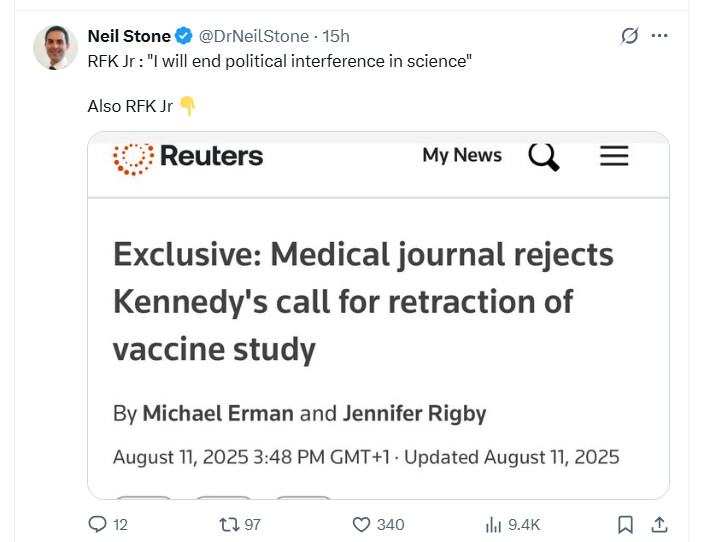
A US journal is refusing to withdraw a study of 1.2 million children that showed aluminium in vaccines has no negative effect despite RFKjr claiming it is a fraud
Cumulative aluminum exposure from vaccination during the first 2 years of life was not associated with increased rates of any of the 50 disorders assessed.
1 Like
I am so happy I do not live in the US where my health is threatened by nutters from all levels.
Tucker Carlson’s fiery condemnation of the COVID vaccine:
“This is pure evil.”
“The people who make it should go to prison.”
From the study (and no, I didn’t write it, I just bothered to actually read it — did you?):
“Results based on vaccine type revealed a link between the BNT162b2 vaccine and an increased risk of myocardial infarction (OR, 1.87; 95% CrI: 1.22–2.89) and stroke (OR, 2.09; 95% CrI: 1.36–3.21). These findings were significant for stroke following the first dose (OR, 3.69; 95% CrI: 2.13–6.37) and for myocardial infarction after the second dose of BNT162b2 (OR, 3.84; 95% CrI: 2.21–6.66).”
That’s straight from the study itself. My “point” (since you asked) is simple: I quoted the data. You know — those pesky numbers that appear after you scroll past the abstract.
If you think quoting peer-reviewed findings is “misinformation,” then you’ve basically admitted the same studies you cite can be selectively interpreted depending on which page you look at. That’s exactly the problem: cherry-picking is universal.
So instead of challenging me, maybe explain why this text exists in the study at all. Because unless I’m secretly writing for the journal, those words are theirs, not mine.
Quoting random parts of studies ts called cherry-picking, a tactic often used by people attacking science, nearly always, like here, without sufficient training or background to understand what the data really means.
You claim to have “read” the study, what you’ve really done is pore through it searching for any titbits like these that appear to show something negative, then failed to actually read or understand the context and the analysis methods.
What you think is going to happen is that people will be unable to challenge your assertions - after all, you’ve got data to support them.
What actually happens is that most people ask how come you can reach conclusions that differ from those of the study authors and the whole peer-review process. Is this a result of your superior knowledge and intellectual capacity, or is it more likely that you don’t know what you’re talking about?
4 Likes
Quoting the data, and interpreting and understanding it are two different things.
The quoting requires zero skill and knowledge.
The interpreting and understanding requires skills that the layman does not normally possess.
Hence, the value of the conclusion, which is normally written in terms that more people can comprehend.
2 Likes
Well said.
There is a large group of people who usually have had no scientific training but feel that science is somehow used to trick them.
They delight in searching through studies hoping to find something that appears to contradict the study’s conclusion.
When they do find something then they are convinced they are right and are not open to counter logical arguments.
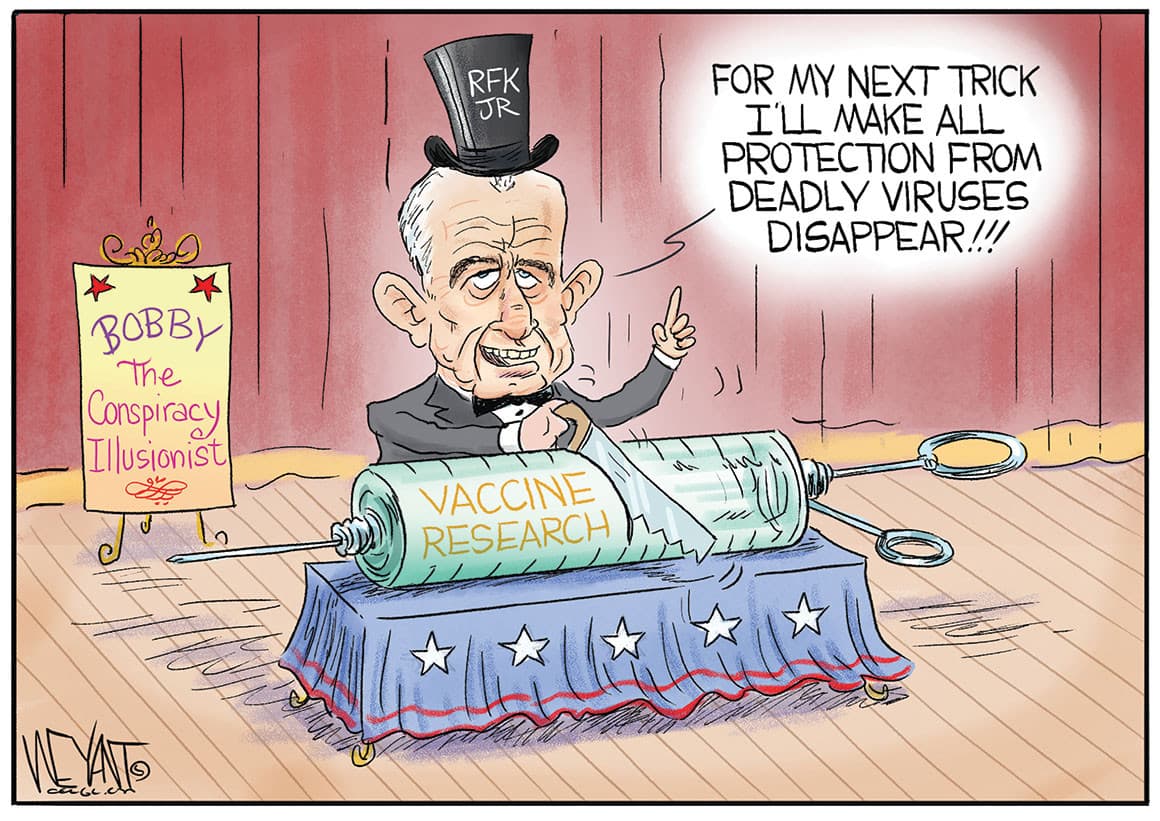
We now have one such, RFKjr, in a very powerful position, who will likely inflict a lot of damage on the US health system. He has already blocked mRNA research, which shows great promise for treating cancers.
Here is a good review of the state of the art for mRNA cancer treatments.
3 Likes
I don’t think there’s anything complicated about the wht I quoted.
Marton: "When they do find something then they are convinced they are right
That doesn’t make sense. ??
are not open to counter logical arguments.
I already asked
"So instead of challenging me, maybe explain why this text exists in the study at all. "
Do you understand what “significant” means in a scientific study?
For example, usually something like this: “Associations were considered statistically significant if the 95% CI did not overlap 1.”
You do not say which study you are referencing
This study has;
Bayesian meta-analysis revealed a link between vaccines and CAD risk (OR, 1.70; 95% CrI: 1.11–2.57), particularly after BNT162b2 (OR, 1.64; 95% CrI: 1.06–2.55) and second dose (OR, 3.44; 95% CrI: 1.99–5.98).
No increased risk of heart attack, arrhythmia, or stroke was observed post-COVID-19 vaccination.
As the only noteworthy point, a protective effect on stroke (OR, 0.19; 95% CrI: 0.10–0.39) and myocardial infarction (OR, 0.003; 95% CrI: 0.001–0.006) was observed after the third dose of the vaccine.
I assume the number after “OR” in your question is the number of cases per 100,000 vaccinations?
So, when you quote (OR, 3.84; 95% CrI: 2.21–6.66) this means 3.84 cases per 100,000 vaccinations?
Can you confirm?