When did you double down on CVI?
Thanks, this is a great pairing for a caffè corretto.
1 Like
Like always I did comment the trade almost real time here. But there is too much noise, as in almost all forums. It was here:
I do comment all my trades close to real time for accountability reasons, nobody will believe that I beat all the fund managers while travelling the world. My gambling portfolio is up again already 33.34% this year.
1 Like

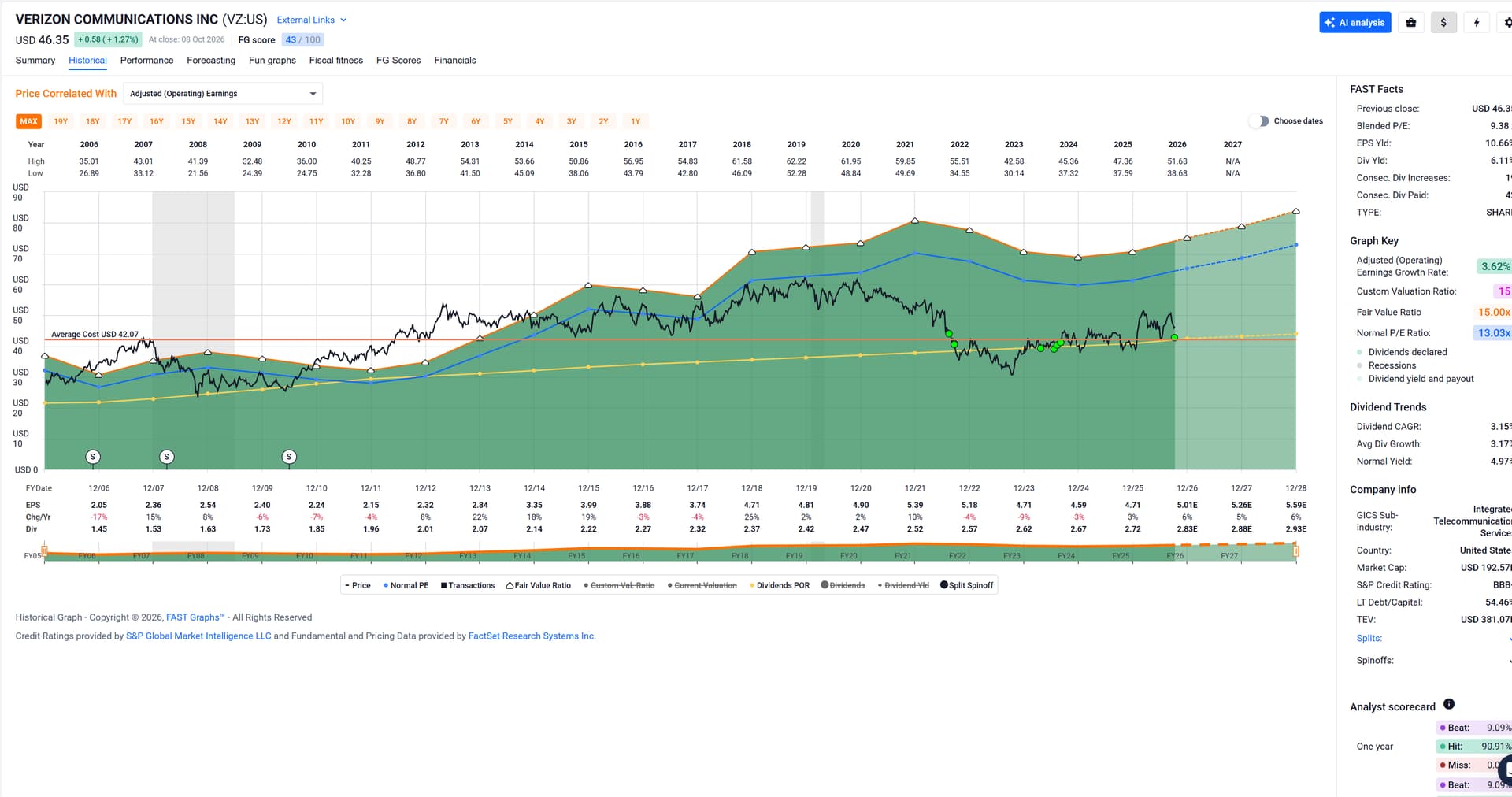
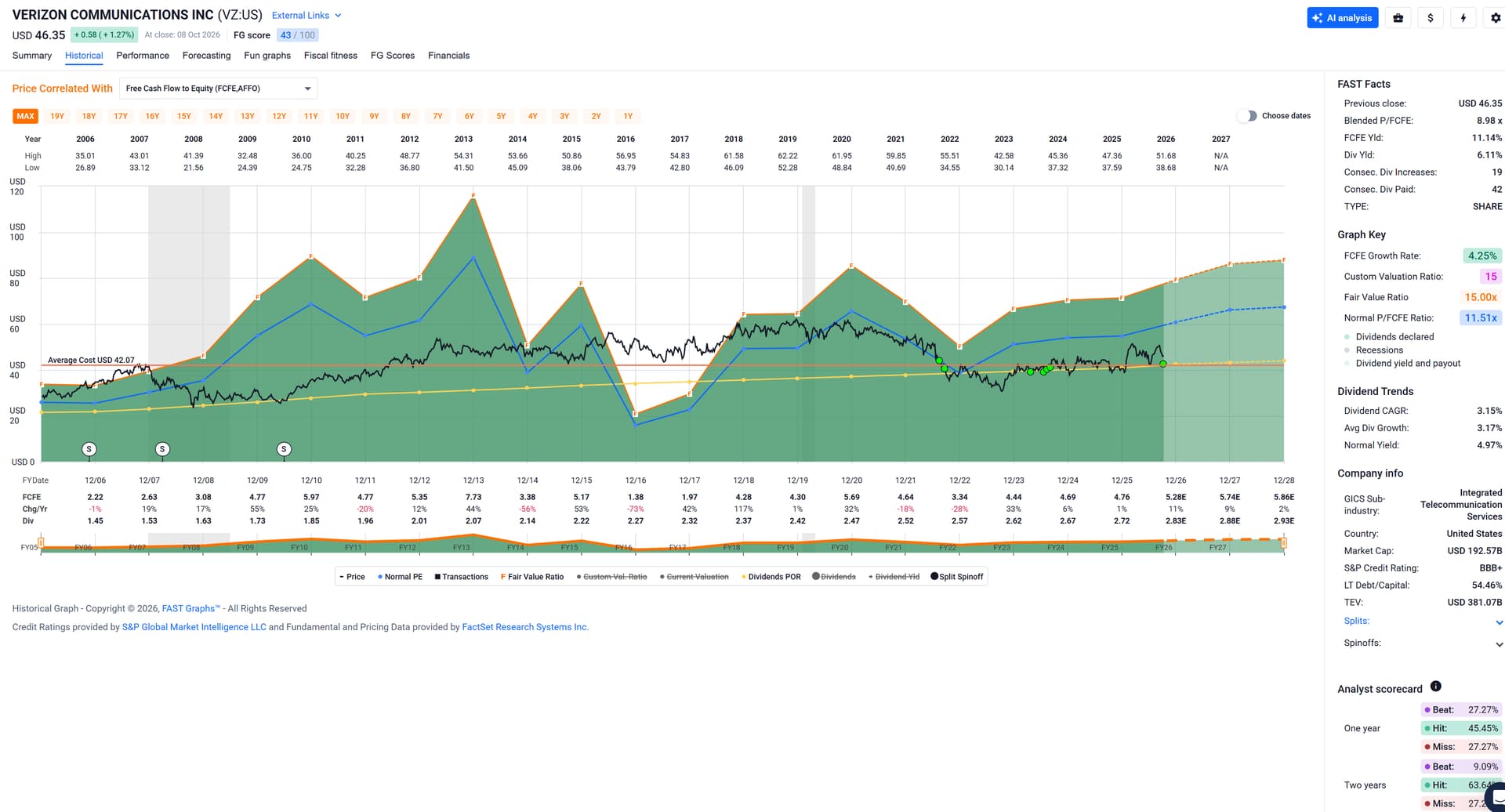
Telcos took a hit today upon news that Space X / Starlink is looking into expanding into the mobile phone business.
Took that as an opportunity to add to my Verizon position. Could have added to Comcast as well, but that position is kind of full. AT&T would have been another option, but I’d like to see them raising their dividend again.
Was tempted to sell long dated Puts, too, but I’m flush with cash at the moment and would rather not have more short positions on my book as the year comes to an end (and ideally have no short Puts on my year end statement).
Remember, kids, always bet against Elno. But never short him.
I am afraid it will take a few years until the new competition gets visible in the cash flow statements. But it is a rule breaker. Nationwide or even worldwide fast internet at very low cost. Probably it is about time, the prices of the telcos are just crazy! Must be inefficiency, how can a worldwide satellite network be cheaper that a few cables in the ground?
I hold Comcast and AT&T.
1 Like
Starlink’s (SL) available bandwith (1 Terabit per second per V3 satellite, Tbps) is limited by the number of satellites in view, that basically rules out metropolitan areas because it would get distributed among too many customers to be attractive. That leaves the countryside, at most 20% of the population in the case of the USA, much less for Europe.
100Mb, SL’s base offer, starts at $55. The vast majority of earth’s population has far less daily income than that let alone disposable income. I seem to remember some 1 billion earns enough for that, most of which are in Europe and North America and already get terrestrial service at lower prices than SL offers so far.
The V3 satellites aren’t geostationary, they orbit earth in ~90 minutes. So they cover any given point for minutes only, meaning you need at least a dozen satellites for a continuous service, probably significantly more. OTOH, from Starlink’s POV at least half the service potential goes unused because they’re over the Pacific Ocean or near the poles. And you want the satellite high in the sky, rather than near the horizon (narrow mountain valleys anyone?), for various reasons. Taken together that reduces the theoretical potential by a big factor.
All in all this reminds me of the bandwidth problems inherent with cable connections a couple decades ago. I’m sure that’s solvable but you destroy your good reputation once only.
Of course SL’s price might come down. But it needs to come down an awful lot to become price competitive, which obviously reduces income per customer in turn. And once people have been pissed off enough, no amount will bring them back if they have an alternative reliable provider. Despite all the groundbreaking stuff Elon has achieved, he has a strong reputation beyond that for being long on promises/dreams and short on realising them.
I won’t hold my breath waiting for Starlink to become competitive with the incumbents.
5 Likes
Thanks, very interesting. I think the “last mile” in cities are already over-covered. Also I don’t know the tech that is needed to add to the satellite bandwidth. Maybe it makes more sense for populated areas to jus buy one of the existing providers.
T dumped 10% yesterday on the news, that is what I feel…
AMT (cell tower REIT) jumped about the same amount. The news triggering this was "SpaceX has agreed to buy licenses for radio airwaves that will enable its Starlink Mobile satellite business to provide cellular service inside buildings, a move the company said will allow it to “become a major mobile carrier in the U.S.”"
Of course these antennas for those radio waves will have to be installed somewhere … which is where my cell tower REIT comes into play.
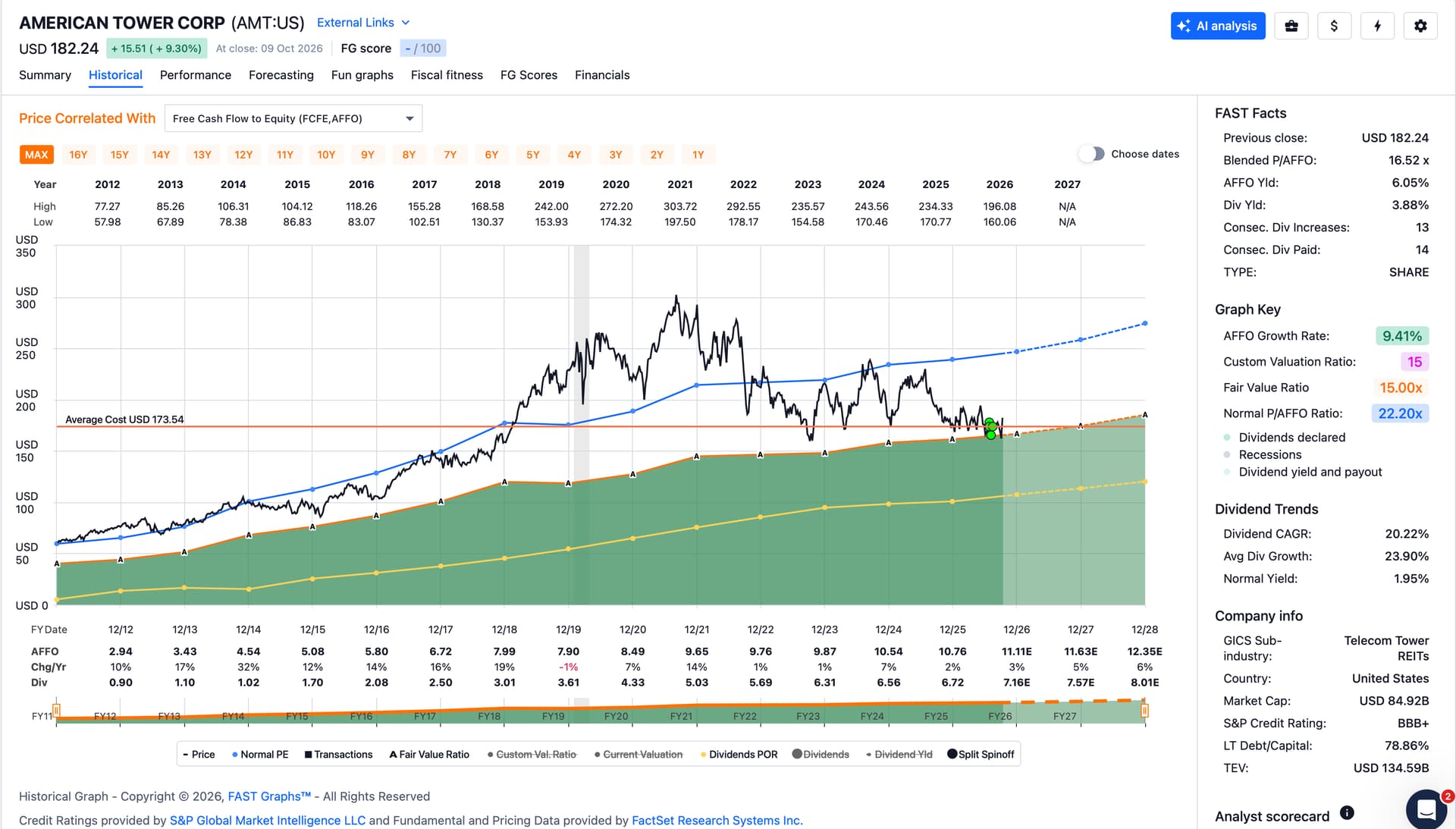
I bought AMT this summer because I had inside information about the Starlink announcement it’s been on my watchlist since forever and the price for the first time in a long time sank into buyable territory.
I hadn’t seen the news about the frequency purchase when I wrote the above. SL will need FCC approval but that’s probably an almost-given with Trump in the WH.
Covering the last mile the conventional way increases SL’s potential customer base very bigly even though easily a fifth of the population would never subscribe out of pure hatred for Elon. A terrestrial network comes with a big price tag, covering Manhattan for example requires 300-600 large G4/G5 antennas plus hundreds or thousands smaller ones to cover hotspots, says my AI. A large antenna in a city typically costs $250-500k to set up plus $100k+ annually to run and maintain. Many smaller ones (often mounted on lamp posts and house facades etc) will need to be camouflaged which increases costs further.
Starlink admits that heavy rain, snow and hail can cause temporary degradation of the communication. This can’t be avoided, you can’t make the kilometers of snow in the air above disappear. So either accept the temporary degradation or provide a bypass (e.g. glass fiber).
But why not use the reliable bypass all the time instead of the satellites? So, Elon’s stance will probably be “accept the limitations”. Whether Joe Comsumer accepts that, and how much of a rebate this requires relative to the incumbents, will be interesting to see. Perhaps they’ll use Elon’s (cheaper) subscription as default plus a prepaid secondary for backup?
Elon is the devil incarnate for the typical blue city, which is the clear majority. They’ll do whatever they can to hinder his success, required permits won’t be provided before pigs can fly.
I’m still not holding my breath.
4 Likes
With or without the vodka? Before buying or selling?
2 Likes
@Your_Full_Name You might be interested in this:
CoreWeave is chasing insurers’ vast pools of capital as the Nvidia-backed AI cloud provider seeks cheaper ways to fund the tens of billions of dollars it is spending on chips and other AI infrastructure.
CoreWeave targets ‘unlimited’ insurance money for funding
Pensioners can always be trusted to be the final bagholders.
CoreWeave’s unsecured bonds had sold off to yield almost 15 per cent and that investors worried about a mismatch between its long data centre leases and shorter customer contracts.
Though at 15%, I’m a buyer. Where can I get these 15% yielding bonds? On IBKR apparently: USU2069EAA83
This got me looking at bonds. Credit spreads still seem quite tight. How can Oracle borrow at only 7.5% for 2035 maturity given the datacenter risks?
2 Likes
I probably should have waited for the next Fed hike, but now I own CoreWeave debt… 
1 Like
WSJ: Broad Pickup in Prices Lifted Inflation to 3.7% in September.
Wall Street traders dialed up their bets that the Fed may indeed raise rates when officials meet in two weeks. Traders now see a roughly 50% chance of an October rate hike, up from 22% before the report was released.
Now that you have CoreWeave by their balls bonds you should squeeze them so they give you some free neocloud computing time … 
Speaking of bonds, there was a very recent article by Jason Zweig in the WSJ on the origins and history of the word “bond”, including pictures:

Elihu Vedder, “Soul in Bondage” (1891-1892). The yellow butterfly that the soul grasps lightly in her left hand is an ancient symbol of the human spirit. In Greek, psyche means both ”soul” and ”butterfly.” (@Refugee) It is the root of our word psychology. Bond issuers that flit around, instead of being bound by their commitments, are playing a psychologically dangerous game. Brooklyn Museum
4 Likes
The AI beatings will continue until I get more likes …
It kind of feels to me like watching a car pileup on the highway in slow motion, from a 10’000 foot in the air view a couple of minutes  before the crash happens with a view of the cars at the front already slowing down, somewhat not visible well as they are behind a bend for the cars and very large trucks approaching from behind still going 130mph …
Anyway, I haven’t been quoting Kuppy in a while (at least on this forum), but this seems interesting:
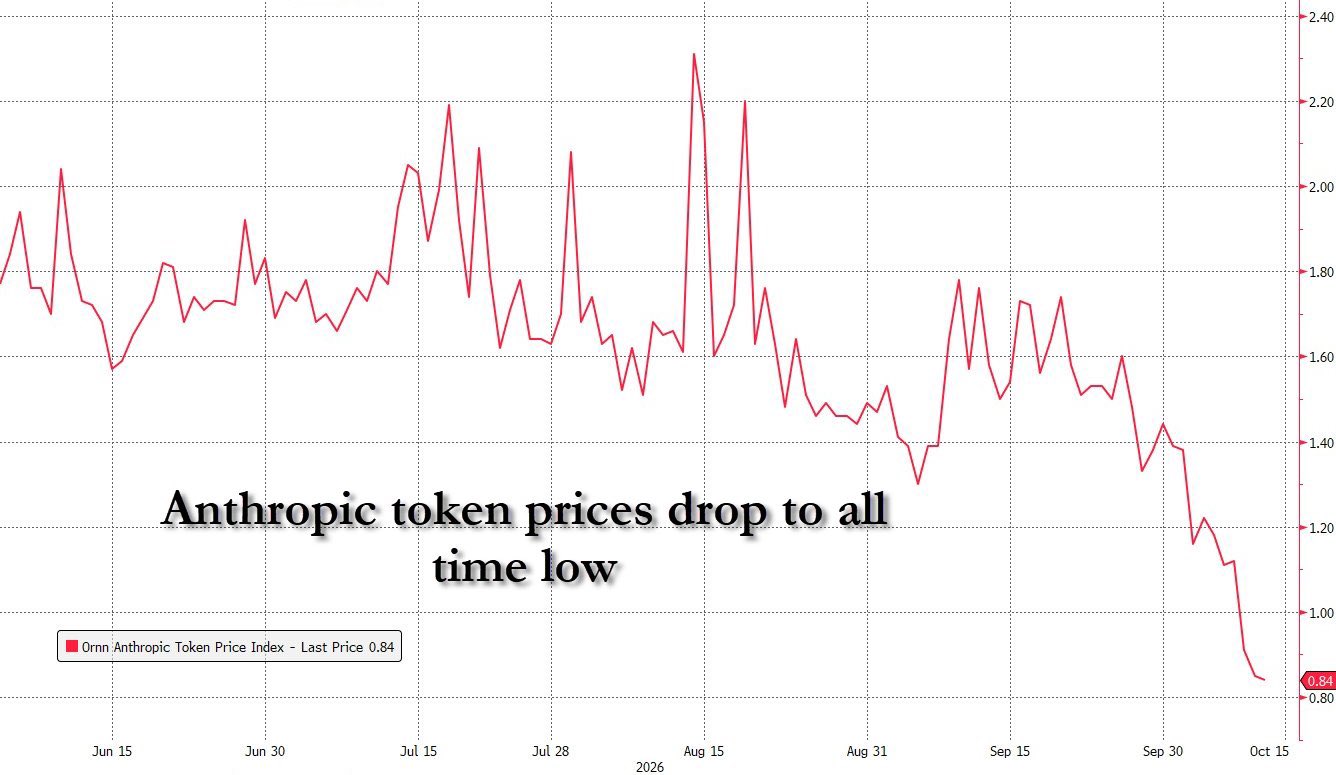
Kuppy:
I get it, there are nuances for tech-bros who are deep in the weeds. Everyone has an anecdote about why I’m wrong.
Take a step back and be a commodity-bro who’s seen enough supply/demand cycles. Tokens are a commodity. Currently, the token factories are out-stripping token demand. Pricing is the adjustment factor. Except token factories are mostly fixed-price businesses. They have take-or-pay. They have commitments. They will produce tokens at a loss rather than turn off.
I’m not saying that token demand is slowing. It’s still growing at astronomical rates. I’m saying that token production is now out-pacing demand. The cycle will turn when demand accelerates or token production slows. There’s like half a trillion $ of GPUs waiting to be installed. I don’t think token production slows anytime soon.
Yeah, I get it. Jevon’s and all. It’s great for AI consumers and innovators. But the guys owning token factories are gonna all go bust in the process, and that’s like $2T of capex to date. You cannot even restructure these things and crush the debt. They’re just stranded by new, and more efficient chips. They’re always going to be stranded by new chips. More efficient Models will strand the more expensive ones. It’s a race to the bottom against fixed costs. It’s the most godawful business misallocation I’ve seen in a while. Makes the Chinese look like prudent capital allocators!

It’s like having iron rails when the new railroads run on steel. This bankruptcy cycle will be epic…
Obviously, minutes in market calendar time can last months or even years. Sometimes they boil down to a week a a couple of days though. The crash may not happen, but I would be surprised.
Honestly, I’m amazed how my mostly non-AI portfolio is outperforming the S&P 500 this year but I am also scared that an epic crash will drag down my portfolio probably 20 or 30 or 40 or 50% or more. I hope the dividends will remain mostly stable during that period.
1 Like
Currently, the token factories are out-stripping token demand.
I have no idea how he can get to the conclusion that token supply is outstripping demand?!
If he’s assuming that just because prices are falling then he’s making overly simplistic arguments.
3 Likes
@Your_Full_Name makes a personal mental adjustment: @Phil_MCR seems to be a “tech-bro” in Kuppy’s book.
I’m in no position to counter your reply. I am a simple mind when it comes to commodities, macro, or … really anything, if I am honest.
If I read Kuppy correctly, he’s comparing AI to a commodity business, where supply and demand determine price and IIUC in my very simplistic interpretation he states
(a) AI token pricing is akin to commodity pricing
(b) AI token price deteriorating means that demand is not keeping up with supply
(c) AI token supply expected to becoming online is going to exceed demand (and contribute to (b), price deterorating)
(d) AI technological advances contribute to the effects taking place in (b) through (c). Reflexive to (d).
No need to respond, but what are the “overly simplistic arguments” by Kuppy in your view and how would you explain token pricing plummeting?
Although I am usually sarcastic and somewhat absolutist about my AI views, I am genuinely interested in why you have a different view (investment wise, medium term). Short term, it’s of course all just speculation.
Longer term … even as I am convinced this technology might be transformational from a societal perspective, I am even more curious why this will interesting investment wise in the medium term.
I think he falls at the first hurdle:
AI token pricing is akin to commodity pricing
He’s assuming tokens are like gasoline, a uniform tradeable item. They are not not all tokens are equal. The point alone voids his whole argument as his premise is false.
Anthropic tokens are like the Louis Vuitton of tokens, expensive premium and people are willing to pay for the best.
Second: selling price is not the same as cost price. Manufacturing cost of tokens have plummeted and part of this is passed onto customers. Initially, passed on as cost per unit intelligence (i.e. we pay the same cost per token, but the results we got were better).
It is true that Anthropic is coming under competitive pressure. You don’t need to buy a LV bag if you just want to carry some vegetables around in your garden. Competing AI products have improved and is taking an increasing share of token volume. I predict an intermediate state where we’ll see something like the Apple / rest of the mobile market split: you have Apple having (say) 20% of the phone market but making 80% of the profits. I’d see top tier e.g. Anthropic taking 80% of the profits while serving 20% of the tokens.
It is not clear that this intermediate stage will be sustainable. It depends on what the demand is for intelligence and whether open/free models continue to advance.
In one world, we could see open models being ‘good enough’ for so much stuff that there isn’t enough market left for an Anthropic premium.
The other is that the pie grows so big and so quickly that there is still a huge market for the premium models / OR that there is an increasing demand for higher intelligence / OR open source models cap out in capability early so that premium is the only option for higher intelligence levels.
Anyway, to anser the direct question. Token price falls due to:
- Competitive pressure
- Increasing capacity meaning there’s a reduction in the need to ration tokens by artificially high prices
- Improving token cost economics allows for reduced pricing while maintaining/increasing margins (market share grab)
ChatGPT started plugging Ricardo adds for me…“this might interest you”, the beginning of the monetization?
But CHDVD and SCHD popped well today.
1 Like