Ya, about10 years after the price stabilises.
Reduced lethality of chronic conditions and their comorbidities. Think organ transplants as an extreme though rare example.
Increased rate of diagnosis as such.
It is estimated that 30% of the US population have pre-diabetes type 2 but only 20% of them are aware. 23% of the population with fullblown diabetes T2 are believed to be unaware. Half the US population has hypertenstion but only 30% of them know. Awareness keeps improving albeit slowly, but that will lead to improved treatment and thus reduced lethality as well as an increased rate known to have a chronic disease. The situation won’t be entirely different around here, though probaly far from that dramatic as overweight and obesity (the main drivers behind the mentioned conditions) are far less prevalent.
Plus possibly reclassification of some conditions as a chronic disease. Obesity that gets treated either with Ozempic et al or a gastric bypass might be such an example.
There are moments when the public vote is not a very good idea…(I am sure many people will disagree of course but this is my opinion too)
1 Like
Myth? One of the reasons I choose to stay in Switzerland is because the Swiss system is one of the best (value) in the world. It is difficult to find the exact numbers to make comparisons but my personal and family/close friend experience puts it ahead of the UK, NZ, USA, Canada. Doctor training is good in all these countries, though not the same. It is not perfect, some countries do some things better. Mistakes are made everywhere. Medicine is also an inexact science. Public expectation is high, sometimes too high. We have to learn to live with uncertainty. A 90% response rate is exactly that.
As for generics - I have often asked for and then received a generic. Unfortunately some doctors and some patients insist on the original with justifications that are, IMO, highly questionable.
1 Like
It took me a while to understand. But, still not sure if I got your point.
If chronic conditions are not diagnosed, people just dies before being “sick” and consuming health services.
If chronic conditions are diagnosed, people meets the doc for regular checkups, some prescriptions, etc. They start consuming health services right after the conditions is diagnosed and they live more years. Then, the fraction of people with a chronic condition in the overall population goes up.
Was this the idea?
1 Like
It becomes very expensive for families with many children!
My daughter’s friend has 7 siblings fortunately they are not living in Switzerland.
7 siblings is an expensive thing anywhere in the world. As much as its a personal choice, if money is a constraint, I have little pity for families who produce 7 children on their own will.
3 Likes
Yes, that’s the idea.
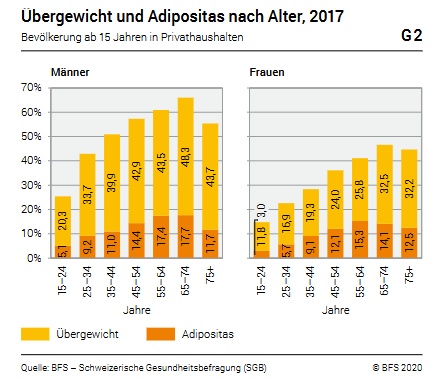
For instance you can see the effect of the “they die” in the obesity-by-age chart. Though probably not undiagnosed, the effect is visible still. The overweight/obese men among the 75+ age group don’t slim down, they die (early) and leave a less obese cohort behind.
1 Like
That might depend on where you’re coming from. Friends and family in the UK trying to get an appointment with a GP can easily wait 2 or 3 weeks, and then if you need a referral to a specialist, hospital, etc, you can wait months.
The Swiss system by comparison is super-quick and efficient.
Read up on the elektronisches Patientendossier, the electronic patient file.
The undertaking started two decades ago but nobody with authority took the lead, the 26 cantons all have their own interest, the various interest groups shunned the costs, the way it was set up offered no benefit to the providers but additional backoffice work instead, and the public/patients neither knew what was happening nor pressured the development forward.
The result is an agonising demise in slow-motion that, even without hindsight, was foreseeable and could have been prevented at least in this extreme form.
1 Like
I have some friends from Czechia who use the health system here only for emergencies. And they still have their GP there and pay very low fees compared to CH (most of it it’s covered by the state). Their health system is very good.
What I don’t understand about UK - are you talking about the public health system or the private one? If I go to my home country I can arrange a visit to a specialist quite easily, but in the private system.
Essentially, if shit happens they’re using Swiss doctors, infrastructure and insurance. But for checking blood pressure, they use a Czech GP. This doesn’t support your view that the Swiss system isn’t good. In fact, it only makes the point that the more reliable and trustworthy one between the two is the Swiss.
I didn’t say it’s not good, I said it is very expensive and has some low points like prevention.
And quite the opposite, for more investigations/non-urgent health issues they use the Czech system.
Prevention is mainly the accountability and responsibility of the insured. How is the Czech system better than the Swiss in preventing, say diabetes II?
Re cost, your making un unfair comparison with a system which is state-sponsored via taxes with minimal individual direct contributions. In other words, unless your friends are paying taxes and healthcare contributions in the Czech Republic, they are free-riding. That’s always cheaper, no question.
Edit: check this interesting ranking. European Health Consumer Index ranks Switzerland No1 and the Czech Republic No14, just below Portugal. Switzerland ranked higher also in prevention.
Could be no.1 but it doesn’t work for everyone. Might be the fact that folks need someone who would speak their language and takes them more seriously, I don’t know.
I meant the public NHS system. There are private healthcare schemes but it’s not really the norm to have such a policy in the UK.
I’m curious what this means. Is this about annual check ups (pap smears, mole mapping, cholesterol tests, etc)? Or stuff like healthcare subsidies if, say, you join a gym?
The premium goes up and the franchise also. THey want to make you sick.
The franchise only goes up ifyou choose to increase it.
That Index has faced criticism (according to the link) due to a lack of logic in weighting different indicators and that sometimes a trend-over time is used and others a cross-section.
However, assuming it as pretty accurate, and noting that this thread is about persistent premium costs rising in the Swiss system, there are countries which show nearly-as-good, or equal outcomes as Switzerland but with much higher waiting times for treatment.
This would suggest that cost-cutting could be made, without sacrificing overall care.
I believe the government is talking about getting rid of the low franchise option.