The approaching mass AI layoffs

Interesting. On one hand, the narrative of transformative change brought on by technology when maybe it’s only some % increase in productivity per worker.

On the other hand. As any of the Gulf countries, a lot of residents have an immigration background (Oman ~45%). Quite funny to focus on the height restrictions for buildings while missing the people. I guess this is also why Shenzhen in China gets criticism. Author is looking at buildings and people as theme park characters, not people. Never asked people how it feels to rise out of poverty and if they would change their current lives for a city with history:

The population went from thirty thousand to nearly eighteen million. The skyline erupted into a wall of glass and steel so total and so fast that no architectural vocabulary had time to form, no aesthetic identity could take root, and no one in the Party had any interest in letting one develop. What emerged is a city of extraordinary productive capacity that has almost no memory of itself.

PS. I’d say the price for charming atmosphere is too high:

Qaboos died in 2020 with no children. The country he built now belongs to his cousin, Haitham, who by all accounts is a serious and competent man. It seems like an open question whether the constraints Qaboos enforced will remain.

When Qaboos took over in 1970, the small (<750K) population was almost homogeneous: Omani Arabs, with a very small minority of Balochi. That must have made things a bit easier than a population where there’s been much “outside” influence and many migrants.

I was wondering about human rights in Oman. This is the most recent report I can find.

Oman scores 3.05 on the 2024 democracy index on a scale of 0 to 10 (most democratic). Switzerland scores 9.32.

1 Like

They have for years, it’s called taxation. People set up companies because they hope to make some money, it’s never to employ people…

With decent people and companies it was historically a bit of both. Particularly German/Swiss/Austrian companies used to act relatively socially. Sadly becoming very uncommon these days.

1 Like

Mark Russinovich is an engineering mind, yet he came with this
https://dl.acm.org/doi/10.1145/3779312

I haven’t seen personally the increased productivity. Hard to say, maybe indeed if the company kind of enforces it, putting people through training how to use it, etc, etc, it kicks in. However they made a very good observation that the benefit is only due to having the knowledge, the years of experience “doing it manually”. AI never stops (i.e. won’t say I don’t really know, sorry), and always speaks with confidence. If you put a junior in front of the tools they won’t be able to tell

How the industry can solve the problem? Hiring juniors to train them by asking to do tasks manually, ineffectively to gain experience? And then they’ll quit and grab the best offer from the market for experienced engineers. I don’t think the mentoring program can be a substitute considering such pace. Learning requires time, focus, repetition

4 Likes

The SysInternals guy!

That sounds an awful lot like a graduate program at any university. Doctorates are clumsy and low yield at first, after work and mentorship they become better. This makes me smile because developers have some animosity against universities :slight_smile:

Our thesis is simple: We must keep hiring EiC (early-in-career) developers, accept that they initially reduce capacity, and deliberately design systems that make their growth an explicit organizational goal. The path forward is a culture of preceptorship at scale.

Looks reasonable. At some point, I understood what a Lagrangian simplification is. These days I look at simulation results and judge if whatever the computer spouted makes sense or not.

Programming is not software engineering. Even the most reliable systems cannot fully replace the judgment, creativity, and adaptability required to handle uncertainty, make complex decisions, and maintain security. While agents can speed up workflows and reduce manual effort, they lack the intuition to anticipate edge cases and build robust solutions. Relying too much on AI risks missing subtle bugs, architectural flaws, and vulnerabilities that only skilled engineers can catch.

I guess this is a risk. Every industry that gets called a dead-end only creates scarcity of people. The industries are still there but no workers available. From this perspective and being a bit egoistic…AI may hinder the development of new talent, which makes current experienced workers indispensable. :money_mouth_face:

The future of software engineering will be defined not by the volume of code AI can generate but by how effectively humans learn, reason, and mature alongside these systems. Investing in early-in-career developers through deliberate preceptorship ensures today’s expertise becomes tomorrow’s intuition. In balancing automation with apprenticeship, we preserve the enduring vitality of the software engineering profession.

yes :money_mouth_face: but I’m especially skeptical about the last paragraph you quoted, I’ve seen many recent graduates not being given a permanent offer, something like 50/50, because they didn’t match the expected learning progress. Now just look at it from the perspective that things will motion with 10x to 100x speed, I don’t think more than 1% recent graduates will make it

No employee is indispensable. None.

People thinks AI is ready for the job. It seems the question about how important are workers is going to be answered soon.

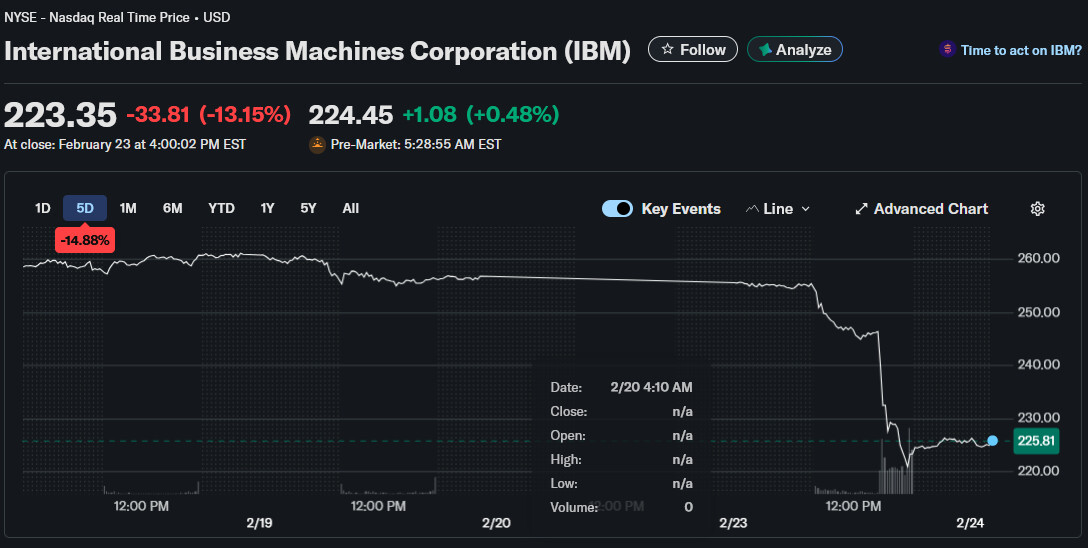
What is COBOL? How an Anthropic Claude blog wiped $30 billion off IBM in a single session

IBM took a -15% hit yesterday.

Tangential anecdote. My insurance agent back home was a retired COBOL developer. After retirement, she freelanced when things broke at banks, and worked part time in insurance to keep active in life. Sadly, she passed away last year…that’s a red flag about the people that keeps banks and credit cards running. It will be fun if AI gets into the mix.

Plenty of narratives and speculative fiction out there. It’s quite hard to measure if AI is really changing things.

But…there may be a simple metric: default rate in private credit (corporate debt). Existing business going bankrupt and defaulting on their payments is relatively easy to track. Default rate around 3-5% now, if it goes quickly up…something is happening.

“The most acute risk is a sector-specific shock triggering cascading defaults,” the UBS strategists wrote. “Technology is especially vulnerable to disruption from AI adoption or rapid retrenchment.”

They added: “Private credit defaults are reportedly between 3% and 5%, and signs of strain —such as interest paid-in-kind — are nearing post-pandemic highs.”

1 Like

Speaking of speculative fiction… Or is it just a message from the future:

Was about to share the same news.

Since machines don’t buy houses or iPhones, this creates “Ghost GDP”—output that looks good on national accounts but never circulates through the real economy.

We’re approaching universal basic income.

1 Like

This is also not the definite measure, many businesses may default because they won’t survive the hype wave, but otherwise it’ll turn out they were needed

1 Like

Of course. Someone will fire the workers only to find out…they’re useful. I wrote simple :wink:

Mortgages work because houses or apartments are the collateral. If I don’t pay regularly, the bank spends a bit, and recovers the collateral. Of course, there are loses because nothing will beat the revenue and profit of a customer that pays on time. But no catastrophic loses, thus a portfolio of thousands of mortgages allows to manage the risk.

Our current AI times, there’s a lot of creativity at work here. The collateral for debt is not a house or land, but GPUs that fully depreciate after 3-4 years. If the debtor stops servicing the loan, there’s practically nothing to recover.

Tech companies are increasingly turning to loans backed by the chips on which their large language models are trained as they hunt for ways to fund their massive AI investments.

Such loans, which are secured against graphics processing units (GPUs) and backed by leases to the tech groups, are popular with a sector burning hundreds of billions of dollars a year in an AI arms race on chips that can quickly become obsolete.

Investors have been attracted by yields in the high single digits to mid-teens, which are typically higher than those on debt issued by the tech companies themselves.

GPUs as collateral started 2 years ago. No one has real-world experience on how this game works.

Pioneered by cloud computing provider CoreWeave in late 2023, GPU-backed debt has grown in popularity as demand for advanced chips skyrockets and prices soar. Citigroup estimates that GPUs and associated servers can account for 30 to 40 per cent of total project costs for data centres.

A this is how the magic happens. Loans are not taken directly by “tech companies” but by other legal entities created by them. So, no big loans in their balance sheets, only expenses (leasing) for the GPUs. This looks much nicer in the annual numbers.

The loans are typically taken out by special-purpose vehicles formed by tech companies and investment firms for the purpose of acquiring a cache of high-performing chips, which would then be leased to the tech businesses to train their AI models. This arrangement allows Big Tech groups, whose use of debt markets is growing rapidly, to shift the loans off their corporate balance sheets.

This is great for the “tech companies”, but the investors are giving the cash to a legal entity whose only revenue is coming from the parent “tech company”. If this flow stops, the value of assets is basically zero. I truly hope only “investors” and not banks or retirement funds are getting into the unsecured loans game.

2 Likes

Isn’t it the normal playbook that investors own it until it looks like it is going to go bad, and then it is sold to pension funds or bailed out by taxpayers?

While the US is designating its leading AI company as a threat for not allowing mass surveillance of US citizens and autonomous killer robots, China is looking to ban AI girlfriends and and anthropomorphic AI.

2 Likes

No mention of banning such products made in CN, outside of CN? But good to see that their is concern and steps are being taken.

I would be happy that China makes rules for its own country only. I wish other countries would do the same.