What did you use to create the summary?

Garbage in, lots of garbage out!
More musings about AI, just another essay.
I have the feeling the essay won’t pass a fact check, it tries to cover too much. At the same time, sometimes it’s good to have an overview even if some details are factually wrong.
The keyword here is commodity and the way the author uses this word:
Before industrialization, it was difficult to separate a product from the person who made it. The weaver who made your shirt, the baker who made your bread: you personally knew them, and their skill and reputation were tied to the product that they sold. Economic transactions had a distinct social component that was innately linked to the consumption experience. The industrial production process changed this by breaking craft into standardized, repeatable steps. Performed by workers based on predetermined and regularized steps, capitalism produced something new: the commodity form, in which a product’s value lies in the product itself, detached from whoever made it. A table is a table, a phone is a phone. The screen that you’re reading this essay on was designed in one country, manufactured in another, using components from around the world. But none of this matters for the experience of buying and using the device.
A curious framing of Marxism from year 2026, interesting:
Marx described this process in intentionally loaded language. The commodity form, he argued, was built on exploitation : the ability to pay workers less than the value of what they produce. They were able to do this because the capitalist production process was based on alienation : severing workers from the product of their labor, from the process of making it, and ultimately from each other. What had once been a person’s craft became abstract ``labor power,’’ a factor of production to be bought and sold like raw materials. Marx saw this as capitalism’s deepest pathology. But to economists, and to the world writ large, the commodity form was an engine of extraordinary prosperity. If production was no longer tied to specific people, it could be disaggregated, reorganized, shipped across oceans, and scaled in ways that turned few resources into vast riches. Both things were true at once: the commodity form created enormous wealth and prosperity, but it made the human behind any specific product invisible, and ultimately, replaceable.
And finally we get to AI:
This is most people’s mental model of what AI will do to the economy. If a machine can produce anything a human can, write the brief, generate the image, compose the song, determine the diagnosis from a radiology scan, then the human will be replaced across all facets of production and jobs will simply disappear. Labor will be replaced with capital.
Nice review covering centuries in 3 paragraphs, now what? Ahhh, there’s a suggestion that AI can only replicate the work that was already alienated (see paragraph about Marxism) and thus only produce commodities.
I want to consider a different scenario, one where automation can replicate human production and the commodities that it produces (a big if!!!), but human labor does not disappear. How could this be the case? A lot of analysis takes the economy as given: there is a set of jobs and a set of goods/services produced by the economy. If the same set of goods/services can be produced by cheaper machines, then these machines replace humans and the jobs disappear. But the economics of structural change, combined with deep-seated features of human preferences, suggests something different: as people get richer, they don’t just want more commodities. They want things that aren’t commodities in the standard sense of the word. The social aspects of products such as the relationships, the status, and exclusivity—what Rene Girard called the mimetic properties of desire—become much more relevant once people’s basic needs are satisfied. And the demand for these properties will bring the human element back into the production process, and with it, the jobs.
And finally, the conclusion. Scarcity does not disappear, our hearts are a bottomless pit:
If this is right, then AI won’t just automate the commodity economy. It will trigger the emergence of something new: a post-commodity economy, where a growing share of expenditure goes toward goods and services whose value is inseparable from the human who provided them. The same economic forces that moved 40% of the American workforce off farms and into factories and offices will move workers out of automatable commodity production and into what I’ll call the relational sector . By this I mean the human-intensive, provenance-rich, sometimes artisanal part of the economy where the human aspect is part of the value of the good or service itself. The economics of scarcity won’t disappear, it’ll just relocate.
A mid-essay reminder of what this is about so the reader doesn’t get lost:
In 1900, about 40% of the American workforce was employed in farming. Today it’s less than 2%. Did people stop eating? No, if anything they’re eating much more. Large scale automation made farmers—and eventually factory farms—much more productive. Agricultural production boomed and prices fell. But because people can only eat so much, the share of income spent on food went down as people got richer, and workers moved to manufacturing and then to services.
The implication here is that AI is just a year 2026 tractor or harvesting machine. It may take over part of our work, but there’s a limit on how much we can consume (see parallel to food). If something becomes too efficient, we pay less for it, not more.
From here the essay gets erratic, but the underlying idea is “if machines take over the commodity work, demand move to relational goods and services”, or any job where the human element is integral to its perceived value.
I want to stress that this extends well beyond artists and luxury craft. Walter Benjamin wrote about this in a different context, the ``aura’’ of a work of art, which mechanical reproduction destroys. But the economic logic goes beyond art. It extends to any category where the human element is integral to the value: teachers, nurses, therapists, childcare workers, trainers, hospitality, clergy, guides, and many forms of local services. In all of these cases the human being is not just an input into the production process. Their judgment, attention, memory, warmth, or presence is an integral part of the value. These are cases where, as Seb Krier put it, provenance remains scarce even in a post-scarcity world.
The essay is much longer. But, the premise is quite interesting. AI might end up being self-effacing as agriculture or electricity production. So, vital for our daily lives, but so developed and efficient that few people cares about them anymore.
If the model is right, the durable jobs of the future won’t be about monitoring AI systems or prompt engineering. Those are transitional roles in the automated sector. The durable jobs will be in the relational sector, where the human element is the product itself.
Some already exist and are growing: nurses, therapists, teachers, boutique fitness instructors, personal chefs, bespoke tailors, craft brewers, live performers, spiritual guides, childcare workers, and many varieties of hospitality and care work. Others are emerging: experience designers, human-AI collaboration artists, provenance certifiers, community curators. Many haven’t been invented yet, just as six out of ten jobs people hold today didn’t exist in 1940.
“Learning AI” could be seen as learning how to farm potatoes or how to make electricity with hydropower. Yes, it’s a job and you can make a living out of it. But only a small fraction of people actually works around them.
The irony here is that the guys who say “ugh, I don’t like working with people, computer don’t come up with bullshit” may be creating a new world where working with people may become more important than ever. One more instance of careful what you wish for.
1 Like
The husband of a colleague of mine has just been laid off due to AI, along with half of the company’s employees.
3 Likes
That’s awful.
And, what does the company do?
1 Like
More interesting I think, is what positions were lost?
1 Like
Indeed. IT, logistics, HR, accounting?
1 Like
Not sure.
Could you ask AI for answer?
1 Like
There are people near where I live in Oberwil ( Zug) who have worked ( mostly the IT boys and girls) and lived in CH for years and can barely order a beer or a coffee in CH German.
The days when as an expat, unless you’re really at the top of the ladder just getting by on English are long gone and those that have recently been judged surplus to requirements are really struggling to find a new position with more than a few now bailing out back to NY, London, or Dubai.
2 Likes
Ah, so we can look forward to their services working much worse than before…
1 Like
Not necessarily, I haven’t written code since months, but that doesn’t mean I commit sloppy code. I let it generate it, ask it to repeat, over and over until it’s fine to commit. Before I used to sit in long sessions typing, now I do prompt, go for a walk, review the outcome, prompt, go away… in practice it takes longer than coding it manually, but it takes less effort so I prompt from morning till night  sometimes on my mobile, and go by with it
of course it depends on each developer, I bet some would commit a first generated slop without giving a finger
2 Likes
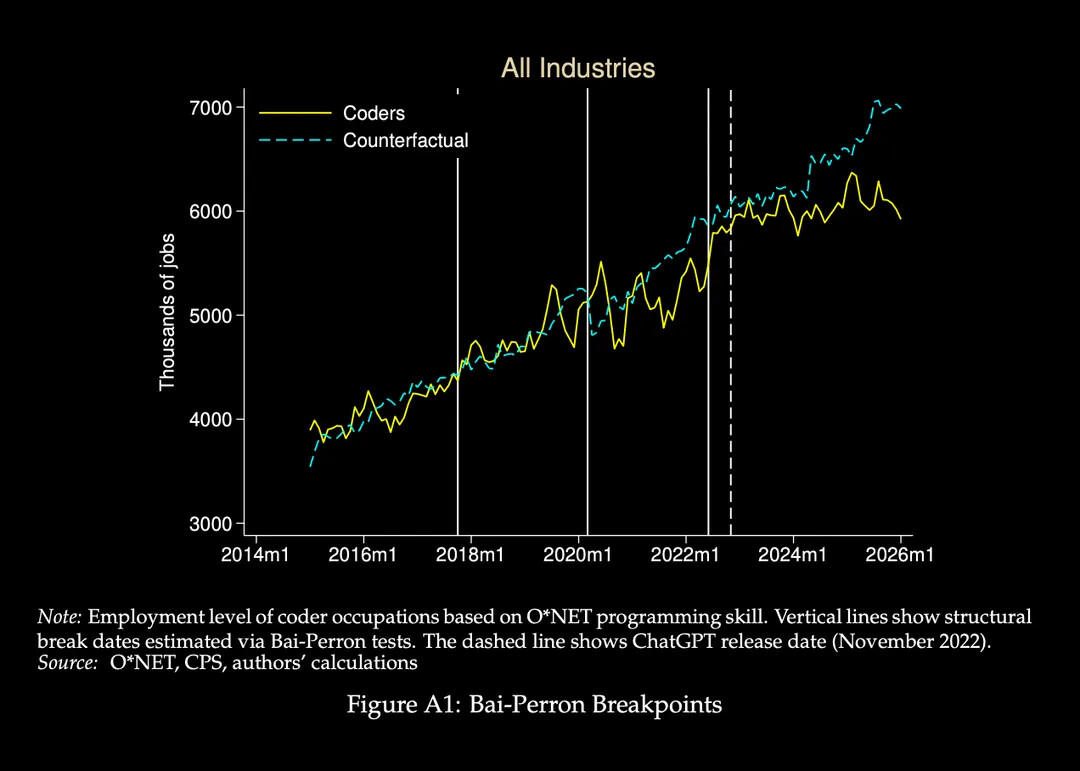
I often give the prompt before going to bed and hope to find the job done the next day. 
1 Like
Just wondering if this is a stable situation, a new equilibrium.
My guess is that top management tells middle managers to do more with AI and less people and AI.
Who knows if this is a new equilibrium or just some trying. An eventual partial return to past conditions. We’ll see.