March 4 (Reuters) - Qatar declared force majeure on gas exports on Wednesday amid the U.S.-Israeli war on Iran, with sources saying it may take at least a month to return to normal production volumes.
The move means global gas markets will experience shortages for weeks even in the unlikely scenario the conflict ends today, as Qatar supplies 20% of global liquefied natural gas.
State energy giant Qatar Energy (QE), which stopped producing gas this week, will fully shut down gas liquefaction on Wednesday, two sources familiar with the matter said. They asked not to be named because they are not allowed to speak to the media.
QE won’t restart the facility for at least two weeks, according to initial estimates of the situation in the region, the sources said. Once the restart decision is taken, it will take another two weeks to turn gas into a super-chilled fuel and reach full capacity, the sources added. The company did not respond to a request for comment.
Qatar accounts for about 20% of global LNG exports all of which transit the Strait of Hormuz, where shipping has ground to a near-halt amid the U.S.-Israeli war on Iran and Tehran’s retaliation.
Why aren’t they using the Dolphin Taweelah-Fujairah pipeline to get some of the gas out? Apparently its capacity can be easily doubled to 3.2 billion standard cubic feet per day (bscfd).
Some of you may die, but that’s a sacrifice I’m willing to make. I wonder about the legislation that applies to these crews. Dying in international waters, dying in UAE or Oman waters? What’s the difference?
I mentioned this issue in the MIddle East thread. bowlie pointed at shipping insurance being the issue.
The cost of insuring a ship sailing through the Strait of Hormuz has soared 12-fold, even after Donald Trump vowed to backstop trade through the key oil chokepoint.
Shipowners have been quoted millions of dollars for cover to cross the Strait or sail in nearby high-risk waters, brokers said, as premiums jumped as high as 3 per cent of the cost of a ship on Wednesday, up from about 0.25 per cent before the war.
Mr. Trump went full nostalgia with the idea of war convoys, but finance people say the US can’t insure shit and the “market” couldn’t care less about the thoughts of Iran striking first.
Trump on Tuesday tasked the Development Finance Corporation to provide insurance to vessels sailing through the Strait of Hormuz, where flows have slowed to a trickle since the outbreak of war with Iran.
The president’s vow to provide insurance and potentially naval escorts to ships passing through the critical waterway initially helped soothe energy markets but Wall Street and the City of London have cast doubt on his plan, sparking fresh alarm over supply security.
New research from JPMorgan shows the DFC has access to just $154bn of the $352bn needed to underwrite the 329 oil vessels in the region.
Natasha Kaneva, an energy analyst at JPMorgan, said: “Each would require oil‐pollution, salvage, hull and third‐party liability coverage in the event of a total loss, implying about $352bn of maximum insurance coverage that private markets are not presently providing.”
Donald Trump’s attack on Iran will have many unintended and unforeseen consequences. One consequence even I wasn’t thinking about, but which is already clear after less than a week, is that Trump has made a strong new case for renewable energy.
The usual argument for promoting solar and wind power is that relying on renewable energy avoids the environmental damage caused by burning fossil fuels. This environmental damage includes, but isn’t limited to, climate change. In addition, air pollution imposes shockingly large direct and immediate costs by harming our health and reducing our life expectancy.
But now we know that there is another reason for nations to reduce their dependence on fossil fuels: security. In a dangerous world, it’s infinitely safer to rely on the sun and the wind than to depend on fossil fuels that must be transported long distances, from nations that are untrustworthy, often exploitative and located in regions that frequently devolve into war zones.
The current situation in the Middle East is essentially the worst-case scenario for world energy supplies. Normally around 20 percent of the world’s oil supply transits through the Strait of Hormuz. It’s also a crucial route for shipment of liquefied natural gas and fertilizer. That passage is now effectively closed and there are no good alternatives.
This has been known for a while. There’s a reason that China has been building nuclear, wind and solar like crazy and pushing aggresively for EVs, but even with this massive push, they are still use fossil fuels on a massive scale.
The sad thing is that the rest of the world will pay for Trump’s actions, but the US will be relatively insulated as they are drowning in gas and a net exporter of oil. If anything, they are going to profit from this at the expense of Europe and Asia.
A great opportunity to pressure Russia thrown into the toilet
" US government has temporarily eased sanctions to allow India to buy Russian oil currently stranded at sea, amid escalating tensions in the Middle East.
Treasury Secretary Scott Bessent said the 30-day waiver was a “deliberate short-term measure” to allow oil to keep flowing in the global market."
We close by marveling at the sheer incompetence of EU leaders. To find themselves in yet another energy crisis five years after the last one began is no small feat, yet here they are again. It will take a remarkable run of good fortune in the weeks and months ahead to avoid a full-blown economic catastrophe.
Despite the stakes involved, hope seems to be the only strategic option left on the board.
Above were the closing remarks of one analyst.
EU was also discussing potential re-negotiation with Russia to help deal with the disruption to Qatari LNG. Putin apparently took the opportunity to tell his underlings to look at cutting off EU entirely and explore exporting gas to ‘better’ markets.
After Ukraine sanctions, EU took the crazy policy of stopping importing cheap Russian piped gas, but at the same time buying half of Russia’s LNG exports at more expensive prices!
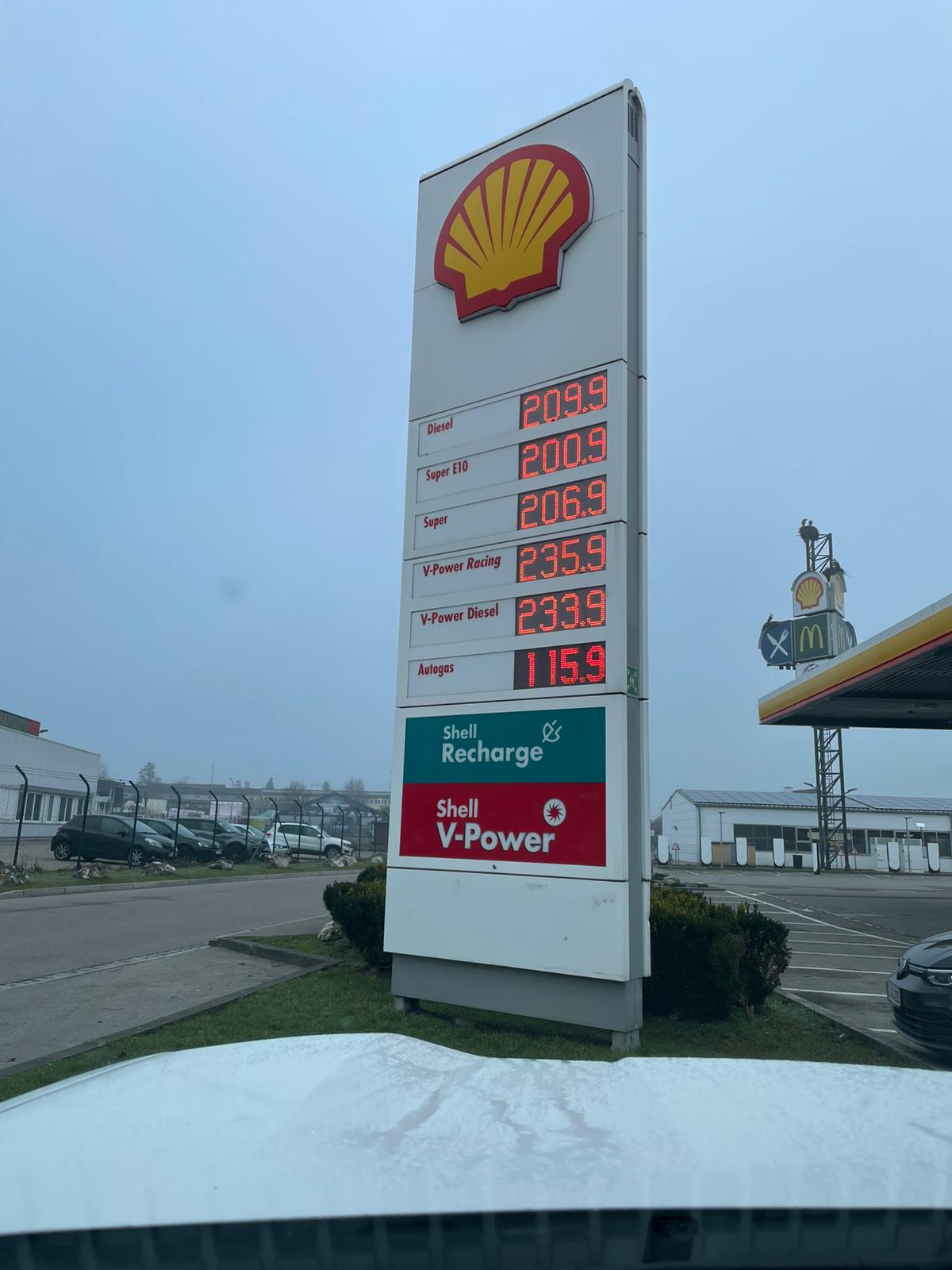
Problems with the local tram, I just drove my wife to work and passed by 4 gas stations.
The one next to the apartment building I call home has the highest price 1.74 CHF/liter for 95. I assume the ones in the motorways should be 1.80+ for the same.
A Ruedi Russel one, 1.62 CHF/liter. I used to refuel is this one during covid because it was pay at the pump with card, no dumb shop. But, it’s not part of my usual paths anymore, so I stopped refueling there.
Curious to see the difference in prices. If things get ugly, there’s a 10 Rappen rebate at automated gas stations.