Hedge fund.
As one of these youngster investors myself, I’m very open to criticism of this approach. From a purely theoretical point I already think that there should be better options, since a herd behavior can be outperformed in many cases.
So I’m at the stage where I’m happy that my investment in VT for the past 5-6 years has lead to significant growth of my wealth, so I’m not complaining too much about VT and still recommend it to friends who just start out investing.
As for my own investing I have higher ambitions than just following the masses. Still, there is some bias from the past performance of VT which makes me go step-by-step to find my own investment strategy.
Your comments are certainly a very valuable part of this journey!
TBH, this is the only thing I have understood from this thread. And the statement is truthful to its meaning.
My risk diversification lies in hiding the money in different holes - I always have seen the random walks of the stock market with the eyes of statistics, and playing poker or blackjack (card-counting in both cases, that is) might actually be a more controlled bet – at least, you know where you stand with your cards!
Nevertheless, I am finding this discussion very interesting.
I don’t follow that index (the FTSE global all cap index), but a comparison to the ones I follow (and did beat all with my gamble strategy) seem to have performed much better:
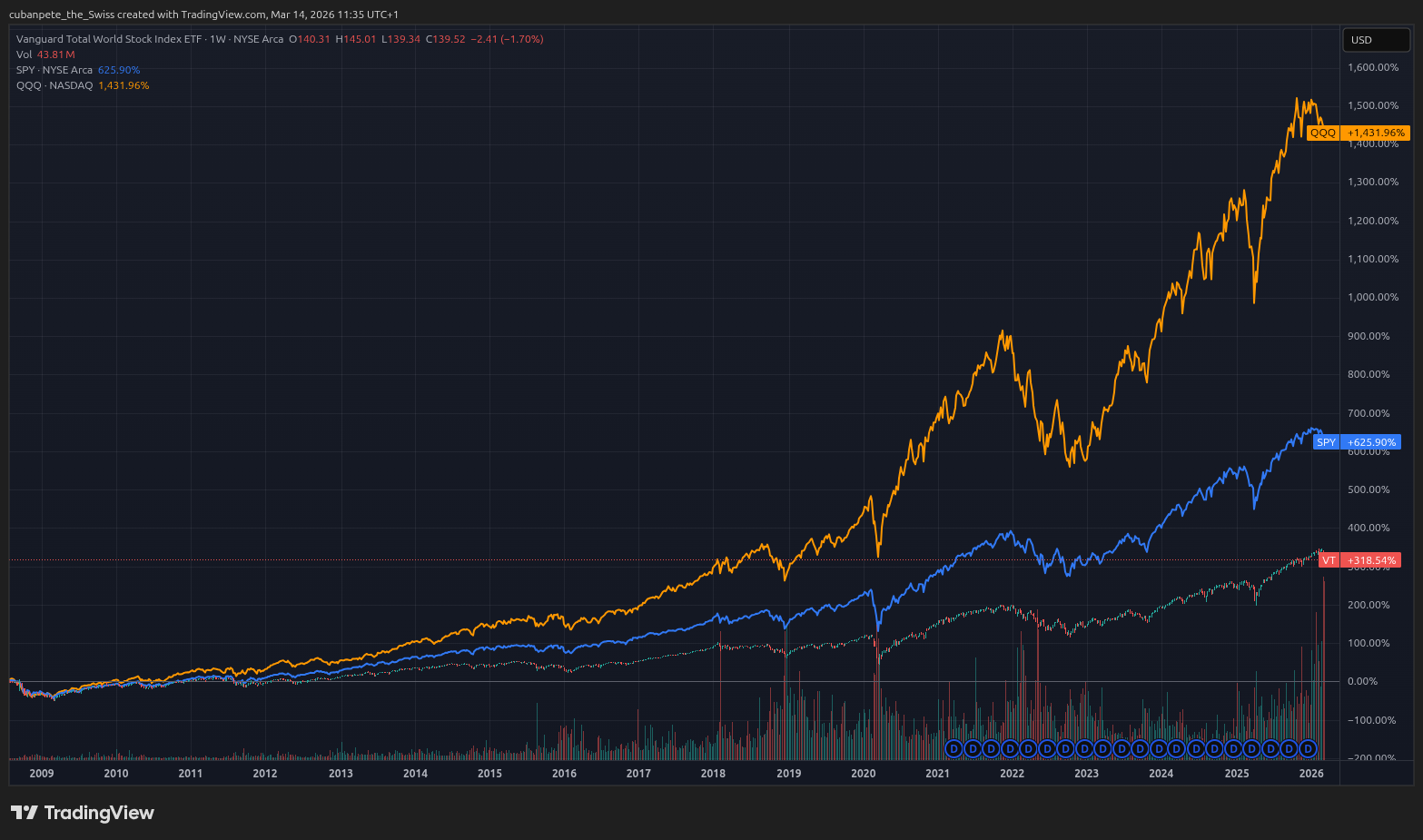
As I said, no performance gain from diversification after around 50-100 stocks and sector diversification is more important. 10’000 stocks is nonsense in my humble opinion. With a market cap based allocation you have the worst of two worlds: over diversification and over concentration.
Now the private investment world is probably 1000:1 against my view. But that is because much of your money invested in Vanguard funds goes into the Boglehead propaganda and after that many years the propaganda did work.
Welcome Izzy. I think the market is mostly a random walk, but not always. There are situations where the probability the market is completely wrong are high. That is where I enter. Then the randomness may continue but much of the market errors get corrected over time. That is where I make money.
Statistics is the most important in this game. But it only helps if you have a strong plan, rules that always do the same in the same situation. Randomness in the market should not mean randomness in your behaviour!
May I suggest to re-read my three articles about the why, how and the example of a mechanical strategy.
When you’re invested in “the market” the dividends will indeed fall. Only occasionally, though, when invested in broad US indices.
E.g. in the GFC, for the S&P 500 (as proxied by SPY):
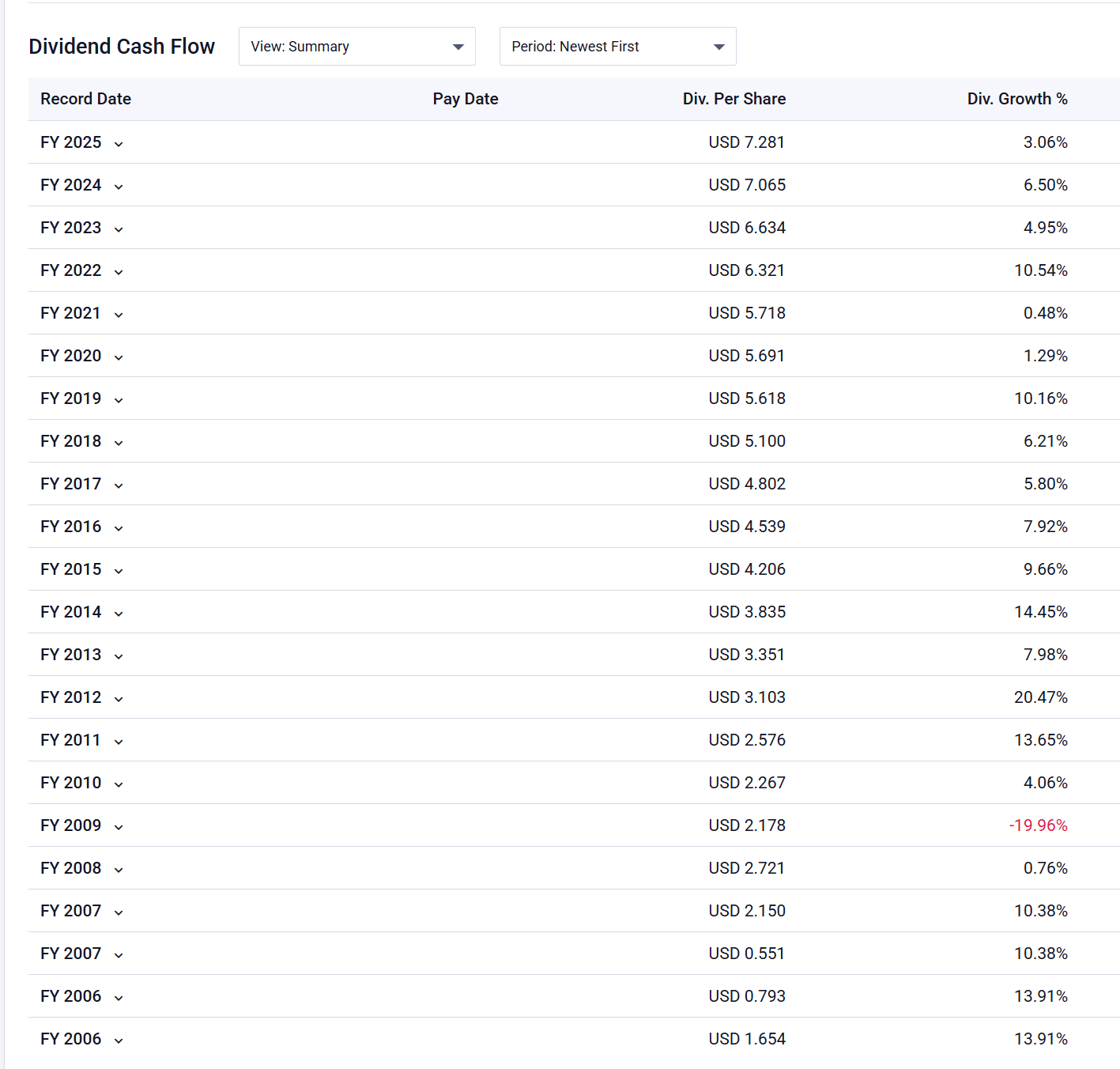
Note that 2009 was the only year where the dividends fell for the S&P 500 – almost 20% – in the past 20 years. That dividend cut was already made whole circa mid 2012.
The compound dividend growth rate over that 20 year period was 6.24%.
Now, of course, maybe you don’t want to own the S&P 500 as a dividend investor … the current dividend return is a paltry 1.1% (even after the latest “drawdown”).
If you have a hand picked portfolio of dividend stocks – I have a mix of dividend growth stocks and dividend stocks – you’ll also experience falling dividends occasionally. If I backtested my current portfolio over the past 20 years I would have seen dividend drawdowns in 2009 (minus 16%) and in 2013 (minus 3%).[$]
Point is: you can put together your own dividend portfolio with companies that haven’t cut their dividends in decades or only pick companies that have paid and/or raised their dividend for at least a x number of years. Of course, you’ll probably still have to compromise on dividend yield and/or on valuation.
My experience is that in most market phases three forces are competing: yield, dividend growth, valuation.
- Easy: You can get low valuation and high yield, but not high dividend growth.
Current examples (from my portfolio): AMCR, BBY, CHCT, CSWC, FLNG, GIS, IIPR, LGEN, LNC, MO, NSA, NWBI, PAX, PRU, TROW, UPS, VICI, VZ, XRN. - Harder: You can get low valuation and high dividend growth, but not high yield.
Current examples (from my portfolio): OZK, UNM. - Hard: You can get high yield and high dividend growth, but not low valuation.
Current examples (from my portfolio): currently none - Impossible: You can get low valuation, high yield, and high dividend growth.[$$]
$ I would – of course – claim that backtesting my current portfolio only makes limited sense as I would not have held the same portfolio in 2006 that I hold today as I evaluate it on a regular basis.
$$ Actually not impossible: you just need the balls and your mechanical trading strategy suggesting to you to buy companies that fulfull all three criteria e.g. in March 2020, when I bought my IRM shares.
Oh, and you also need liquid cash (equivalents) available … 
1 Like
A remark to my dividend strategy: My rule of >2% yield will only lead to a “sell” rating if adding share buybacks and still don’t reach 2%. Share buybacks are actually better tax wise than dividends.
I use dividend stocks for two reasons:
- Dividend stocks usually have lower risk and volatility than non dividend paying stocks.
- Tax, Kreisschreiben 36 - dividends in relation to debt interest. Without dividend stocks I would probably not fulfill all the prerequisites to not being taxed as a professional because I have debt.
Nice special dividend from CNA last weak…
2 Likes
For my dividend portfolio I had to invest dividends again. I will soon run out of positions to add to, then I will buy a new position. Or just spend some…
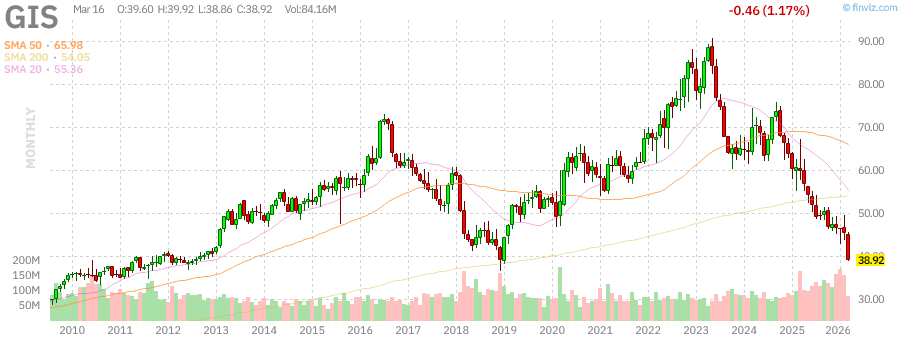
I bought General Mills again, falling knife:

1 Like
I’m up 22% so far this year with my gambling stock trading strategy, >6 years CAGR is 29.5%.
Crisis, what crisis? There was not even one second in my 64 years on this earth without a war and it seems to be good for business.
Fund managers are always scrambling around, their most important task is to find excuses why they do not perform. A fund manager may lose money but he may not lose money alone. Therefor he cannot (or doesn’t want to) take the risks that really pay out over long term.
ETF do not help as most of them have two problems that seem to be impossible to have at the same time: too much diversification and too much concentration. The big index ETF on U.S. index did lose the SEC “diversified” label last year and even the all world index (with its insane 10’000 holdings) did lose that label when NVDA was at its high I think. 10’000 holdings and not diversified? This you can sell only with the Boglehead propaganda that you pay when buying ETF.
Metals are OK for my bike, Commodities for my heating tank. Crypto, what’s crypto? Who in his right mind would invest money in crypto; buy stones from the river, at least they may be pretty. It works as long as you find someone more stupid, but one day you will be that person. I mean, there are big parts of new generations where I think I could put the label “stupid” on, but they are probably separated from their money long before they can lose it with crypto.
Back to subject: seems the tax rise is no longer discussed. But depending on the political climate it can come back any time. I do not have a single cent in 2nd or 3rd since 13 years, was molested by the lousy performance of those fund managers.
1 Like
OK. I tried to sort out posts into the right topics.
I never understand the stock markets. Stocks up massively today even though war continues and oil is up. Even oil futures haven’t moved much outside the short term. It seems that most people expect this war to be short or at least the economic effects to be relatively contained.
Perfect Phil. I was just answering @thedude and indeed the first part was just that, but then it went back on topic. I will never understand why somebody posts a question to which he seems to know all the answers. Feels like in the Spanish saying: “Por favor una limosna… pero rapido!”.
As I said, war is usually good for business. In this special case it seems that oil will stay over $60, which is more or less where fracking starts to pay out. I suppose the Venezuelan heavy oil is more expensive to treat then other kind of oil. But from $50-$56 up it is good business too.
I’m up now already 21.66% YTD with he gambling portfolio. Oil is probably the reason, but most of the gains in this field I made already last year.
The stock market will tank when money gets temporarily more worth than real investments, when interest goes up, when we have deflation / stagflation. There are always way overpriced stocks that cannot make in a hundred years what you pay for it, and they may tank any second. But if you are investing in single stocks you can avoid those.
2 Likes
Tonight after good numbers somebody paid $30 for Movado, what would be about 30% over last trading price at the NYSE. Remembers me of a hobby I had when I was younger: off-market fishing. 
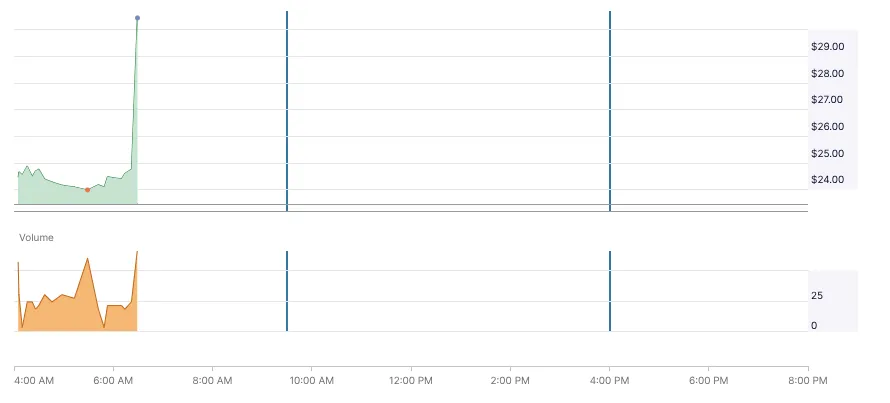

(Off market fishing: some inexperienced Investors use market orders when the market is not open. No market maker around, whatever price is offered gets the deal. You do fishing by entering limits way off the actual prices, then close the position when the market opens.)
With the benefit of AI, I can get my computer to categorize what stocks I have and it made me a summary of my portfolio:
| Investment Area | Percentage |
|---|---|
| SaaS | 15% |
| Precious Metals | 14% |
| Energy | 13% |
| MLPs | 8% |
| Tobacco | 8% |
| Uranium | 7% |
| Commodities | 7% |
| Healthcare | 5% |
| Turnaround | 5% |
| REIT | 5% |
| Insurance | 4% |
| Consumer Staples | 4% |
| Oil Refiners | 2% |
| Dividends | 1% |
| Semiconductors | 1% |
| Swiss | 1% |
Precious metals and Energy have gone up due to recent geopolitical uncertainties. Started investing in SaaS due to the panic about AI.
Interesting categories. I use sector diversification in my divi portfolio and try to publish the “wheel of fortune” for positions, dividends and sectors once a month here. I suppose MLPs and Energy have quite a big intersection.
I did use several models, but at the moment the GICS (Global Industry Classification Standard) is OK for me. I think the last change was to separate real estate and financials.
At the moment I cannot buy more stocks from the industrials and from the healthcare sector.
In the gambling portfolio I do not use sector diversification. Except for two stocks I did only buy energy (oil) since October there.
These are my own categories. I actually simplified it a bit for this post e.g. Precious metals is divided between: Gold, Gold Miners and Silver Miners.
The groupings represent the different way I look at elements of my portfolio and what I want from them. e.g. Midstream energy (shown as MLP) has a different function from Integrated Oil etc.
A Supermicro Executive has just been arrested for smuggling $2.5 billion worth of computers to China. Supermicro is actually at minus 19% and I suppose it will go down further today.
Shit. Before doing something like that one must get to be a good friend of Trump…
But OK, I just checked: I did spend a total of $27’088 for my shares. Then I sold part of it over time for a total of $122’346 and the position after the 19% fall is still worth $42’422. It is always a compromise to sell parts of a holding, but it gets you the needed calm for such situations.
I think they found the perfect scapegoat. But today and probably next week there will be exaggerations. The founder should step back after the now third scandal in that company. But then, the best buying time was between the first and the second scandal. And that China has that much of an interest in that screwed metal of theirs makes me think the company may be not completely worthless…
I lean back and wait. Will sell only if the capt’n tells me to.
Whenever there’s money to be made smuggling, there are going to be people doing it. SMCI has had so many scandals now…
How do you think Greek ship magnates made their billions (edit: in the 1950s/60s)? Smuggling, running blockades, and breaking embargos.
Also, hi, seems this is where the cool kids hang out?
2 Likes
They still do today! 
I think the first ship to run the Strait of Hormuz after the war started was a Greek owned ship.
1 Like